SLIDE 1
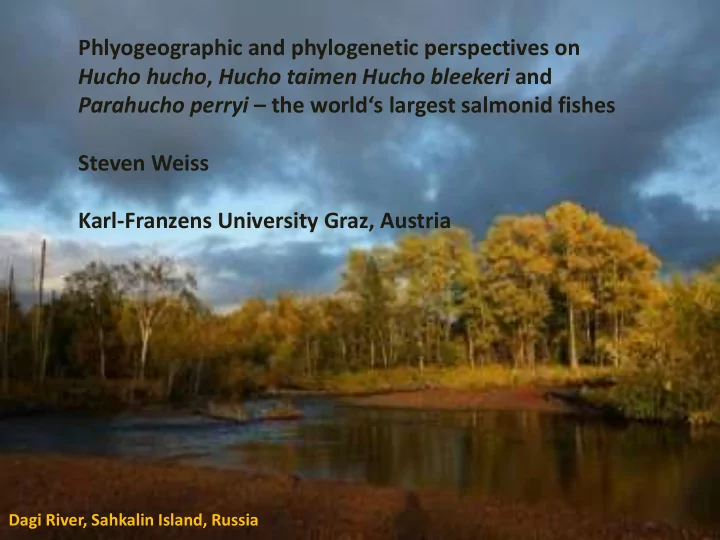
Phlyogeographic and phylogenetic perspectives on Hucho hucho, Hucho taimen Hucho bleekeri and Parahucho perryi – the world‘s largest salmonid fishes Steven Weiss Karl-Franzens University Graz, Austria
Dagi River, Sahkalin Island, Russia
SLIDE 2
Global Distribution of the Species
SLIDE 3
Thymallus Coregonus Prosopium Stenodus Salmo Brachymystax Parahucho Salvelinus Salvethymus ? Oncoryhnchus Hucho
Hucho taimen Parahucho perryi
Salmonoid Phylogeny (schematic)
Hucho hucho Hucho bleekeri Hucho (?) ishikawae Salmonidae
SLIDE 4
Parahucho perryi
Salmonidae Phylogeny (mtDNA, ca. 1700 bases)
(ATP6 + partial Control region + partial NADH-1) Onchorhynchus mykiss Salmo Salvelinus – alpinus + fontinalis
Brachymystax Hucho hucho Hucho bleekeri
97 99
Coregonus Thymallus Hucho taimen
94 all exhibit anadromy 99 Hucho and Brachymystax do not exhibit anadromy Strong support for Salmonidae, sister-group status for Hucho and Brachymystax and monophyly for Hucho
SLIDE 5 Distribution Area of Danube salmon Hucho hucho (Danube endemic)
Map of the Danubian basin, showing the original distribution range
- f Hucho hucho (in grey) as well as the sampling locations (numbered 1-11,
and corresponding to the names listed in Table 1 (Weiss et al 2010)
- H. hucho has lost approximately two thirds of ist range overall (Holčik et al. 1988) and 90% of its range
within Austria (Schmutz et al 2003). In Austria there are reproducing populations in at least the Mur, Gail und Pielach rivers. Hucho exists in Germany (Bavaria), Slovenia, Bosnia-Herzegovinia, Ukraine, Czech Republic, Croatia, Serbia, Montenegro, Slovakia, Hungary and Poland. In many rivers, the question arises whether or not populations are self-sustaining, that is would they exist without stocking measures. In the most southern regions (e.g. Montenegro) there is no stocking of
- Hucho. Nonetheless, illegal fishing is a major problem there, and population densities are extremely low.
The original distribution was limited to montane tributaries and thus much of this territory, and especially the lowlands of Hungary, Romania and Bulgaria are not Hucho habitat.
SLIDE 6
Very low levels of genetic diversity across the entire distribution area – four closely related mtDNA haplotypes across over 1800 base pairs
SLIDE 7
For the four sequence haplotypes, no phylogeographic structure across the range could be found. However, by sequencing across an 82 bp repeat in the mtDNA control region, a statiscially significant structure was revealed based on the number of repeats.
SLIDE 8
Caught in Plav Lake, Montenegro in 2004, reportedly 135 cm in total length and 37 kg in weight.
SLIDE 9 Largest remaining populations
Chain of low-head (7 to 15 MW) hydropower plants on the Mur River in Austria Estimated 1500 adults left in the Mur River, by far the largest population in Austria. 31 dams existing, four more in adanced stages
- f planning, including the first new dam in the
upper Mur, inside a „Natura 2000“ area. No sign of governmental interest in stopping ANY dam construction due to species protection Interests.
SLIDE 10
Media engagement against government and power company propaganda
SLIDE 11
Documented hydropower plants on Austrian rivers with a catchment area > 10 sq. km The environmental ministry as well as numerous lobbying groups are calling for expanding hydropower to its fullest potential in Austrian rivers, with no regard to protected areas, outside of a few high elevation national parks
SLIDE 12
Siberian Taimen Phylogeography - 2005
SLIDE 13
Hucho taimen
SLIDE 14
Haplotype network for Hucho taimen across all of Russia Three clades are evident, with significant basin haplotype sharing Ob, Enisey, and Volga Some presumably ancestral haplotypes in the upper Enisey Basin near Baikal and The Amur and Lena basins Haplotype divergence spans only approximately 1.5% and clades are separated by a maximum of 0.5%.
SLIDE 15
Distribution of Parahucho perryi
SLIDE 16
Parahucho perryi – Dagi River expedition
SLIDE 17
Parahucho perryi 70 individuals, no phylogeographic structure across the range Haplotype network for P. perryi (< 1% divergence)
SLIDE 18
Sakhalin Russian mainland Hokkaido
Factorial Correspondence Analysis based on 10 microsatellite loci (Outliers removed, coded by major drainage)
SLIDE 19 Vabaisky Lakes Sakhalin
Nabile Dagi
Factorial Correspondence Analysis based on 10 microsatellite loci (coded by population)
SLIDE 20
Summary
Hucho hucho – limited „endemic“ distribution, extremely low levels of mtDNA variation, self-reproducing populations still in decline. Where investigated, moderate levels of Variation at the population level, very little regional data on self-reproducing status of populations Hucho bleekeri – more or less equally diverged from H. hucho, and H. taimen, extremely Limited distribution, no further genetic information avaialble. Hucho taimen – very large distribution, limited mtDNA variation for such a large range, some lineage diversification across major drainages, potentially relevant for conservation Purposes, Ural specimens clearly H. taimen. Parahucho perryi – clearly distinct genus, limited distribution, mtDNA variation moderate, but no sign of phylogeographic structure with the exception of a few isolated populations, limited population genetic structure, some signs of inbreeding. Hucho ishikawae– no data
SLIDE 21
Mur River, City Center Graz, Austria THANK YOU!
(and special thanks to Pete Rand of the Wild Salmon Center)