
SLIDE 1
2019 Terrapin Survey
May 28 – June 1
Maryland Coastal Bays Program
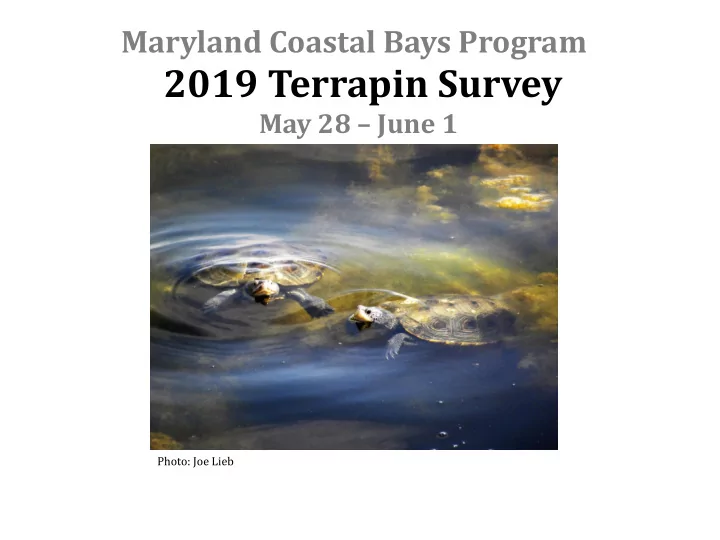
Photo: Joe Lieb
2019 Terrapin Survey May 28 June 1 Photo: Joe Lieb Maryland - - PowerPoint PPT Presentation
Maryland Coastal Bays Program 2019 Terrapin Survey May 28 June 1 Photo: Joe Lieb Maryland Coastal Bays Program As a National Estuary Program, Maryland Coastal Bays Program (MCBP) is a non-profit partnership among the towns of Ocean
Photo: Joe Lieb
Maryland Coastal Bays Program (MCBP) is a non-profit partnership among the towns of Ocean City and Berlin, the National Park Service (NPS), Worcester County, the U.S. Environmental Protection Agency, and the Maryland Departments of Natural Resources, Agriculture, and Planning.
nationwide, our goal is to protect and enhance the watershed, which includes Ocean City, Ocean Pines and Berlin, and Assateague Island.
watershed is home to the treasured resources of the St. Martin River, Newport Bay, Assawoman Bay, Isle of Wight Bay, Sinepuxent Bay, and Chincoteague Bay.
MCBP, in partnership with the Maryland Department of Natural Resources, is conducting the Terrapin Survey to better understand the current population status the diamondback terrapin (Malaclemys terrapin).
Photo: Martha Johnson
brackish marshes along the East and Gulf coasts.
Texas.
❖ Seven subspecies found within this range. ❖ Northern Diamondback Terrapin range is from Cape Cod, Massachusetts to Cape Hatteras, North Carolina. ❖ Fun Fact: The Diamondback Terrapin is also found in Bermuda! This population has not been assigned a subspecies, but mtDNA testing shows it is closely related to the Carolina subspecies.
Marine Worms Bivalves Blue Crabs Shrimp Marine Snails
Mid-July
after laying
Hatchling Sex: ≤ 82 degrees mostly male ≥ 86 degrees mostly female
Unknown/Highly Variable
http://kellyandsarah.blogspot.com/2010_06_01_archive.html
– Classified “Apparently Secure” in Maryland
– Living space – Nesting sites – Food
– Boats – Cars
– Bycatch Reduction Devices (BRDs) help prevent terrapin drownings
http://www.turtlejournal.com/?p=6464
– From your home, friend’s home (with permission), or contact MCBP for locations – 3 surveys, 15 minutes each
– https://itunes.apple.com/us/app/coordinates-calculate- convert/id494286614?mt=8
– https://play.google.com/store/apps/details?id=com.woozilli.gpscoordinates
to install an app but still has GPS enabled: – http://www.gps-coordinates.net – (Be sure to allow location services the first time you visit the website, if it asks.)
– http://www.windowsphone.com/en-us/store/app/gps-calculator/4e06928a- de12-e011-9264-00237de2db9e
http://www.mdcoastalbays.org/terrapin-project
report the absence of terrapins and location surveyed as well as presence!
will be visible.
needed, go forward slowly to see if the head disappears
does, it’s a turtle! If not, it’s probably a stick.
*If surveying on land
– 410-213-2297 ext. 109 or kphillips@mdcoastalbays.org