Panellists: Janet Valentine, Director, Clinical Practice Research - - PowerPoint PPT Presentation

panellists
SMART_READER_LITE
LIVE PREVIEW

Panellists: Janet Valentine, Director, Clinical Practice Research - - PowerPoint PPT Presentation

Breakout 1: How do we make the UK world leading for COVID-19 clinical trials? This session will start at 10:45 BST. Chairs: Martin Landray, Professor of Medicine and Epidemiology, University of Oxford & Research Director, HDR UK Oxford


slide-1
SLIDE 1

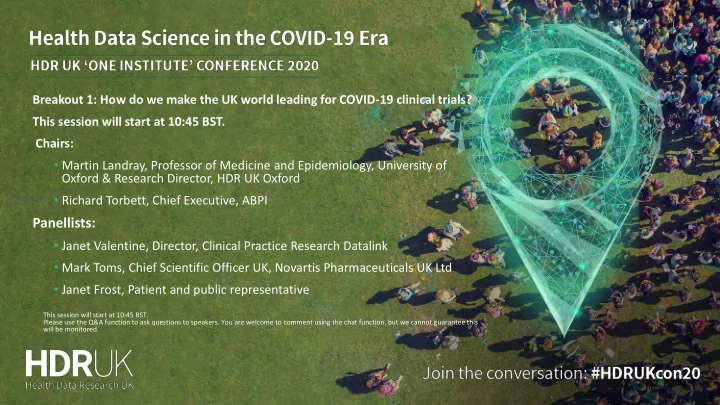
Breakout 1: How do we make the UK world leading for COVID-19 clinical trials? This session will start at 10:45 BST. Chairs:

  • Martin Landray, Professor of Medicine and Epidemiology, University of

Oxford & Research Director, HDR UK Oxford

  • Richard Torbett, Chief Executive, ABPI

Panellists:

  • Janet Valentine, Director, Clinical Practice Research Datalink
  • Mark Toms, Chief Scientific Officer UK, Novartis Pharmaceuticals UK Ltd
  • Janet Frost, Patient and public representative

This session will start at 10:45 BST. Please use the Q&A function to ask questions to speakers. You are welcome to comment using the chat function, but we cannot guarantee this will be monitored.

slide-2
SLIDE 2

Randomised Evaluation of COVID-19 Therapy: the RECOVERY trial

Martin Landray University of Oxford, UK

  • n behalf of the RECOVERY trial investigators

www.recoverytrial.net

slide-3
SLIDE 3

Randomisation & rational treatment of COVID-19

Huge therapeutic uncertainty

  • Many candidates
  • Many opinions (from many sources)
  • No reliable data (uncontrolled case series, retrospective association studies)

Addressing the treatment challenge

  • Unlikely to be a single “big win” but moderate benefits plausible
  • For example, reducing hospital mortality by one-fifth would be important
  • In future, combining several effective drugs may produce big effects
slide-4
SLIDE 4

Selection of treatments

Prioritisation principles:

  • Potentially effective (based on prior pre-clinical & clinical data)
  • Major safety issues understood
  • Sufficient treatment available for large-scale recruitment
  • Potential to rapidly scale up as a clinical treatment (if shown to be effective)

Three broad categories:

  • Anti-viral treatments (lopinavir-ritonavir, hydroxychloroquine)
  • Immunomodulatory treatments (corticosteroid, azithromycin, tocilizumab)
  • Treatments targeted at SARS-CoV-2 (convalescent plasma)
slide-5
SLIDE 5

Eligibility

  • Hospitalised (regardless of age, gender, ethnicity, co-morbidity, location)
  • SARS-CoV-2 infection (clinically suspected or laboratory confirmed)
  • No medical history that might, in the opinion of the attending clinician,

put the patient at significant risk if he/she were to participate in the trial Note: If one or more of the treatment arms is not available or believed, by the attending clinician, to be contraindicated (or definitely indicted), then the patient can be randomised between the remaining arms

slide-6
SLIDE 6

Informed consent

  • Simple information sheet (2 pages)
  • Option for witnessed consent
  • if participant cannot read or sign for themselves
  • If infection control procedures do not allow ICF out
  • f the ‘red zone’
  • Option for legal representative
  • if patient lacks capacity
slide-7
SLIDE 7

Randomisation

  • Simple data entry (online)
  • Patient details
  • Inclusion criteria
  • Key co-morbidities
  • Any treatments for which the patient is not suitable
  • Any treatments not available in hospital pharmacy
  • Randomly assigns participant between suitable

and available treatments

  • Doctor prescribes allocated treatment on usual

hospital drug chart

slide-8
SLIDE 8

Follow-up

  • Simple on-line form completed by research nurses
  • Which treatments did the patient receive
  • COVID-19 test result
  • Discharge status & date
  • Use of ventilation
  • Linkage to national health data sources
  • Vital status, death certificate
  • Coded hospital episode statistics (diagnoses, procedures)
  • Intensive Care audit data, SARS-CoV-2 PCR laboratory results
  • Primary care, national outpatient prescribing data
  • Permission to follow-up via record linkage for up to 10 years
slide-9
SLIDE 9

Study outcomes

  • Primary outcome:

All-cause mortality at 28 days

  • Secondary outcomes: Time to discharge from hospital

Use of mechanical ventilation/ECMO or death

(among those not on ventilation or ECMO at baseline)

  • Subsidiary outcomes: Cause-specific mortality

Use of renal dialysis or haemofiltration Serious cardiac arrhythmia (recorded in a subset) Use of ventilation (overall and by type) Duration of ventilation (overall and by type)

slide-10
SLIDE 10

Recruitment progress

Total recruitment: 11,000 at 176 hospitals

slide-11
SLIDE 11

Characteristics at main randomisation

Male sex 6786 (63%) Age 66 (SD 16) Days since symptom onset 9 (IQR 5-13) Severity of disease No oxygen required 2622 (24%) Supplemental oxygen only 6633 (62%) Ventilation/ECMO 1502 (14%) Prior disease Diabetes 2896 (27%) Cardiovascular disease 2903 (27%) Chronic lung disease 2359 (22%)

slide-12
SLIDE 12

Preliminary result - Hydroxychloroquine

  • 4 June – DMC advised unblinding
  • 5 June – results made public
  • No evidence of benefit
slide-13
SLIDE 13

Preliminary result - Hydroxychloroquine

slide-14
SLIDE 14

Acknowledgements

  • UK Research & Innovation
  • National Institute for Health Research
  • Wellcome Trust
  • Bill & Melinda Gates Foundation
  • Department for International Development
  • Department of Health & Social Care
  • National Health Service in England, Wales, Scotland, and Northern Ireland
  • NIHR Clinical Research Network
  • NHS DigiTrials
  • NIHR Oxford Biomedical Research Centre
  • Medical Research Council Population Health Research Unit
  • Nuffield Department of Medicine
  • Nuffield Department of Population Health
  • The very many doctors, research nurses, pharmacists, and R&D managers at over 175 NHS hospitals
  • And, most importantly, the patients who are participating

Full protocol and trial materials available at www.recoverytrial.net

slide-15
SLIDE 15
  • Dr Janet Valentine, Director Clinical Practice Research Datalink
  • HDRUK One Institute Conference, 16th June 2020

Using electronic health records to improve the efficiency of clinical trials

slide-16
SLIDE 16

Traditional methods of delivering clinical trials are unsustainable

Difficult to find eligible patients 50% fail to achieve target recruitment >50% of protocols require amendments 80% of trials are delayed ~70% data duplication between EHRs & CT system Loss to follow up

slide-17
SLIDE 17

Can we use EHR to improve efficiency of trial delivery?

Inform protocol design and feasibility Select and locate eligible patients Targeted site selection Reduce screen failures Minimise loss to follow-up

slide-18
SLIDE 18

What is CPRD?

UK Government health data research service supporting observational & interventional public health and clinical studies by academics, industry and regulators worldwide Services based on > 30 years of collecting longitudinal primary care EHR across UK

Daily data collection In house quality checks 23% UK population coverage

slide-19
SLIDE 19

What information is in CPRD primary care data?

EHR

Hospital attendance Laboratory results Demographics and lifestyle GP Consultation

slide-20
SLIDE 20

Advantages of near-real time primary care EHR searches

  • GP = gatekeepers to NHS → manage most chronic conditions
  • Longitudinal primary care data contains all patient’s medical history
  • Representative population across geographies, demographics, SES
  • Rich information → enables sophisticated pre-screening
  • Daily data updates → dynamic list of eligible patients
slide-21
SLIDE 21

Precision and timeliness in the Primary Care record

Receiving treatment with a stable dose (≥12 weeks) of a qualifying statin HbA1c 6.5% - 10.0% (47 - 86 mmol/mol) within past 30 days Recent CVD event (e.g. MI) within 8 weeks of screening visit Factors likely to limit adherence to study treatment or procedures eg substance abuse or dementia

Treatment data Laboratory data Event data Adherence

slide-22
SLIDE 22

Traditional approaches to locating suitable patients

Print advertising

Social media Pool of known clinicians Local databases

slide-23
SLIDE 23

EHR-enabled patient location and recruitment across the UK

CPRD network of 1900 GP practices GP reviews eligible patients for suitability High quality patients contact study centre Central search of CPRD primary care database for eligible patients GP invites only suitable patients 15+ million patients

2 weeks

slide-24
SLIDE 24

Real time, modifiable EHR search based on clinical feedback

Phase 2 clinical trial investigating treatment for Major Depressive Disorder.

After 2 days noted 50% patient rejection rate on GP review Modified search list in 24 hours by restricting inclusion timeframe Rejection rate reduced to 3% Faster review, high quality patients

Complex EHR selection criteria

  • Diagnosis of MDD less than 18 months
  • SSRI/SNRI prescription within the past 12 months
  • Excluded if diagnosis in past year of psychotic disorder, bipolar disorder
slide-25
SLIDE 25

Impact on eligibility for Oxford COVID-19 Vaccine Phase II/II Trial 70+ cohort

Criteria Proportion of original cohort (%) Age 70+ 100% Cancer record in last two years 92.0% Any history of ischaemic stroke 87.2% Any history of renal transplant 87.1% Any history of renal dialysis 87.0% Any history of cardiac surgery 82.6% Any history of alcoholic liver disease 82.4% Any history of Crohn’s disease 82.0% Current anticoagulant use 75.5% Any history of an immune disorder 75.4% Any history of a bleeding disorder 75.3% Any history of anaphylaxis 75.1% Any history of angioedema 74.9% Any history of severe mental illness 74.0% Any history of dementia, Alzheimer’s or Parkinson’s disease. 69.3%

Live within a 20 mile radius of Study Site Have had a flu vaccination within 24 months Ethnicity

Cohort based

  • n selection

criteria Refining the search

http://www.isrctn.com/ISRCTN9 0906759

slide-26
SLIDE 26

CPRD data-enabled post authorisation vaccine safety monitoring

Near real time surveillance Linkage to secondary care & death data Patient safety

  • utcomes

Drug vaccine interactions

slide-27
SLIDE 27

CPRD supported EHR-based post-authorisation vaccine effectiveness and safety trials in the real world population

SES CPRD Interventional Research Services Platform

slide-28
SLIDE 28

What have we learnt for this experience?

Have valuable data assets, expertise and infrastructure in the UK Need to use these assets and expertise for patient benefit Ensure co-ordination of efforts to maximise the value of our world leading assets, capability and experience

slide-29
SLIDE 29

For more information please contact CPRD at enquiries@cprd.com cprd.com

slide-30
SLIDE 30

Improving speed, quality, cost – the UK’s distinctive opportunity

Mark Toms, Chief Scientific Officer, Novartis UK June 16, 2020

Novartis UK

slide-31
SLIDE 31

Date of preparation: June 2020 COR20-E071 31

Introduction

▪ COVID-19 has transformed how we need to think about clinical trials and the use of health data. ▪ The industry is continually adapting and evolving, but the past few months have seen change at an unparalleled pace. ▪ Years of innovation and transformation have taken place in a very short space of time.

slide-32
SLIDE 32

Date of preparation: June 2020 COR20-E071 32

Clinical trials in the UK: where are we now?

▪ The NHS has adapted its operating model at a pace and scale not seen before, particularly in the digitisation

  • f health.

▪ We are starting to see the utilisation

  • f NHS data to refine and improve

clinical trials. ▪ World-leading data research and management are essential to realise the potential of using data in clinical trials.

slide-33
SLIDE 33

▪ We are seeing significant advances in the implementation of health data within UK trials. ▪ We should be looking to build a health system that is connected and ever-learning; making better use of the data generated by the NHS. ▪ Learnings from COVID-19 show us that we can make clinical trial participation easier for patients.

Date of preparation: June 2020 COR20-E071 33

Clinical trials in the UK: where are we going?

slide-34
SLIDE 34

▪ Data interoperability is a significant challenge for the integration of data within clinical trials. ▪ The work of HDRUK and the Data Innovation Hubs is critical to this ▪ We need to continue to understand how best to collaborate across healthcare, academia and industry to build a healthier tomorrow.

Date of preparation: June 2020 COR20-E071 34

Clinical trials in the UK: the challenges to overcome

slide-35
SLIDE 35

Date of preparation: June 2020 COR20-E071 35

Conclusion

▪ The COVID-19 response has shown what healthcare, academia and industry can do when we work together. ▪ Protecting patient confidentiality, safety and data integrity must never be compromised. ▪ Together, we are capable of remarkable scientific progress and innovation.

slide-36
SLIDE 36

Th Thank you

slide-37
SLIDE 37

Breakout 1: How do we make the UK world leading for COVID-19 clinical trials? This session has now ended – thanks for joining. Chairs:

  • Martin Landray, Professor of Medicine and Epidemiology, University of Oxford &

Research Director, HDR UK Oxford

  • Richard Torbett, Chief Executive, ABPI

Panellists:

  • Janet Valentine, Director, Clinical Practice Research Datalink
  • Mark Toms, Chief Scientific Officer UK, Novartis Pharmaceuticals UK Ltd
  • Janet Frost, Patient and public representative