Overview A small open economy facing a constant rate of return and - - PowerPoint PPT Presentation

overview
SMART_READER_LITE
LIVE PREVIEW

Overview A small open economy facing a constant rate of return and - - PowerPoint PPT Presentation

Overview A small open economy facing a constant rate of return and subject to foreign demand shocks. Two sectors of production: basic goods - b , and consumption goods - s . A competitive search friction in the consumption goods market and idle


slide-1
SLIDE 1

Overview

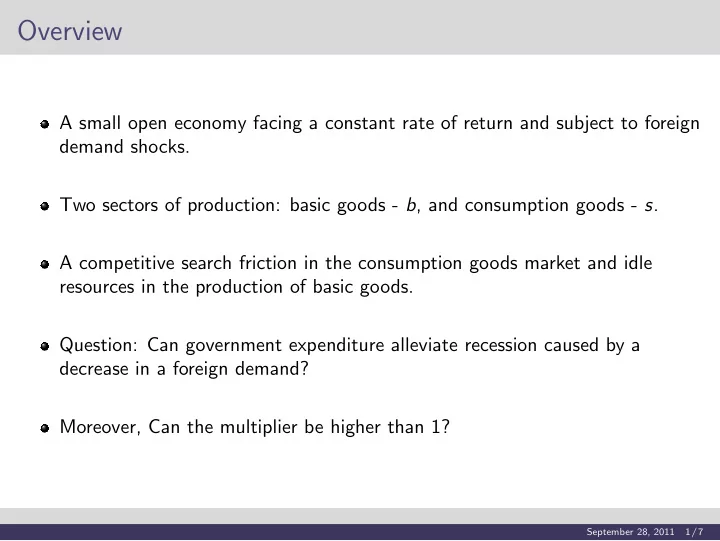
A small open economy facing a constant rate of return and subject to foreign demand shocks. Two sectors of production: basic goods - b, and consumption goods - s. A competitive search friction in the consumption goods market and idle resources in the production of basic goods. Question: Can government expenditure alleviate recession caused by a decrease in a foreign demand? Moreover, Can the multiplier be higher than 1?

September 28, 2011 1/7

slide-2
SLIDE 2

Preferences and Technology

u(c, d, n, G) + β.....

  • Assumption about preferences: c and n are complements.

F b(K b, Nb), K b is a fixed factor.

  • Basic goods can be used for export or publig good purposes,

F s(K s, Ns, M) K s is a fixed factor, M is imports.

  • Services require search. The basic good no.

Pb[Nb(z), θ∗, G]

  • Foreign and domestic demand (public) for Basic good.

September 28, 2011 2/7

slide-3
SLIDE 3

Households

Aggregate states: foreign demand θ∗, domestic wealth A. Government Expenditures G. Let z = (θ∗, G, A). Individual state: individual asset position a. Numeraire: price of imported intermediate good m. V (z, a) = max

c,n,d,a′ u(c, d, n, G) + βE [v(z′, a′)]

s.t. Ps(z)c + a′ = Ra + w(z)n + Πs(z) + Πb(z) − T(z) c = d Ψd [D(z)] F s(Ns, M) A′ = H(θ∗, A). Solution: c(z, a), d(z, a), n(z, a), a′(z, a).

September 28, 2011 3/7

slide-4
SLIDE 4

Production: Basic Goods

Managers of unit of K b solve: πb(z) = max

nb

F b(1, nb) Pb[Nb(z), θ∗, G] − w(z) nb where nb is a labor input.

  • Agregation yields

Πb(z) = K b πb(z)

September 28, 2011 4/7

slide-5
SLIDE 5

Production: Services

  • Owners of one unit of K s solve:

πs(z) = max

ns,m

F s(1, ns, m) Ps(z) Ψ[D(z)] − w(z)ns − m (1)

  • ns is labor,
  • m is an imported intermediate good,
  • Ps(z) is the price of the good.
  • Ψ[Ds(z)] is the probability that the firm will sell given the market tightness.
  • Agregation yields

Πs(z) = K s πs(z)

September 28, 2011 5/7

slide-6
SLIDE 6

An Equilibrium is

(i) Aggregate allocations {Nb, Ns, M, A′, D, C, T}, function H and prices {Ps, Pb, w} as functions of z (ii) {c, d, n, a′, v} as functions of z, a (iii) {nb, Πb} and {ns, m, Πs} as functions of z such that (1) Households and producers solve theiir problems. (2) Representative agents conditions hold. (3) Market clearing C(z) = D(z) Ψ[D(z)] F s[Ns(z), M(z)] G + θ∗ = F b[Nb(z)] N(z) = Nb(z) + Ns(z) (5) Government budget is balanced: G = T(z)

September 28, 2011 6/7

slide-7
SLIDE 7

Recession and fiscal policy

Suppose there is a drop in a foreign demand: θ∗ ↓. Adjustment of both: price and quantity produced in sector b. In particular Nb ↓. By complementarity C ↓ and economy goes into recession (GDP decreases). Government can increase G to boost the demand for a good b. Two effects: direct increase in a utility from public good and an increase in GDP through increase in Nb and complementarity with C. The effect of higher tax T is partially offset (depending on the elasticity of demand in sector b) by increase in Πb.

September 28, 2011 7/7