Overview Modification Anomalies Functional Dependencies Normal - - PDF document

overview
SMART_READER_LITE
LIVE PREVIEW

Overview Modification Anomalies Functional Dependencies Normal - - PDF document

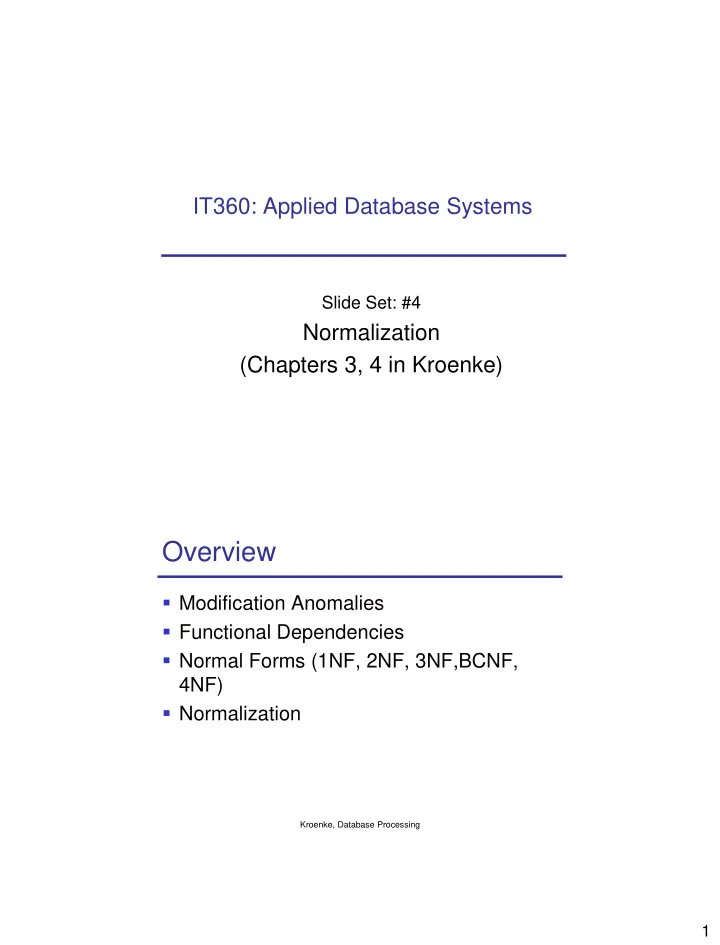
IT360: Applied Database Systems Slide Set: #4 Normalization (Chapters 3, 4 in Kroenke) Overview Modification Anomalies Functional Dependencies Normal Forms (1NF, 2NF, 3NF,BCNF, 4NF) Normalization Kroenke, Database Processing 1


slide-1
SLIDE 1

1

IT360: Applied Database Systems

Slide Set: #4

Normalization (Chapters 3, 4 in Kroenke)

Kroenke, Database Processing

Overview

  • Modification Anomalies
  • Functional Dependencies
  • Normal Forms (1NF, 2NF, 3NF,BCNF,

4NF)

  • Normalization
slide-2
SLIDE 2

2

Kroenke, Database Processing

Premise

  • We have one or more tables with data
  • The data is to be stored in a new database
  • QUESTION: keep or change tables

structure?

Kroenke, Database Processing

Data Redundancy

Number LastName FirstName Email Company CompanyOfficer 190 Smith John jsmith@usna.edu 12 LT Berge 673 Doe Jane jdoe@usna.edu 7 LT Madison 312 Doe Bob bred@usna.edu 6 LT Mean 152 Johnson Matt mat@usna.edu 7 LT Madison

Rule: All mids with same Company have the same CompanyOfficer (Company CompanyOfficer) Problems due to data redundancy?

slide-3
SLIDE 3

3

Kroenke, Database Processing

Modification Anomalies

  • Deletion Anomaly: lose more than intended
  • What if we delete all mids in Company 7? (we lose info about

CompanyOffice)

  • Insertion Anomaly: need to insert more than intended
  • What if we want to record the fact the CompanyOfficer for

Company 31 is LT New? (need to have a student in that company)

  • Update Anomaly: inconsistencies due to updates of

some but not all rows

  • What if we change the CompanyOfficer for Company 7 to

be LT Derek for only one row?

Kroenke, Database Processing

Update Anomalies

  • The MID table before and after an incorrect update
  • peration on CompanyOfficer for Company = 7

Number LastName FirstName Email Company CompanyOfficer 190 Smith John jsmith@usna.edu 12 LT Berge 673 Doe Jane jdoe@usna.edu 7 LT Madison 312 Doe Bob bred@usna.edu 6 LT Mean 152 Johnson Matt mat@usna.edu 7 LT Madison Number LastName FirstName Email Company Wing 190 Smith John jsmith@usna.edu 12 LT Berge 673 Doe Jane jdoe@usna.edu 7 LT Derek 312 Doe Bob bred@usna.edu 6 LT Mean 152 Johnson Matt mat@usna.edu 7 LT Madison

slide-4
SLIDE 4

4

Kroenke, Database Processing

Table decomposition

Number LastName FirstName Email Company CompanyOfficer 190 Smith John jsmith@usna.edu 12 LT Berge 673 Doe Jane jdoe@usna.edu 7 LT Madison 312 Doe Bob bred@usna.edu 6 LT Mean 152 Johnson Matt mat@usna.edu 7 LT Madison Number LastName FirstName Email Company 190 Smith John jsmith@usna.edu 12 673 Doe Jane jdoe@usna.edu 7 312 Doe Bob bred@usna.edu 6 152 Johnson Matt mat@usna.edu 7 Company CompanyOfficer 6 LT Mean 7 LT Madison 12 LT Berge

Disadvantage?

Kroenke, Database Processing

Decisions

  • Do we have to decompose / merge?
  • How do we identify problems caused by

redundancy?

  • Functional dependencies
slide-5
SLIDE 5

5

Kroenke, Database Processing

Functional Dependency (FD)

  • X  Y (X determines Y)
  • If same value for X then same value for Y
  • Examples:
  • Any primary key
  • Alpha  (Name, Class, DateOfBirth)
  • EmployeeRating  Wage
  • (NbHours, HourlyPrice)Charge

Kroenke, Database Processing

Functional Dependency (FD) Rules (some are Armstrong’s Axioms)

Let A, B, C be sets of attributes

  • A  (B, C) if and only if A  B and A C
  • Always, AA (reflexivity)
  • If A B and BC, then AC (transitivity)
  • If A B, and C is a set of attributes, then

(A,C)(B,C) (augmentation)

slide-6
SLIDE 6

6

Kroenke, Database Processing

FD Facts

  • A functional dependency is a statement about all

allowable instances of a table

  • You cannot find the functional dependencies

simply by looking at some data:

  • Data set limitations
  • Must be logically a determinant
  • Given some data in a table R, we can check if it

violates some FD, but we cannot tell if the FD holds over R!

Kroenke, Database Processing

Functional Dependencies in the MIDSHIPMAN Table

Assuming data is representative, determine the FD

Alpha LastName FirstName Major Advisor 111342 Thomas Sarah IEA Lewis 112368 Smith John IFP Jones 116644 Mikalson Michael IFA Skapanski 117862 Doe Jane IFA Skapanski 123116 Doe Bob IFP Lefferton 120908 Johnson John IFP Jones 121198 Thomas Thomas IEA Lewis 129722 Jefferson Janet IFP Lefferton 129832 Thomas Sarah IFP Lefferton

slide-7
SLIDE 7

7

Kroenke, Database Processing

Functional Dependencies in the MIDSHIPMAN Table

Alpha  (LastName, FirstName, Major, Advisor) Advisor  Major

Kroenke, Database Processing

What Makes Determinant Values Unique?

  • A determinant is unique in a relation if, and
  • nly if, it determines every other column in

the relation

  • Unique determinants = superkey
slide-8
SLIDE 8

8

Kroenke, Database Processing

Key

  • A set of columns is a key for a relation if :
  • 1. a) No two distinct rows can have same values in all

key columns

  • r equivalently

b) determines all of the other columns in a relation

  • 2. This is not true for any subset of the key
  • Candidate key = key
  • Primary key, Alternate key

Kroenke, Database Processing

Normal Forms

  • Relations are categorized as a normal form

based on which modification anomalies or other problems that they are subject to:

slide-9
SLIDE 9

9

Kroenke, Database Processing

Normal Forms

  • 1NF: A table that qualifies as a relation is in 1NF
  • 2NF: 1NF + all non-key attributes depend on all PK
  • 3NF: 2NF + (every determinant is a (super) key or determinee is

part of key)

  • Boyce-Codd Normal Form (BCNF) : A relation is in BCNF if every

determinant is a (candidate) key “I swear to construct my tables so that all nonkey columns are dependent on the key, the whole key and nothing but the key, so help me Codd.”

Number Last Name First Name Email Company Wing 190 Smith John jsmith@usna.edu 12 2 673 Doe Jane jdoe@usna.edu 7 4 312 Doe Bob bred@usna.edu 6 6 152 Johnson Matt mat@usna.edu 7 4

Kroenke, Database Processing

Eliminating Modification Anomalies from Functional Dependencies in Relations

  • Put all relations into Boyce-Codd Normal Form

(BCNF):

slide-10
SLIDE 10

10

Kroenke, Database Processing

Putting a Relation into BCNF: ASSIGNMENT_GRADES

Alpha Assignment Points PointsTotal 129722 QUIZ1 10 10 129722 QUIZ2 2.5 10 129722 QUIZ3 2 20 122422 QUIZ1 6 10 122422 QUIZ2 7 10 122422 QUIZ3 18 20 129936 QUIZ1 6 10 129936 QUIZ2 8 10 129936 QUIZ3 20 20 Kroenke, Database Processing

Putting a Relation into BCNF: ASSIGNMENT_GRADES

ASSIGNMENT_GRADES (Alpha, Assignment, Points, PointsTotal)

(Alpha, Assignment)  (Points, PointsTotal) Assignment  (PointsTotal)

ASSIGNMENT (Assignment, PointsTotal) GRADES (Alpha, Assignment, Points) Where GRADES.Assignment must exist in ASSIGNMENT.Assignment

slide-11
SLIDE 11

11

Kroenke, Database Processing

Putting a Relation into BCNF: New Relations

Alpha Assignment Points 129722 QUIZ1 10 129722 QUIZ2 2.5 129722 QUIZ3 2 122422 QUIZ1 6 122422 QUIZ2 7 122422 QUIZ3 18 129936 QUIZ1 6 129936 QUIZ2 8 129936 QUIZ3 20 Assignment PointsTotal QUIZ1 10 QUIZ2 10 QUIZ3 20 Kroenke, Database Processing

Redundancy Example

  • PartKit  Part, PartKit Price
slide-12
SLIDE 12

12

Kroenke, Database Processing

Multivalued Dependencies

Kroenke, Database Processing

Eliminating Anomalies from Multivalued Dependencies

  • Multivalued dependencies are not a

problem if they are in a separate relation, so:

  • Always put multivalued dependencies into

their own relation

  • This is known as Fourth Normal Form (4NF)
slide-13
SLIDE 13

13

Kroenke, Database Processing

Normalize or Not?

Customer(CustID, Name, City, State, Zip)

  • Assuming that city and state determine

zip code, is Customers table in BCNF?

  • If Customers table is not in BCNF, would

you or would you not normalize it to BCNF? Give one reason for the choice you make

Kroenke, Database Processing

Class Exercise

  • R(A, B, C, D, E, F)

A(B,C,D,E,F) BC (D,E)F

  • Is A a key? Why?
  • Is R in BCNF? Why?
  • If R not in BCNF, decompose to BCNF
slide-14
SLIDE 14

14

Kroenke, Database Processing

Class Exercise

ID Name University MainCampus 1 John Smith Cornell Ithaca 2 John Smith MIT Boston 3 Matt Johnson Ithaca College Ithaca 4 Chris Brown USNA Annapolis 5 Jane Doe Cornell Ithaca 6 Ric Crabbe USNA Annapolis

  • Do these FDs hold? Why?
  • IDUniversity
  • NameID
  • UniversityMainCampus
  • MainCampusName
  • Example of deletion anomaly?
  • Example of insertion anomaly?
  • Example of update anomaly?

Kroenke, Database Processing

Summary

  • Modification anomalies
  • Functional dependency
  • X  Y (X determines Y)
  • Unique determinant (candidate) key
  • 1NF – A table that qualifies as a relation is in 1NF
  • Boyce-Codd Normal Form (BCNF) – A relation is

in BCNF if every determinant is a (candidate) key

  • 4NF – Multivalued dependencies are in a relation

by themselves