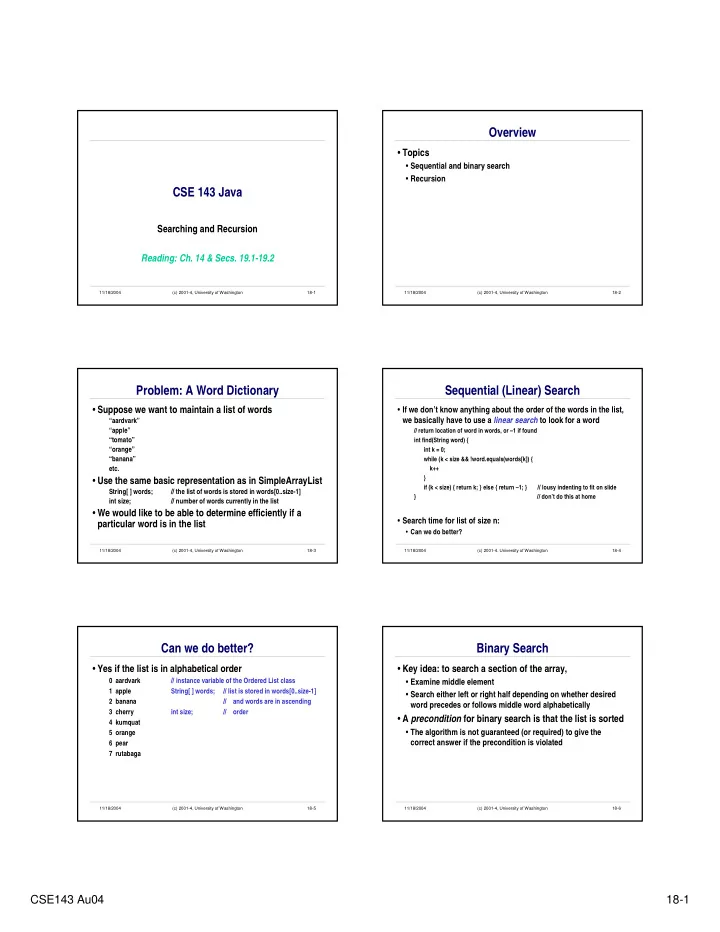
Overview Topics Sequential and binary search Recursion CSE 143 - - PDF document

overview
SMART_READER_LITE
LIVE PREVIEW

Overview Topics Sequential and binary search Recursion CSE 143 - - PDF document

Overview Topics Sequential and binary search Recursion CSE 143 Java Searching and Recursion Reading: Ch. 14 & Secs. 19.1-19.2 11/18/2004 (c) 2001-4, University of Washington 18-1 11/18/2004 (c) 2001-4, University of


slide-1
SLIDE 1

CSE143 Au04 18-1

11/18/2004 (c) 2001-4, University of Washington 18-1

CSE 143 Java

Searching and Recursion Reading: Ch. 14 & Secs. 19.1-19.2

11/18/2004 (c) 2001-4, University of Washington 18-2

Overview

  • Topics
  • Sequential and binary search
  • Recursion

11/18/2004 (c) 2001-4, University of Washington 18-3

Problem: A Word Dictionary

  • Suppose we want to maintain a list of words

“aardvark” “apple” “tomato” “orange” “banana” etc.

  • Use the same basic representation as in SimpleArrayList

String[ ] words; // the list of words is stored in words[0..size-1] int size; // number of words currently in the list

  • We would like to be able to determine efficiently if a

particular word is in the list

11/18/2004 (c) 2001-4, University of Washington 18-4

Sequential (Linear) Search

  • If we don’t know anything about the order of the words in the list,

we basically have to use a linear search to look for a word

// return location of word in words, or –1 if found int find(String word) { int k = 0; while (k < size && !word.equals(words[k]) { k++ } if (k < size) { return k; } else { return –1; } // lousy indenting to fit on slide } // don’t do this at home

  • Search time for list of size n:
  • Can we do better?

11/18/2004 (c) 2001-4, University of Washington 18-5

Can we do better?

  • Yes if the list is in alphabetical order

0 aardvark // instance variable of the Ordered List class 1 apple String[ ] words; // list is stored in words[0..size-1] 2 banana // and words are in ascending 3 cherry int size; // order 4 kumquat 5 orange 6 pear 7 rutabaga

11/18/2004 (c) 2001-4, University of Washington 18-6

Binary Search

  • Key idea: to search a section of the array,
  • Examine middle element
  • Search either left or right half depending on whether desired

word precedes or follows middle word alphabetically

  • A precondition for binary search is that the list is sorted
  • The algorithm is not guaranteed (or required) to give the

correct answer if the precondition is violated

slide-2
SLIDE 2

CSE143 Au04 18-2

11/18/2004 (c) 2001-4, University of Washington 18-7

Binary Search Sketch (not quite legal Java)

/** Return the location of word in words[lo..hi], or -1 if not found */ int bSearch(String word, int lo, int hi) { if (lo > hi) { return -1; } // empty interval int mid = (lo + hi) / 2; if (word “==” words[mid]) { return mid; } // found it! else if (word “<=” words[mid]) { // look for word in the left half return _________________________________ ; } else { // word “>=” words[mid] // look for word in the right half return _________________________________ ; }

11/18/2004 (c) 2001-4, University of Washington 18-8

Recursion

  • A method (function) that calls itself is recursive
  • Nothing really new here
  • Method call review:
  • Evaluate argument expressions
  • Allocate space for parameters and local variables of function

being called

  • Initialize parameters with argument values
  • Then execute the function body
  • What if the function being called is the same one that is

doing the calling?

  • Answer: no difference at all!

11/18/2004 (c) 2001-4, University of Washington 18-9

Wrong Way to Think About It

... bSearch(array, lo, mid-1) ... bSearch

11/18/2004 (c) 2001-4, University of Washington 18-10

Right Way to Think About It

... bSearch(array, lo, hi) ... bSearch ... bSearch(array, lo, mid-1) ... bSearch

11/18/2004 (c) 2001-4, University of Washington 18-11

Recursive Definitions

  • We see these all the time in mathematics
  • Simple example: factorial function

⎩ ⎨ ⎧ − × ≤ =

  • therwise

n n n if n )! 1 ( 1 , 1 !

11/18/2004 (c) 2001-4, University of Washington 18-12

Recursive Implementation in Java

  • We can use the definition directly to create a java

method to compute factorial

/** Return n! */ int fact(int n) { if (n <= 1) { return _______________ ; } else { return __________________________ ;

slide-3
SLIDE 3

CSE143 Au04 18-3

11/18/2004 (c) 2001-4, University of Washington 18-13

Trace

  • Execution of: result = fact(4);

11/18/2004 (c) 2001-4, University of Washington 18-14

Recursive Cases, Base Cases, and Termination

  • A recursive definition needs to have two parts
  • One or more base cases that are not recursive

if (n <= 1) { return 1; }

  • One or more recursive cases that handle a “smaller” instance
  • f the problem

else { return n * fact(n-1); }

  • The recursive cases must “make progress” towards a

base case

  • If not, or if no base case(s) – infinite recursion

11/18/2004 (c) 2001-4, University of Washington 18-15

Back to Binary Search – Real Java This Time

/** Return word loc. in the list or –1 if not found */ int find(String word) { return bSearch(0, size-1); } // Return location of word in words[lo..hi] or –1 if not found int bSearch(String word, int lo, int hi) { // return –1 if interval lo..hi is empty if (lo > hi) { return –1; } // search words[lo..hi] int mid = (lo + hi) / 2; int comp = word.compareTo(words[mid]); if (comp == 0) { return mid; } else if (comp < 0) { return bSearch(word, lo, mid-1) ; } else /* comp > 0 */ { return bSearch(word, mid+1, hi) ; } }

  • Which are the
  • Base case(s)?
  • Recursive case(s)?
  • How do the recursive case(s) make

progress towards the base case(s)?

11/18/2004 (c) 2001-4, University of Washington 18-16

Trace

  • Trace execution of find(“orange”)

0 aardvark 1 apple 2 banana 3 cherry 4 kumquat 5 orange 6 pear 7 rutabaga

11/18/2004 (c) 2001-4, University of Washington 18-17

Trace

  • Trace execution of find(“kiwi”)

0 aardvark 1 apple 2 banana 3 cherry 4 kumquat 5 orange 6 pear 7 rutabaga

11/18/2004 (c) 2001-4, University of Washington 18-18

Analysis of Binary Search

  • Time (number of steps) per each recursive call:
  • Number of recursive calls:
  • Total time:
slide-4
SLIDE 4

CSE143 Au04 18-4

11/18/2004 (c) 2001-4, University of Washington 18-19

How Many Calls Needed for a List of Size n?

# of recursive calls needed (t) List size (n)

11/18/2004 (c) 2001-4, University of Washington 18-20

Graph: Linear vs Binary Search

11/18/2004 (c) 2001-4, University of Washington 18-21

Another Way to Picture the Cost

N N/2 N/2 N/4 N/4 N/4 N/4 1 1 1 1

... ... ...

All paths from the size N case to a size 0 case are the same length: 1+log2N

Any given run of binary search will follow only one path from the root to some leaf

11/18/2004 (c) 2001-4, University of Washington 18-22

Linear Search vs. Binary Search

  • What is incremental cost if size of list is doubled?
  • Linear search:
  • Binary search:
  • Why is Binary search faster?
  • The data structure is the same
  • The precondition on the data structure is different: stronger
  • Recursion itself is not an explanation

One could code linear search using recursion, or binary search with a loop

11/18/2004 (c) 2001-4, University of Washington 18-23

Recursion vs. Iteration

  • Recursion can completely replace

iteration

  • Some rewriting of the algorithm is

necessary

  • usually minor
  • Some languages have recursion only
  • Recursion is often more elegant but

has some extra overhead (often not a major issue, but can be)

  • Recursion is a natural for certain

algorithms and data structures

  • Useful in "divide and conquer"

situations

  • Iteration can completely replace

recursion

  • Some rewriting of the algorithm is

necessary

  • often major
  • A few (mostly older languages) have

iteration only

  • Iteration is not always elegant but is

usually efficient

  • Iteration is natural for linear (non-

branching) algorithms and data structures

11/18/2004 (c) 2001-4, University of Washington 18-24

Recursion Summary

  • Recursive definition: a definition that is (partially) given

in terms of itself

  • Recursive method (function): a method that is (partially)

implemented by calling itself

  • Need base case(s) and recursive case(s)
  • Recursive cases must make progress towards reaching a base

case – must solve “smaller” subproblems

  • Often a very elegant way to formulate a problem
  • Let the method call mechanism handle the bookkeeping behind

the scenes for you

  • A powerful technique – add it to your toolbag