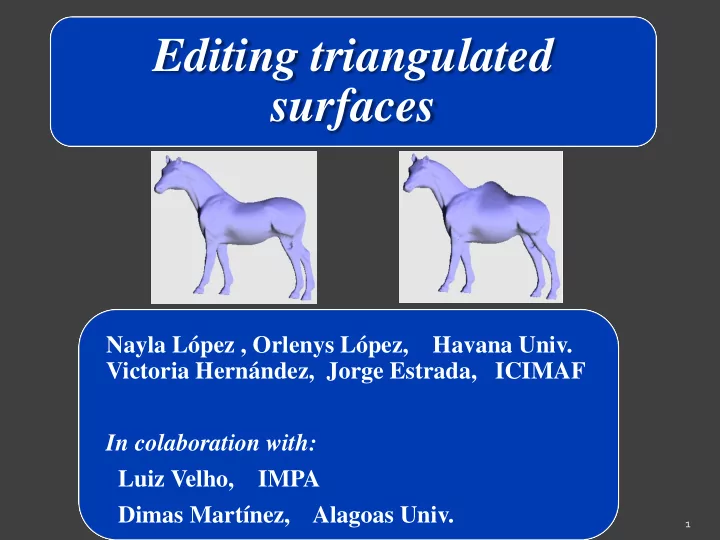
Editing triangulated surfaces Nayla Lpez , Orlenys Lpez, Havana - - PowerPoint PPT Presentation

editing triangulated surfaces
SMART_READER_LITE
LIVE PREVIEW

Editing triangulated surfaces Nayla Lpez , Orlenys Lpez, Havana - - PowerPoint PPT Presentation

Editing triangulated surfaces Nayla Lpez , Orlenys Lpez, Havana Univ. Victoria Hernndez, Jorge Estrada, ICIMAF In colaboration with: Luiz Velho, IMPA Dimas Martnez, Alagoas Univ. 1 1-Motivation How to modify


slide-1
SLIDE 1

1

Editing triangulated surfaces

Nayla López , Orlenys López, Havana Univ. Victoria Hernández, Jorge Estrada, ICIMAF In colaboration with: Luiz Velho, IMPA Dimas Martínez, Alagoas Univ.

slide-2
SLIDE 2

1-Motivation

How to modify interactively a triangulated surface?

slide-3
SLIDE 3

2004 2007

PreviousWork

slide-4
SLIDE 4

General strategy: given a triangulated surface S

1 3

2

slide-5
SLIDE 5

5

4 5

slide-6
SLIDE 6

2-Geodesic curve- Geodesic distance

CG(A, B)

CG(A, B): Shortest curve on the surface passing through A and B.

g(S; AB)

Dg(S;AB): length between A y B of the geodesic curve CG(A,B)

slide-7
SLIDE 7

Computing Geodesic distance

Eikonal equation: nonlinear PDE

DIFFERENCIABLE SURFACE NON DIFFERENCIABLE TRIANGULATED SURFACE

Good approximation to the gradient function restricted to a triangle

slide-8
SLIDE 8

8

Theoretically

Geodesic distance is computed as the length of the geodesic curve

Practically

Solving the Eikonal equation it is possible to compute approximately the Geodesic Distance from any point on a triangulated surfaced to a prescribed boundary. Geodesic distances can be used to compute the geodesic curve passing through two points.

Geodesic curve- Geodesic distance

slide-9
SLIDE 9

9

3-Fast Marching Method

Idea Kimmel & Sethian, 1998

  • To sweep the front ahead in an upwind fashion by considering a set of

points in a narrow band around the existing front

Vertices where the geodesic distance is already known Boundary vertices Vertices in the front Vertices in the narrow band of the front

d=0 < d1 < d2 < d3

slide-10
SLIDE 10

Fast Marching Method

Geodesic distance function restricted to a triangle

  • Dg(C) is computed from all triangles ABC having C as a vertex if the geodesic

distance is already known in the other vertices A,B.

  • The procedure for computing Dg(C) is different for acute and obtuse triangles.

Acute triangles

Geodesic distance function in ABC is approximated by a linear function interpolating Dg(A) and Dg(B ) and satisfying the Eikonal Equation. Dg(C) is computed as solution of a quadratic equation.

Obtuse triangles

Splits the obtuse angle into two acute ones, joining C with any point in the sector between the lines perpendicular to CB and CA. Extend this sector recursively unfolding the adjacent triangles, until a new vertex E is included in the

  • sector. Compute Dg(C) as the distance between

C and E on the unfolded triangles plane.

slide-11
SLIDE 11

Extensions of FMM

4 extensions

…are neccesary to implement some steps of the method for edition of triangulated surfaces…

slide-12
SLIDE 12

…stop the advancing front when the geodesic distance reachs a given value

d=0 < d1 < d2 <d3

3.1-Computing a geodesic neighborhood

slide-13
SLIDE 13

3.2-Computing the geodesic distance for a point which is not a vertex of the triangulation

3 cases depending on the position of the point P: update the list of adjacent points for the vertices of all triangles containing P

slide-14
SLIDE 14

Vertices in the front Vertices in the narrow band of the front boundary target Vertices where the geodesic distance has been computed

3.3-Stop the advancing front when the geodesic distance has been computed for all points in the target set

Evolution of FMM Classic FMM Modification of FMM

slide-15
SLIDE 15

3.4-Computing the closest vertex

boundary P0 P1 P2 P3

Dg(P P0 ) < Dg(P P1 ) < Dg(P P2 ) < Dg(P P3)

Yellow points are closer to than to the rest

  • f the boundary points

P1

slide-16
SLIDE 16
  • Compute an initial approximation to the geodesic

curve passing through A,B using FMM.

  • Correct the initial approximation of the geodesic

curve.

4-Computing Geodesic curves

Given two consecutive control points A,B on the triangulated surface S…

  • D. Martínez, L. Velho, P. C. Carvalho, 2005
slide-17
SLIDE 17

Computing the initial approximation to the geodesic curve

CG(AB) = CG(AC )U(C B)

slide-18
SLIDE 18

Discrete geodesic curvature

slide-19
SLIDE 19

19

Iterative correction of the polygonal approximation to the geodesic curve

A node P of the current polygonal approximation can be corrected if

  • r
slide-20
SLIDE 20

Correction

P is in the interior of an edge of S P is a vertex of S 2 Cases

2D 2D 3D 3D

slide-21
SLIDE 21

Correction of the inicial approximation

Iterative process

Initial approximation Correction

Higest geodesic curvature point

Correction

slide-22
SLIDE 22

Some iterations of the correction process

slide-23
SLIDE 23

5-Defining the control curve and the control region

Control region: set of vertices P on the surface such that Control curve: a geodesic polygonal curve interpolating a set of given control points

slide-24
SLIDE 24

Computing the normal vector at the vertices

  • f the control curve

6-Deformation of the control curve

slide-25
SLIDE 25

Deformation of the control curve

Parametrizing the control curve by chord length Changing the position of the knots to modify the geometry of the B-spline curve New position of Magnitude of the displacement for a vertex in terms of a cubic B-spline.

slide-26
SLIDE 26

Moving the control curve vertices

slide-27
SLIDE 27

7-Edition of the control region.

Magnitude of the displacement for P in the interest region

h(P)=(1- Dg(P,Pc)/dismax) h(Pc)

Dg( P,Pc) = 0 h(P) = h(Pc) Dg(P,Pc) = distMax h(P) = (1-1) h(Pc) =0

slide-28
SLIDE 28

Selected points on the control region Points on the boundary of the control region Scaled normal vectors at selected points

Edition of the control region

slide-29
SLIDE 29

(1) (2)

Edition of the control region

slide-30
SLIDE 30

(2) (3)

Edition of the control region

slide-31
SLIDE 31

(3) (4)

Edition of the control region

slide-32
SLIDE 32

8-Implementation

Data structure:

  • HalfEdge

Libraries:

  • TriangMesh
  • OpenGL

User Interface:

  • GLUT
  • GLUI

Programming Language:

  • C++
slide-33
SLIDE 33

Options for users

Modify the geometry of the control curve.

Selection of the width of the control region. Definition of the displacement magnitude.

MeshTools

slide-34
SLIDE 34

Conclusions

A new method for editing a triangulated surface S in an instuitive way has been proposed. Deformations are introduced by means of:

  • control curve: defined as a piecewise geodesic curve
  • n S

interpolating given control points on S.

  • control region:

geodesic neighborhood

  • n S of the control

curve

  • deformations in the control curve: introduced by means of a

cubic B-spline curve

  • displacements of points in the control region: in the direction of

the normal vectors

  • n S, with

magnitude depending on the geodesic distance to the control curve.

slide-35
SLIDE 35

Future Work

  • To introduce closed curves as control curves.
  • Study new deformation patterns

for the control curve.

  • To

improve the computation

  • f

the initial approximation to the geodesic curve passing throught 2 prescribed points.

  • To extend the method to introduce deformations

preserving surface details.

slide-36
SLIDE 36

References

  • D.

Martinez, Geodesic-based modeling

  • n

manifold triangulations, Ph.D.Thesis, IMPA, Brasil, 2006.

  • R. Kimmel and J.A. Sethian, Computing geodesic paths on

manifolds, In Proceedings of the National Academy of Sciences of the USA 95 (1998), no. 15, 8431-8435.

  • J. A. Sethian, A fast marching level set method for

monotonically advancing fronts, In Proceedings

  • f

the National Academy of Sciences of the USA 93 (1996), no. 4, 1591-1595.