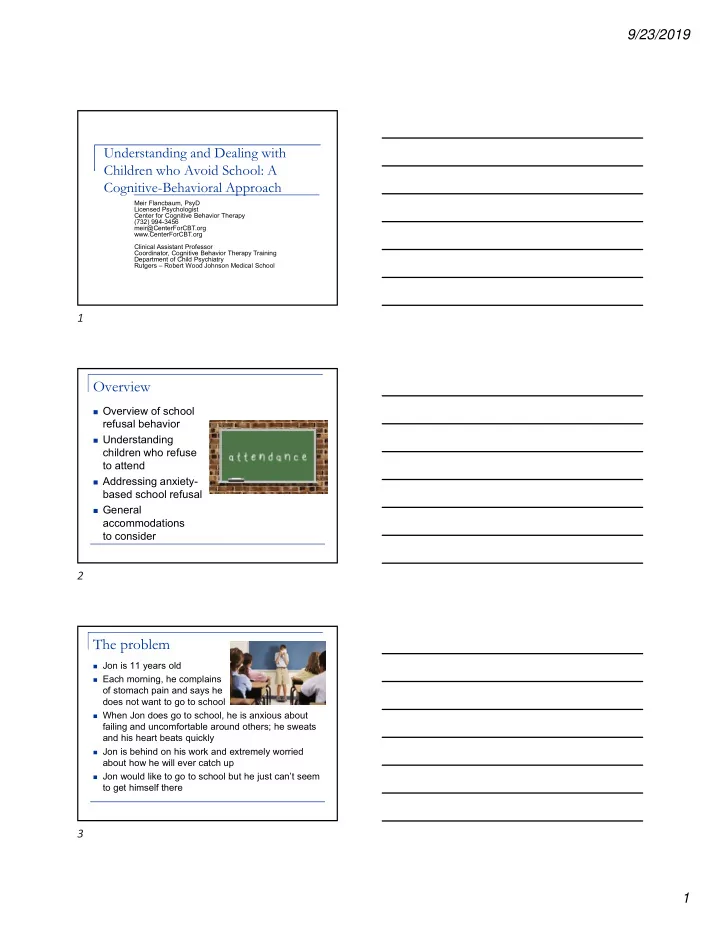
Overview Overview of school refusal behavior Understanding - - PDF document

overview
SMART_READER_LITE
LIVE PREVIEW

Overview Overview of school refusal behavior Understanding - - PDF document

9/23/2019 Understanding and Dealing with Children who Avoid School: A Cognitive-Behavioral Approach Meir Flancbaum, PsyD Licensed Psychologist Center for Cognitive Behavior Therapy (732) 994-3456 meir@CenterForCBT.org www.CenterForCBT.org


slide-1
SLIDE 1

9/23/2019 1 Understanding and Dealing with Children who Avoid School: A Cognitive-Behavioral Approach

Meir Flancbaum, PsyD Licensed Psychologist Center for Cognitive Behavior Therapy (732) 994-3456 meir@CenterForCBT.org www.CenterForCBT.org Clinical Assistant Professor Coordinator, Cognitive Behavior Therapy Training Department of Child Psychiatry Rutgers – Robert Wood Johnson Medical School

Overview

 Overview of school

refusal behavior

 Understanding

children who refuse to attend

 Addressing anxiety-

based school refusal

 General

accommodations to consider

The problem

 Jon is 11 years old  Each morning, he complains

  • f stomach pain and says he

does not want to go to school

 When Jon does go to school, he is anxious about

failing and uncomfortable around others; he sweats and his heart beats quickly

 Jon is behind on his work and extremely worried

about how he will ever catch up

 Jon would like to go to school but he just can’t seem

to get himself there

1 2 3

slide-2
SLIDE 2

9/23/2019 2

What’s in a name?

 School Refusal: Poorly named, but well defined

 Child-motivated absenteeism from school  Chronic tardiness or leaving school early  Tantrums/complaints before finally going to school  Extreme distress when at school

 An umbrella term for chronic absenteeism

 School phobia, separation anxiety, and truancy

 Not a formal diagnosis

Absenteeism is only the tip of the iceberg

Disorder % No diagnosis 32.9 Separation anxiety disorder 22.4 Generalized anxiety disorder 10.5 Oppositional defiant disorder 8.4 Major depression 4.9 Specific phobia 4.2 Social anxiety disorder 3.5 Conduct disorder 2.8 Prevalence of psychiatric diagnoses among youth with school attendance problems

Kearney and Albano, 2004

Why target school refusal?

 Short term consequences

 Poor academic performance  Impaired social development  Depression and suicide ideation

 Long term consequences

 Criminal behavior  Marital problems and social isolation  Difficulty maintaining employment  Psychiatric problems

Kearny & Tollotson, 1998; Kearney, 2006

4 5 6

slide-3
SLIDE 3

9/23/2019 3

Comprehensive Assessment

Child Parent Medical School Providers

Clinical Interviews

 Student’s interests and goals  Differential diagnosis interview, especially

anxiety disorders, depression, suicide

 Home environment, including parent attitude,

discipline style, and stressors

 School view of the challenging behaviors  Understand nature of school avoidance and

possible legitimate factors that may contribute to it (e.g., medical condition)

Questionnaires

 School Refusal Assessment Scale – Revised;

parent and child versions

 Screen for Child Anxiety Related Disorders

(SCARED); parent and child versions

 Child Depression Inventory (CDI)

7 8 9

slide-4
SLIDE 4

9/23/2019 4

Getting to the root of the problem

Access Avoidance Tangible rewards: Sleeping late, TV, friends, delinquency, substance use Objects or people: Alarms, playgrounds, crowded hallways, buses, teachers, peers, Attention from parents or significant other: non- compliance, tantrums, clinging Performance/evaluative situations: tests, recitals, public speaking

Understanding what maintains school refusal is the key to its effective treatment

Kearney & Albano, 2007

Reasons for School Refusal: Trends

 Children ages 5-11

 Avoid objects/people that evoke negative affect  Receive attention

 Children ages 12-17

 Escape social or evaluative situations  Obtain tangible rewards

Maintenance of anxiety-based absenteeism

Temporary Relief Calmness at home Anxious Feelings Dizziness, heart racing Anxious Thoughts “I’m so behind I’ll never catch up on my work” Escape/Avoidance Don’t go to school

X

10 11 12

slide-5
SLIDE 5

9/23/2019 5 Habituation

Peak Distress

Time Anxiety

Wagner, 2000

Strategies for parents, teachers & counselors

 Externalize

 Separate the child from his behavior  Avoid “blaming” the child or assuming manipulation

 Empathize

 Listen and acknowledge  Label triggers, thoughts, and feelings

 Encourage

 Cheerlead and provide labeled praise  Problem solve with the child  Prompt use of coping strategies

 Don’t enable avoidance or be overly reassuring

Typical interventions for children

 Anxiety education

 Cycle of anxiety and the ‘false alarm’

 Thoughts-Feelings-Actions education

 What we think impacts how we feel

 Cognitive restructuring

 Is this a ‘false alarm’? Thought challenging and coping talk

 Relaxation training

 Can be helpful, or problematic if not used correctly

 Problem solving

 What can I say or do to make the situation less fearful?

 Creating a fear hierarchy/bravery mountain  Graded exposure/practice  Contingency management

13 14 15

slide-6
SLIDE 6

9/23/2019 6

CBT Model

Actions & Behaviors Thoughts Feelings

The Fear Plan

Feeling frightened? Expecting bad things to happen? Attitudes and actions to help Review and Reward

Kendall & Hedtke, 2006

School Accommodations to consider

 Teacher education about school refusal  Increased developmentally appropriate labeled praise  Prompting use of coping strategies  “Break pass” to speak with trusted adult or counselor  Call home  Additional time in preferred activity (e.g., club)  Jobs around the school (e.g., library or computer

room)

 Modified assignments or testing conditions  Modified schedule (e.g., attend only certain classes)  Alternative classroom setting

16 17 18

slide-7
SLIDE 7

9/23/2019 7 A comment about accommodations

 Determined based on what is maintaining

the school refusal behavior

 Are viewed as temporary and should be

faded with progress

School-Family Partnership

 Assessment and plan creation with joint input  Communicate on a regular basis

 Jointly develop and regularly review the hierarchy, use of

coping skills, and progress with exposure

 Avoid blaming language

 Work together to decrease parent factors that are

maintaining school avoidance

 Praise successes  Determine reasonable and appropriate

accommodations (Consider 504 or IEP)

 As needed, collaborate with an outside expert in school

avoidance to assist in assessment and treatment

Center for Cognitive Behavior Therapy

 Expertise in the following clinical areas:  Tics and Tourette syndrome  Trichotillomania and skin picking  Anxiety and obsessive-compulsive disorders  Attention deficit hyperactivity and disruptive behavior disorders  Depression, cutting, suicide, and mood dysregulation  Clinical and consultation services include:  Cognitive behavior therapy for children and adolescents  Behavioral parent coaching and support  School-based consultation and behavior plan development  Workshops for parents, educators, and mental health professionals  To make a referral, schedule an in-service, or learn more:  Call: 732-994-3456  Email: info@CenterForCBT.org  Visit: www.CenterForCBT.org

19 20 21