Overview Last Week: Efficiency read/write The File Unix System - - PDF document

overview
SMART_READER_LITE
LIVE PREVIEW

Overview Last Week: Efficiency read/write The File Unix System - - PDF document

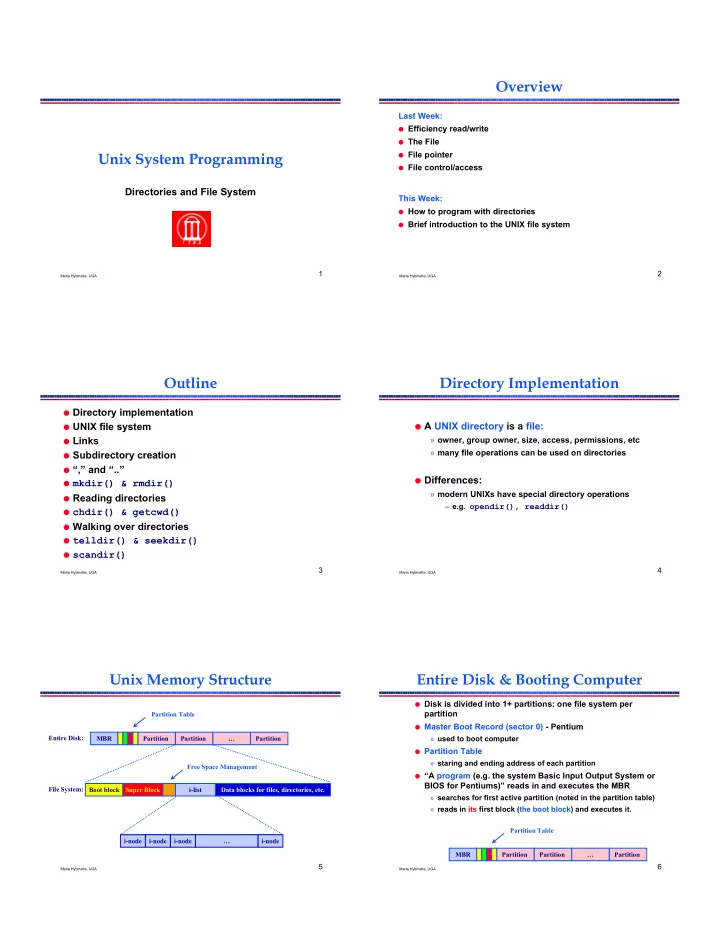
Overview Last Week: Efficiency read/write The File Unix System Programming File pointer File control/access Directories and File System This Week: How to program with directories Brief introduction to the UNIX file system


slide-1
SLIDE 1

Maria Hybinette, UGA

1

Unix System Programming

Directories and File System

Maria Hybinette, UGA

2

Overview

Last Week:

Efficiency read/write The File File pointer File control/access

This Week:

How to program with directories Brief introduction to the UNIX file system

Maria Hybinette, UGA

3

Outline

Directory implementation UNIX file system Links Subdirectory creation “,” and “..” mkdir() & rmdir() Reading directories chdir() & getcwd() Walking over directories telldir() & seekdir() scandir()

Maria Hybinette, UGA

4

Directory Implementation

A UNIX directory is a file:

» owner, group owner, size, access, permissions, etc » many file operations can be used on directories

Differences:

» modern UNIXs have special directory operations

– e.g. opendir(), readdir()

Maria Hybinette, UGA

5

Unix Memory Structure

MBR Partition Partition Partition … i-node i-node i-node … i-node Boot block Super Block i-list Data blocks for files, directories, etc. Partition Table Free Space Management Entire Disk: File System:

Maria Hybinette, UGA

6

Entire Disk & Booting Computer

Disk is divided into 1+ partitions: one file system per

partition

Master Boot Record (sector 0) - Pentium

» used to boot computer

Partition Table

» staring and ending address of each partition

“A program (e.g. the system Basic Input Output System or

BIOS for Pentiums)” reads in and executes the MBR

» searches for first active partition (noted in the partition table) » reads in its first block (the boot block) and executes it.

MBR Partition Partition Partition … Partition Table

slide-2
SLIDE 2

Maria Hybinette, UGA

7

Partition Layout

Boot block:

» contains a hardware specific program that is called automatically to load “UNIX” at system startup time

Super block:

» file system type, #blocks in file system

Free space management (two lists):

» a chain of free data block numbers » a chain of free i-node numbers

i-list/i-node table:

» administrative information about a file (meta-data: name, type, location, size, protection bits, … ) structured into an array: inode table or simply the i-list » An i-node number:

– uniquely identifies a file in a file system – is an index to the i-node table

Boot block Super Block i-list Data blocks for files, directories, etc. Free Space Management

Maria Hybinette, UGA

8

Directory Implementation

Directory system function: Maps ASCII names onto

what is needed to locate the data

Where do we store the files’ attributes?

» A simple directory: fixed sized entries attributes stored with the entry » Directory in each entry just refers to an i-node (UNIX implementation)

attributes work attributes news attributes mail attributes games work news mail games attributes attributes attributes attributes

Maria Hybinette, UGA

9

Directory Structure

A directory “file” is a sequence of lines; each line

holds an i-node number (index-node) and a file name

The data is stored as binary so we cannot simply

cat to view it:

» but some UNIXs allow an “octal dump” (other formats also available) :

“.” 895690 “..” 288767 “gunnar.txt” 287259 “maria.html” 287243

{atlas:maria:187} od -c . 0000000 \0 \r 252 312 \0 \f \0 001 . \0 \0 \0 \0 004 g 377 0000020 \0 \f \0 002 . . \0 \0 \0 004 b 013 \0 024 \0 \n 0000040 m a r i a . h t m l \0 \0 \0 004 b 033 0000060 \0 024 \0 \n g u n n a r . t x t \0 \0

Maria Hybinette, UGA

10

File System Expanded

“.” 895690 “..” 288767 “gunnar.txt” 287259 “maria.html” 287243 i-node i-node … 895690

BB SB i-list directory data directory data data data data

Maria Hybinette, UGA

11

Links - Outline

What is a Link? Creating a Link Seeing Links Removing a Link Symbolic Links Implementation

Maria Hybinette, UGA

12

tucker-todo.txt

What is a Link?

A link is a pointer to a file Useful for sharing files;

» A file can be shared by giving each person their own link (pointer to it)

ln <existing-file> <new-pointer> Maria types, in directory: ~/maria ln tucker-todo.txt /home/tucker/todo.txt

/ tmp home bin tucker maria a.txt g.txt

/home/maria/tucker-todo.txt /home/tucker/todo.txt

and

slide-3
SLIDE 3

Maria Hybinette, UGA

13

Creating Links

Changes to a file affect every link:

{atlas} cat file_a This is file A. {atlas} ln file_a file_b {atlas} cat file_b This is file A {atlas} echo “appending this to b” >> file_b {atlas} cat file_b This is file A. appending this to b {atlas} cat file_a This is file A. appending this to b

Maria Hybinette, UGA

14

Seeing Links

Compare status information : {saffron:maria:104} ls -l file_a file_b file_c

  • rw-r--r-- 2 maria 36 May 24 10:52 file_a
  • rw-r--r-- 2 maria 36 May 24 10:52 file_b
  • rw-r--r-- 1 maria 16 May 24 10:55 file_c

File mode, # links, owners name, group name, #bytes, date, pathname Look at i-node number: {saffron:maria:105} ls -i file_a file_b file_c 3534 file_a 3534 file_b 5800 file_c Directories may appear to have more links: {saffron:maria:106} ls -ld dir drwxr-xr-x 2 maria users 68 Apr 7 17:57 dir/ {saffron:maria:107} mkdir dir/hello {saffron:maria:108} ls -ld dir drwxr-xr-x 3 maria users 68 Apr 7 17:58 dir/ This is because subdirectories (e.g. directories inside

dir/)have a link back to their parent.

Maria Hybinette, UGA

15

Removing a Link

Removing or deleting a link does not

necessarily remove the file

Only when the file and every link is gone will

the file be removed

Maria Hybinette, UGA

16

Symbolic Links

The links described so far are hard links

» A hard link is a pointer to a file which must be on the same file system

A symbolic link is an indirect pointer to a file

» Stores the pathname of the file that it points to » Symbolic links can link across file systems

Symbolic links are listed differently:

{saffron:ingrid:62} ln -s dir ~/unix/d/Sdir {saffron:ingrid:62} ls -lFd dir ~/unix/d/Sdir lrwxr-xr-x 1 ingrid staff 3 1 Apr 21:51 /home/ingrid/unix/d/Sdir@ -> dir drwxr-xr-x 3 ingrid staff 102 1 Apr 21:39 dir/

Maria Hybinette, UGA

17

Link Creation, Update & Removal

?

abc abc abc

update new delete bob

XY XY abc

new bob new bob bob new

abc

cp bob new

abc abc

ln bob new bob

abc

new

XY

ln -s bob new

Maria Hybinette, UGA

18

link()

#include <unistd.h> long link( const char *oldpath, const char *newpath ); Meaning of: » link( “maria.html”, “tucker.html” );

“tucker.html” 287243 “.” 895690 “..” 288767 “gunnar.txt” 287259 “maria.html” 287243 “.” 895690 “..” 288767 “gunnar.txt” 287259 “maria.html” 287243

slide-4
SLIDE 4

Maria Hybinette, UGA

19

unlink()

clears directory record

» usually means that the i-node number is set to 0 » the file may not be affected

The i-node is only deleted when the last link

to it is removed; the file data blocks are deleted/reclaimed when there are no processes having the file opened.

Maria Hybinette, UGA

20

Example unlink

#include <stdio.h> #include <sys/stat.h> #include <sys/types.h> #include <fcntl.h> int main(void) { if( open( “temp”, O_RDWR ) < 0 ) { perror( “open error” ); exit( 1 ); } if( unlink( “temp” ) < 0 ) { perror( “unlink error “ ); exit( 1 ); } printf( “file temp is unlinked\n” ); exit( 0 ); } {saffron} make unlinktemp gcc unlinktemp.c -o unlinktemp {saffron} ./unlinktemp file temp is unlinked {saffron} ./unlinktemp

  • pen error: No such file or directory

Maria Hybinette, UGA

21

remove()

#include <stdio.h> int remove( const char *pathname ); C Library function (not a system call) Delete a name and possibly the file it refers

to.

» It calls unlink() for files and rmdir() for directories

Maria Hybinette, UGA

22

rename()

#include <stdio.h> int rename( const char *oldpath, const char *newpath ); Changes the names of oldpath to newpath (for

both directories and files)

If oldpath is open or is a nonexistent file, or if

newpath names a file that already exists, then the action of rename() is implementation dependent.

Maria Hybinette, UGA

23

symlink()

#include <stdio.h> int symlink( const char *oldpath, const char *newpath ); Creates a symbolic link named newpath

which contains the string oldpath

Symbolic links are interpreted at run-time Dangling link - may point to a nonexisting file If newpath exists it will not be overwritten

Maria Hybinette, UGA

24

readlink()

#include <stdio.h> int readlink( const char *path, char buf, size_t bufsize );

Read value of a symbolic link (does not follow the

link)

» Places the contents of the symbolic link path in the buffer buf which has size bufsize » Does not append a NULL character to buf

Return value

» The count of characters placed in the buffer if it succeeds » -1 on error

slide-5
SLIDE 5

Maria Hybinette, UGA

25

Subdirectory Creation

shell command “mkdir uga” causes

» the creation of uga directory file and new i-node » an i-node number and name are added to the parent directory

“.” 895690 “..” 288767 “uga” 288000 “maria.html” 287243 “.” 895690 “..” 288767 “maria.html” 287243

Maria Hybinette, UGA

26

“.” and “..”

“.” and “..” are stored as ordinary file names

with i-node numbers pointing to the correct directory files

“.” 155 “..” 111 “tucker” 600 “maria” 300 “.” 300 “..” 155 “uga” 589 “.” 600 “..” 155 “gtech” 680

Directory faculty Directory maria Directory tucker

home maria tucker uga gtech Maria Hybinette, UGA

27

mkdir()

#include <sys/types.h> #include <fcntl.h> #include <unistd.h> int mkdir( char *path, mode_t mode );

Creates a new directory with the specified mode Returns 0 if OK and -1 on error “.” and “..” entries are added automatically mode must include execute permissions so user(s)

can use cd

» e.g. 0755

Maria Hybinette, UGA

28

rmdir()

#include <unistd.h> int rmdir( char *pathname );

Deletes an empty directory Returns 0 if OK, -1 on error Will delay until other processes have stopped

using the directory

Maria Hybinette, UGA

29

Reading Directories

Directories can be read by any one who have

access

Directories can be modified only by the kernel

» Note we may be able to create new files and remove files from a directory

Maria Hybinette, UGA

30

Reading Directories

#include <sys/types.h> #include <dirent.h> DIR *opendir( char *pathname ); struct dirent *readdir( DIR *dp ); void rewinddir( DIR *dp ); int closedir( DIR *dp );

DIR is a directory stream (similar to FILE)

» when a directory is first opened the stream points to the first entry in the directory

dirent next slide

returns a pointer if OK NULL on error returns a pointer if OK NULL at end or on error returns 0 if OK

  • 1 on error
slide-6
SLIDE 6

Maria Hybinette, UGA

31

dirent

struct dirent { long d_ino; /* i-node number */ char d_name[NAME_MAX + 1]; /* null terminated file name */

  • ff_t d_off;

/* offset to next record */ unsigned short d_reclen; /* record length */ }

NAME_MAX not available on all UNIXs, may need to use a function

to define it (fpathconf defined in unistd.h) - gets configurable pathname variables)

Maria Hybinette, UGA

32

Example: listdir.c

#include <stdio.h> #include <dirent.h> int main( void ) { DIR *dp; struct dirent *dir; if( (dp = opendir( “.” )) == NULL ) { fprintf( stderr, “Cannot open dir\n” ); exit( 1 ); } /* read entries */ while( (dir = readdir( dp )) != NULL ) if( dir-> d_ino != 0 ) /* ignore empty records */ printf( “%s\n”, dir->d_name ); closedir( dp ); return 0; } /* end main */

{saffron:50} ./listdir . .. listdir.c listdir {saffron:51}

Maria Hybinette, UGA

33

chdir()

#include <unistd.h> int chdir( char *pathname ); int fchdir( int fd );

Every process has a current working directory (search

for a relative pathname starts here)

Change the current working director working directory

(cwd) of the calling process

Returns 0 if OK, -1 on error Directory change is limited to within the program

Maria Hybinette, UGA

34

Example to_tmp.c : Changing current working directory

#include <stdio.h> #include <unistd.h> int main( void ) { if( chdir( “/tmp” ) < 0 ) { fprintf( stderr, “chdir failed\n” ); exit( 1 ); } else printf( “In /tmp\n” ); exit( 0 ); }

{saffron} pwd /usr/lib {saffron} ./to_tmp In /tmp {saffron} pwd /usr/lib {saffron}

Maria Hybinette, UGA

35

getcwd()

#include <unistd.h> int *getcwd( char *buf, size_t size );

Store the cwd of the calling process in buf Return buf if OK, NULL on error buf must be big enough for the pathname string

(size specifies maximum length of buf );

Maria Hybinette, UGA

36

Example printcwd.c

#include <stdio.h> #include <unistd.h> #define BUFSIZE 255 int main( void ) { char name[BUFSIZE+1]; /* accommodate \0 */ if( getcwd( name, BUFSIZE+1 ) == NULL ) perror( “getcwd error\n” ); else printf( “Current directory is %s\n”, name ); exit(0); }

{saffron} pwd /usr/lib {saffron} ./printcwd Current directory is /usr/lib {saffron}

slide-7
SLIDE 7

Maria Hybinette, UGA

37

Walking over Directories

‘Visit’ every file in a specified directory and all

  • f its subdirectories

» visit means the get name of the file

Apply a user-defined function to every visited

file

Maria Hybinette, UGA

38

ftw()

#include <ftw.h> /* file tree walk starting at dir */ int ftw( char *dir, MyFunc *fp, int depth ); /* apply MyFunc() to each visited file */ typedef int MyFunc( const char *file, struct stat *sbuf, int flag );

depth is the maximum number of directories that can be

  • pened at once. Safest value is 1, although it slows down ftw()

Returns 0 on success (visiting every file), -1 on error file is the pathname relative to the start directory, it is passed

to MyFunc() automatically by ftw() as it visits each file

sbuf is a pointer to the stat information for the current file

examined

Maria Hybinette, UGA

39

ftw() - (cont)

The flag argument will be set to one of the

following for the item being examined

» FTW_F Item is a regular file » FTW_D Item is a directory » FTW_NS Could not get stat info for item » FTW_DNR Directory cannot be read

If MyFunc() returns a non-zero value then

ftw() will terminate

Maria Hybinette, UGA

40

Example: shower.c

#include <stdio.h> #include <sys/types.h> #include <sys/stat.h> #include <ftw.h> int shower( const char *file, const struct stat *sbuf, int flag ); int main( void ) { ftw( “,”, shower, 1 ); } Print the names of all the file found below the current directory

Maria Hybinette, UGA

41

Example: shower.c (cont)

int shower( const char *file, const struct stat *sbuf, int flag ) { if( flag == FTW_F ) /* is a file */ printf( “Found: %s”, file ); return 0; }

Maria Hybinette, UGA

42

telldir() & seekdir()

#include <dirent.h>

  • ff_t telldir( DIR *dp );

Returns the location of the current record in the

directory, -1 on error #include <dirent.h>

  • ff_t seekdir( DIR *dp, off_t loc );

Set the location in the directory file

slide-8
SLIDE 8

Maria Hybinette, UGA

43

scandir()

#include <dirent.h>

  • ff_t scandir( char *dir, struct dirent ***pitems, SelectFnc *sfp,

CompareFnc *cfp ); /* selection function for searching */ typedef int SelectFnc( const struct dirent *d ); /* comparison function for sorting */ typedef int CompareFnc( const struct dirent *d1, const struct dirent *d2 ); Scan the directory file calling the selection function (sfp) on each

directory item

Items for which sfp returns non-zero are stored in an array

pointed by pitems

The items in the array are sorted using qsort() using the

comparison function (cfp)

scandir() and alpasort() not implemented on Solaris

Maria Hybinette, UGA

44 dirent.h includes one predefined comparison

function, which compares directory item names

int alphasort( const struct dirent *d1, const struct dirent *d2 );

Causes the pitems array to be sorted in

increasing alphabetical order by item name

NULL item 1 item 2 item 3 pitems

Maria Hybinette, UGA

45

Example geth.c

#include <stdio.h> #include <dirent.h> #include <sys/types.h> /* our selection function */ int selectH( struct dirent *d ); int main( void ) { struct dirent ** pitems; scandir( “.”, &pitems, selectH, alphasort ); while( *pitems != NULL ) { printf( “%s\n”, (*pitems)->d_name ); pitems++: } exit( 0 ); }

List files/subdirectories in the current directory which begin with an ‘h’ sorted in alphabetical order

Maria Hybinette, UGA

46 int selectH( struct dirent *d ) { if( d-> d_name[0] == ‘h’ ) return 1; return 0; }