Virtual File System Project 2: Virtual File System Handouts / - - PDF document

virtual file system
SMART_READER_LITE
LIVE PREVIEW

Virtual File System Project 2: Virtual File System Handouts / - - PDF document

Virtual File System Project 2: Virtual File System Handouts / Description to be published by end Project 2 of week Due Dates (subject to change): The Virtual File System Minimum Effort Due: February 6, 2003 Full Project


slide-1
SLIDE 1

1

Project 2

The Virtual File System

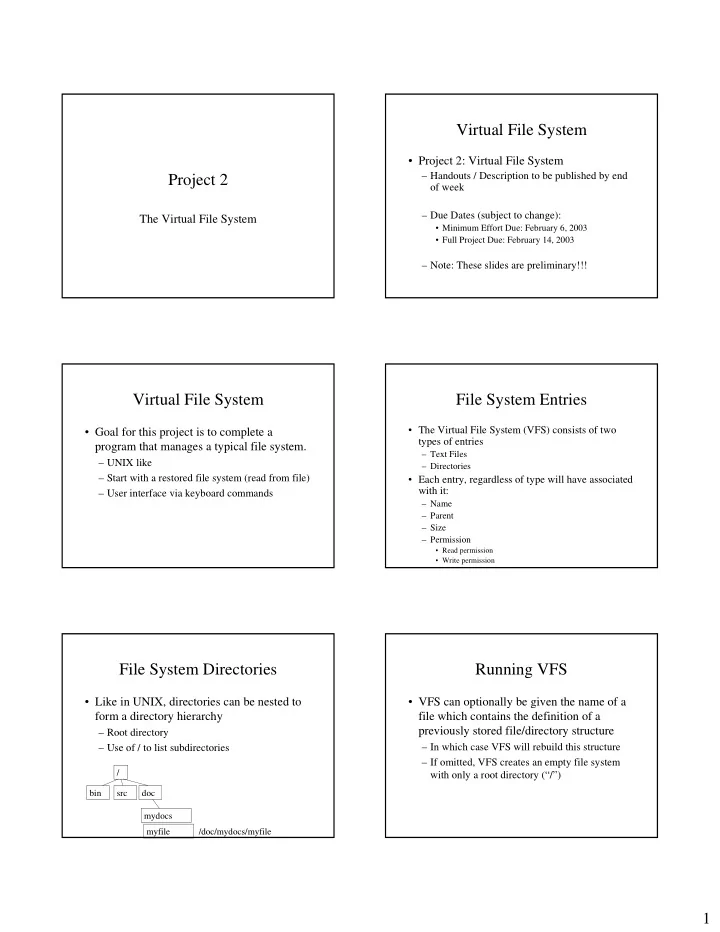
Virtual File System

  • Project 2: Virtual File System

– Handouts / Description to be published by end

  • f week

– Due Dates (subject to change):

  • Minimum Effort Due: February 6, 2003
  • Full Project Due: February 14, 2003

– Note: These slides are preliminary!!!

Virtual File System

  • Goal for this project is to complete a

program that manages a typical file system.

– UNIX like – Start with a restored file system (read from file) – User interface via keyboard commands

File System Entries

  • The Virtual File System (VFS) consists of two

types of entries

– Text Files – Directories

  • Each entry, regardless of type will have associated

with it:

– Name – Parent – Size – Permission

  • Read permission
  • Write permission

File System Directories

  • Like in UNIX, directories can be nested to

form a directory hierarchy

– Root directory – Use of / to list subdirectories

/ bin src doc mydocs /doc/mydocs/myfile myfile

Running VFS

  • VFS can optionally be given the name of a

file which contains the definition of a previously stored file/directory structure

– In which case VFS will rebuild this structure – If omitted, VFS creates an empty file system with only a root directory (“/”)

slide-2
SLIDE 2

2

VFS Commands

  • ls flags entry_name

– If entry_name is a file, info about the file is printed. – If entry_name is a directory, info about directory contents is printed. – If entry_name is omitted, do ls on root directory – Flags

  • -l Give a long listing (file_name size permission)
  • -r Recursive listing
  • -lr both of the above

VFS Commands

  • access flags entry_name permissions

– Sets the attributes of a file or directory – Flags

  • -r recursive
  • backup file-name

– Write the contents of the current VFS into a file.

  • restore file_name

– Read the contents of a file and restores the VFS based

  • n its contents.

VFS Commands

  • mkdir directory_name

– Creates a new subdirectory

  • rm text_entry_name

– Removes a text file

  • rmdir directory_entry_name

– Removes a directory

  • mk text_file_name size

– Creates a new text file

VFS Commands

  • quit (ctrl-D)

– Exits the program

Design – classes

  • VFS – main class
  • Virtual File System classes

– Entry – entries that can exist in the file system

  • Directory – represents a directory
  • Document – represents a text file

– VFSystem – represents the file system as a whole. All commands should result is calls to VFSystem methods.

  • Does NOT define the user interface!

– Lot’s o’ Exception classes

Design – classes

  • User interface classes

– VFSView – java interface for user interface

  • VFSTextView -- gets command from keyboard

input.

– VFSCommandException – yet another exception class.

slide-3
SLIDE 3

3

Design – classes

  • VFSCommand – abstract class that represents a

valid VFS command…each has an execute method.

– VFSbackup – backup command – VFSls – ls command – VFSmk – mk command – VFSmkdir – mkdir command – VFSaccess – access command – VSFrestore – restore command – VFSrm – rm command – VFSrmdir – rmdir command

Classes you’ll need to write

  • VFS Classes:

– Entry – Document – Directory – Complete the VFSystem class – Please use RCS

Testing your work

  • You can use try to test out your classes

– try cs2-grd project2-test infile

  • Will run our solution on your test data in file infile
  • You can redirect the output into a file and then

compare with your output

– try cs2-grd project2-test infile > correctSolution – java VFS infile > mySolution – diff mySolution correctSolution

Submissions

  • 4 submissions

– Minimum: Entry.java & Document.java Submission 2: Directory.java – Submission 3: VFSystem.java – Submission 4: all of the above (?)

  • All submissions via try
  • NO LATE SUBMISSIONS!

Submissions

  • About the minimum submission

– Entry.java and Document.java is the minimum reasonable effort requirement for this project

  • Due Feb 6, 2003 (subject to change)

– Must submit successfully.

  • Otherwise, you fail the course

Grading

  • 100 points for functionality

– Up to 35 point deduction for bad implementation – Up to 30 point deduction for bad style

  • Including non-use of RCS
  • Submission percentages (subject to change)

– Entry/Document – 30% – Directory – 25% – VFSystem – 20% – All classes 20%

slide-4
SLIDE 4

4

Questions? Next time

  • Trees

– Which you’ll need for your project!

  • Questions?