Overview CS20a: Turing Machines (Oct 29, 2002) So far: DFA = - - PDF document

overview
SMART_READER_LITE
LIVE PREVIEW

Overview CS20a: Turing Machines (Oct 29, 2002) So far: DFA = - - PDF document

Overview CS20a: Turing Machines (Oct 29, 2002) So far: DFA = regular languages PDA = context-free languages Today: Computability U S T T I T E O F N T I A E C I H N N Computation, Computers, and Programs


slide-1
SLIDE 1

Overview

Computation, Computers, and Programs Course Introduction http://www.cs.caltech.edu/courses/cs20/a/ October 29, 2002

1

C A L I F O R N I A I N S T I T U T E O F T E C H N O I L O G Y

If this page displays slowly, try turning off the “smooth line art” option in Acrobat, under Edit->Preferences

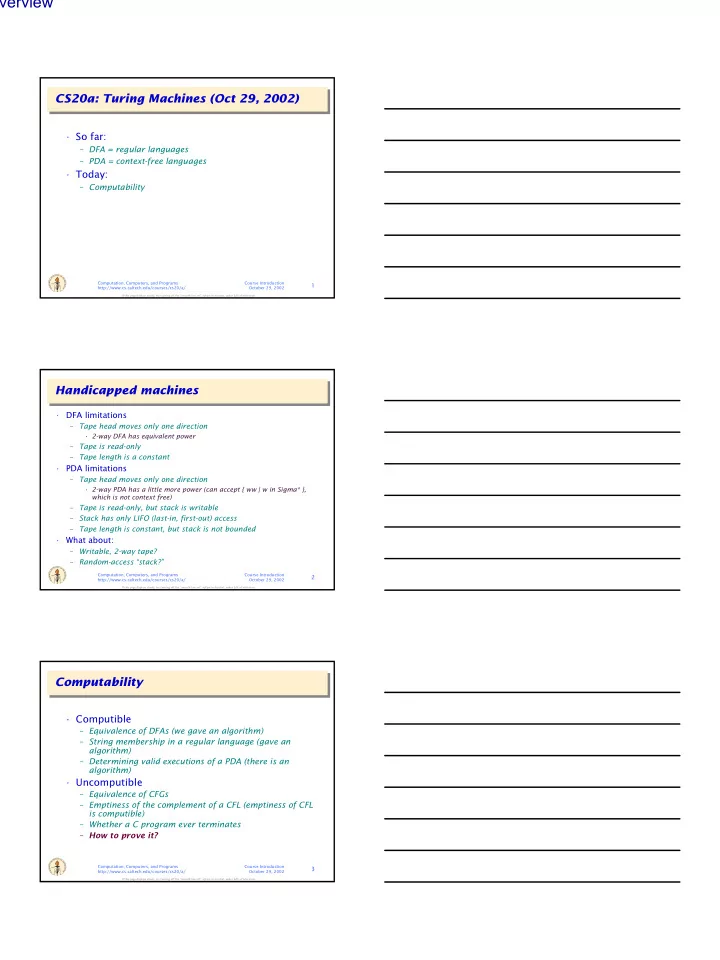
CS20a: Turing Machines (Oct 29, 2002)

  • So far:

– DFA = regular languages – PDA = context-free languages

  • Today:

– Computability

Computation, Computers, and Programs Course Introduction http://www.cs.caltech.edu/courses/cs20/a/ October 29, 2002

2

C A L I F O R N I A I N S T I T U T E O F T E C H N O I L O G Y

If this page displays slowly, try turning off the “smooth line art” option in Acrobat, under Edit->Preferences

Handicapped machines

  • DFA limitations

– Tape head moves only one direction

  • 2-way DFA has equivalent power

– Tape is read-only – Tape length is a constant

  • PDA limitations

– Tape head moves only one direction

  • 2-way PDA has a little more power (can accept { ww | w in Sigma* },

which is not context free)

– Tape is read-only, but stack is writable – Stack has only LIFO (last-in, first-out) access – Tape length is constant, but stack is not bounded

  • What about:

– Writable, 2-way tape? – Random-access “stack?”

Computation, Computers, and Programs Course Introduction http://www.cs.caltech.edu/courses/cs20/a/ October 29, 2002

3

C A L I F O R N I A I N S T I T U T E O F T E C H N O I L O G Y

If this page displays slowly, try turning off the “smooth line art” option in Acrobat, under Edit->Preferences

Computability

  • Computible

– Equivalence of DFAs (we gave an algorithm) – String membership in a regular language (gave an algorithm) – Determining valid executions of a PDA (there is an algorithm)

  • Uncomputible

– Equivalence of CFGs – Emptiness of the complement of a CFL (emptiness of CFL is computible) – Whether a C program ever terminates – How to prove it?

slide-2
SLIDE 2

Overview

Computation, Computers, and Programs Course Introduction http://www.cs.caltech.edu/courses/cs20/a/ October 29, 2002

4

C A L I F O R N I A I N S T I T U T E O F T E C H N O I L O G Y

If this page displays slowly, try turning off the “smooth line art” option in Acrobat, under Edit->Preferences

Turing machines

1 1

b b b

Finite Control Infinite read-write tape Tape head

  • 1. In state q
  • a. read a symbol c
  • b. print a new symbol c'
  • c. move the tape head one

position left or right

  • d. goto state delta(q, c)
  • 2. Accept iff the TM ever enters

a final state Blanks

Computation, Computers, and Programs Course Introduction http://www.cs.caltech.edu/courses/cs20/a/ October 29, 2002

5

C A L I F O R N I A I N S T I T U T E O F T E C H N O I L O G Y

If this page displays slowly, try turning off the “smooth line art” option in Acrobat, under Edit->Preferences

Turing machine formal definition

A Turing Machine is a 7-tuple M = (Q, Σ, Γ, δ, s, b, F)

  • Q is a finite set of states,
  • Γ is a finite set of tape symbols,
  • b ∈ Γ is the blank symbol,
  • Σ ⊆ Γ − {b} is the set of input symbols,
  • δ : Q × Γ → Q × Γ × {L, R} is a partial transition

function,

  • s ∈ Q is the start state,
  • F ⊆ Q is the set of final states

Computation, Computers, and Programs Course Introduction http://www.cs.caltech.edu/courses/cs20/a/ October 29, 2002

6

C A L I F O R N I A I N S T I T U T E O F T E C H N O I L O G Y

If this page displays slowly, try turning off the “smooth line art” option in Acrobat, under Edit->Preferences

Nontermination

A TM that does not terminate M = (Q, Σ, Γ, δ, s, b, F)

  • Q = {q0, q1}
  • Σ = {a}
  • Γ = {a, b}
  • δ(q0, a) = (q0, a, R)
  • s = q0
  • F = {}
slide-3
SLIDE 3

Overview

Computation, Computers, and Programs Course Introduction http://www.cs.caltech.edu/courses/cs20/a/ October 29, 2002

7

C A L I F O R N I A I N S T I T U T E O F T E C H N O I L O G Y

If this page displays slowly, try turning off the “smooth line art” option in Acrobat, under Edit->Preferences

Nontermination execution

1 1 b b b a 1 1 b b b a a a a a b b b a a a a a a b b q0 q0 q0 q0

Computation, Computers, and Programs Course Introduction http://www.cs.caltech.edu/courses/cs20/a/ October 29, 2002

8

C A L I F O R N I A I N S T I T U T E O F T E C H N O I L O G Y

If this page displays slowly, try turning off the “smooth line art” option in Acrobat, under Edit->Preferences

Termination

A partial function U → V is a function that may not be defined for every argument u ∈ U

  • A TM that accepts Σ∗
  • Q = {q0}
  • Γ = Σ ∪ {b}
  • δ(q0, c) is arbitrary (possibly not defined)
  • s = q0
  • F = {q0}

Computation, Computers, and Programs Course Introduction http://www.cs.caltech.edu/courses/cs20/a/ October 29, 2002

9

C A L I F O R N I A I N S T I T U T E O F T E C H N O I L O G Y

If this page displays slowly, try turning off the “smooth line art” option in Acrobat, under Edit->Preferences

Termination execution

1 1 b b b q0 in F

slide-4
SLIDE 4

Overview

Computation, Computers, and Programs Course Introduction http://www.cs.caltech.edu/courses/cs20/a/ October 29, 2002

10

C A L I F O R N I A I N S T I T U T E O F T E C H N O I L O G Y

If this page displays slowly, try turning off the “smooth line art” option in Acrobat, under Edit->Preferences

Instantaneous descriptions

  • An instantaneous description ID (σ) is α1qα2, where

– q is the current state of the TM, – α1α2 ∈ Γ ∗ if the contents of the tape (to the last non-blank symbol) – The current symbol is the first symbol of α2

Computation, Computers, and Programs Course Introduction http://www.cs.caltech.edu/courses/cs20/a/ October 29, 2002

11

C A L I F O R N I A I N S T I T U T E O F T E C H N O I L O G Y

If this page displays slowly, try turning off the “smooth line art” option in Acrobat, under Edit->Preferences

Transitions

  • Define a left transition

a1 . . . ai−1 q ai, . . . , an →L a1, . . . , ai−2 pc ai . . . an

  • Define a right transition

a1 . . . ai−1 q ai, . . . , an →R a1, . . . , ai−1 cp ai+1 . . . an

  • A transition → is either →L or →R

Computation, Computers, and Programs Course Introduction http://www.cs.caltech.edu/courses/cs20/a/ October 29, 2002

12

C A L I F O R N I A I N S T I T U T E O F T E C H N O I L O G Y

If this page displays slowly, try turning off the “smooth line art” option in Acrobat, under Edit->Preferences

Executions

  • An execution is either:

– A finite sequence σ1σ2 · · · σn – An infinite sequence σ1σ2 · · ·

  • where σi → σi+1
slide-5
SLIDE 5

Overview

Computation, Computers, and Programs Course Introduction http://www.cs.caltech.edu/courses/cs20/a/ October 29, 2002

13

C A L I F O R N I A I N S T I T U T E O F T E C H N O I L O G Y

If this page displays slowly, try turning off the “smooth line art” option in Acrobat, under Edit->Preferences

Acceptance condition

  • Let x ∈ Σ∗, and M = (Q, Σ, Γ, δ, q0, b, F)
  • M accepts x iff

– q0x →∗ α1pα2 – p ∈ F – α1α2 ∈ Γ ∗

Computation, Computers, and Programs Course Introduction http://www.cs.caltech.edu/courses/cs20/a/ October 29, 2002

14

C A L I F O R N I A I N S T I T U T E O F T E C H N O I L O G Y

If this page displays slowly, try turning off the “smooth line art” option in Acrobat, under Edit->Preferences

Definitions

  • The languages accepted by TM are called recur-

sively enumerable (r.e.) – Recursion is related to recursion in programs, – Enumerable means there is some TM that can enumerate the strings in the language (we'll see why)

  • A language is recursive if it is accepted by some

TM that halts on all inputs

  • WLOG, we'll usually assume that TM halt if they

enter a final state

Computation, Computers, and Programs Course Introduction http://www.cs.caltech.edu/courses/cs20/a/ October 29, 2002

15

C A L I F O R N I A I N S T I T U T E O F T E C H N O I L O G Y

If this page displays slowly, try turning off the “smooth line art” option in Acrobat, under Edit->Preferences

Multi-tape machines

1

b b b b

Finite Control

1 1 1 1

b b

1

b b b b

Σ3

slide-6
SLIDE 6

Overview

Computation, Computers, and Programs Course Introduction http://www.cs.caltech.edu/courses/cs20/a/ October 29, 2002

16

C A L I F O R N I A I N S T I T U T E O F T E C H N O I L O G Y

If this page displays slowly, try turning off the “smooth line art” option in Acrobat, under Edit->Preferences

Making space

  • To make space on the tape

– Remember a symbol, and replace it with a $ – Move all the way to the right – Move left, copying symbols one position to the right – When reaching $, write the original symbol to the right – Replace $ with a blank

Computation, Computers, and Programs Course Introduction http://www.cs.caltech.edu/courses/cs20/a/ October 29, 2002

17

C A L I F O R N I A I N S T I T U T E O F T E C H N O I L O G Y

If this page displays slowly, try turning off the “smooth line art” option in Acrobat, under Edit->Preferences

Unary addition

  • To add 0m$0n → 0n+m$ (in unary):

– Find $ – Replace with 0, and move right to first blank – Back up one space, and write $

Computation, Computers, and Programs Course Introduction http://www.cs.caltech.edu/courses/cs20/a/ October 29, 2002

18

C A L I F O R N I A I N S T I T U T E O F T E C H N O I L O G Y

If this page displays slowly, try turning off the “smooth line art” option in Acrobat, under Edit->Preferences

Copying

  • To copy 0n$ → 0n$0n

– Move to first 0 – Replace with X – Move to first blank and replace with 0 – Move back to X, move right, and repeat – On reaching $, convert all Xs to 0s

slide-7
SLIDE 7

Overview

Computation, Computers, and Programs Course Introduction http://www.cs.caltech.edu/courses/cs20/a/ October 29, 2002

19

C A L I F O R N I A I N S T I T U T E O F T E C H N O I L O G Y

If this page displays slowly, try turning off the “smooth line art” option in Acrobat, under Edit->Preferences

Unary multiplication

  • To multiply 0m$0n → 0mn

– Place a $ at right end of tape – Move to first 0, and replace with Y – Move past first $ – Invoke copy – Move back to Y and repeat

Computation, Computers, and Programs Course Introduction http://www.cs.caltech.edu/courses/cs20/a/ October 29, 2002

20

C A L I F O R N I A I N S T I T U T E O F T E C H N O I L O G Y

If this page displays slowly, try turning off the “smooth line art” option in Acrobat, under Edit->Preferences

Multi-head, multi-tape machines

1

b b b b

Finite Control

1 1 1 1

b b

1

b b b b

# # # For each move: delta(<i, ci>, ..., <j, cj>) = <i+D,ci'>, ..., <j+D, cj'> Scan right: collect <i, ci>, ..., <j, cj> Scan left: write <i+D,ci'>, ..., <j+D, cj'>

Computation, Computers, and Programs Course Introduction http://www.cs.caltech.edu/courses/cs20/a/ October 29, 2002

21

C A L I F O R N I A I N S T I T U T E O F T E C H N O I L O G Y

If this page displays slowly, try turning off the “smooth line art” option in Acrobat, under Edit->Preferences

RAM machines (standard processors)

  • A RAM has:

– A finite number of random-access registers R1, …, Rn – A program counter PC – A program I1, …, In

  • Example program (R1 factorial, R2 gets result, R0 is zero)
  • fact:

– CMP R1,R0 – JMP EQ,out – MUL R2R2*R1 – DEC R1 – JMP fact

  • out:
slide-8
SLIDE 8

Overview

Computation, Computers, and Programs Course Introduction http://www.cs.caltech.edu/courses/cs20/a/ October 29, 2002

22

C A L I F O R N I A I N S T I T U T E O F T E C H N O I L O G Y

If this page displays slowly, try turning off the “smooth line art” option in Acrobat, under Edit->Preferences

A RAM

#0$R1 #1$R2 #01$R3 #10$R4... PC #0 $CMP R1,R0 #01 $JMP EQ,110 #10 $MUL R2<-R2,R1 #11 $DEC R1 #101$JMP 0 Each move:

  • 1. Use PC to find instruction

For example: ADD Ri<-Rj,Rk

  • 2. Find Ri,Rj,Rk
  • 3. Perform arithmetic
  • 4. Increment PC
  • 5. Continue

Computation, Computers, and Programs Course Introduction http://www.cs.caltech.edu/courses/cs20/a/ October 29, 2002

23

C A L I F O R N I A I N S T I T U T E O F T E C H N O I L O G Y

If this page displays slowly, try turning off the “smooth line art” option in Acrobat, under Edit->Preferences

Church’s thesis

  • “The computable functions are the same

as the partial recursive functions”

– What is a “computable function?”

  • Lots of models: l-calculus, mechanical devices,

fluids and valves, DNA, quantum devices…

  • All of these seem to define the same set of

functions (but some have better performance)

Computation, Computers, and Programs Course Introduction http://www.cs.caltech.edu/courses/cs20/a/ October 29, 2002

24

C A L I F O R N I A I N S T I T U T E O F T E C H N O I L O G Y

If this page displays slowly, try turning off the “smooth line art” option in Acrobat, under Edit->Preferences

Definitions

  • A problem is a yes-or-no question

– Are two CFGs equivalent? – Does a TM halt on blank tape?

  • An instance of a problem has specific arguments

– Does this TM halt on blank tape?

  • An algorithm is a program that always halts (with

the correct answer), so it is recursive

  • A problem is decidable if it is recursive
  • If not, it is undecidable
  • Classically, every instance of a problem is

decidable

– Not true constructively…

slide-9
SLIDE 9

Overview

Computation, Computers, and Programs Course Introduction http://www.cs.caltech.edu/courses/cs20/a/ October 29, 2002

25

C A L I F O R N I A I N S T I T U T E O F T E C H N O I L O G Y

If this page displays slowly, try turning off the “smooth line art” option in Acrobat, under Edit->Preferences

Some properties

  • The complement of a recursive set is recursive

– Given M that halts on all inputs, construct M’ that simulates M.

  • If M halts and accepts, M’ halts and does not accept
  • If M halts and does not accept, M’ halts and accepts
  • The union/intersection of two recursive sets is

recursive

– Simulate machine M1, then simulate machine M2 – Union: accept if either accepts – Intersection: accept if both accept

  • If L and (Sigma* - L) are r.e., then L is recursive

Computation, Computers, and Programs Course Introduction http://www.cs.caltech.edu/courses/cs20/a/ October 29, 2002

26

C A L I F O R N I A I N S T I T U T E O F T E C H N O I L O G Y

If this page displays slowly, try turning off the “smooth line art” option in Acrobat, under Edit->Preferences

Quiz

Computation, Computers, and Programs Course Introduction http://www.cs.caltech.edu/courses/cs20/a/ October 29, 2002

27

C A L I F O R N I A I N S T I T U T E O F T E C H N O I L O G Y

If this page displays slowly, try turning off the “smooth line art” option in Acrobat, under Edit->Preferences

Writing down a Turing Machine

  • Consider M = (Q, Σ, Γ, δ, s, b, F)
  • Write it down as a sequence of symbols

– Kozen: write as 0n#0m#0k#0s#0t#0r#0u#0v# – USe integer representations for states, sym- bols, etc. – n = |Q|, m = |Γ|, k = |Σ| – s, t, r are start, accept, reject states – u and v are some translation of δ

slide-10
SLIDE 10

Overview

Computation, Computers, and Programs Course Introduction http://www.cs.caltech.edu/courses/cs20/a/ October 29, 2002

28

C A L I F O R N I A I N S T I T U T E O F T E C H N O I L O G Y

If this page displays slowly, try turning off the “smooth line art” option in Acrobat, under Edit->Preferences

Universal Turing Machines

Next, build a universal Turing machine U that accepts L(U) ≡ {M#x | x ∈ L(M)}

  • U checks that M#x is a valid description
  • Copy M to one tape, and x to another tape
  • Use a scratch tape to represents current state, head

position, etc.

  • Simulate M: for each move:

– Figure out δ function from M – Move the head, – modify the tape x

Computation, Computers, and Programs Course Introduction http://www.cs.caltech.edu/courses/cs20/a/ October 29, 2002

29

C A L I F O R N I A I N S T I T U T E O F T E C H N O I L O G Y

If this page displays slowly, try turning off the “smooth line art” option in Acrobat, under Edit->Preferences

Reals are uncountable

  • Cantor’s

diagonalization argument

0. 7 3 5 9 2... 1 0. 3 7 7 1 8... 2 0. 1 0... 3 0. 9 7 9 8 4... 4 0. 8 1 5 2 5... 5 0. 6 6 6 0... 0. 8 8 2 6...

Computation, Computers, and Programs Course Introduction http://www.cs.caltech.edu/courses/cs20/a/ October 29, 2002

30

C A L I F O R N I A I N S T I T U T E O F T E C H N O I L O G Y

If this page displays slowly, try turning off the “smooth line art” option in Acrobat, under Edit->Preferences

Another diagonalization argument

Input string ε 1 10 01 11 ... Mε M0 M1 M01 M10 ... x x x x x x x x x x x x Place an x iff M halts on x x x x Machine

slide-11
SLIDE 11

Overview

Computation, Computers, and Programs Course Introduction http://www.cs.caltech.edu/courses/cs20/a/ October 29, 2002

31

C A L I F O R N I A I N S T I T U T E O F T E C H N O I L O G Y

If this page displays slowly, try turning off the “smooth line art” option in Acrobat, under Edit->Preferences

Halting problem

  • Problem: determine entries in the matrix
  • Find a recursive machine K, given M#x

– K halts and accepts if M accepts x – K halts and rejects if M does not terminate

  • Is there such a machine?
  • Suppose so, then build a new machine N, that,

given x, runs K on Mx#x and:

– Accepts if K rejects – Loops forever of K accepts

  • If K exists, then N does too; let N = My

– N#y halts and accepts if N#y does not halt – N#y loops forever if N#y halts