Computability on real numbers 1 Wrapping Sets 2 3 Taylor Models - - PowerPoint PPT Presentation

computability on real numbers
SMART_READER_LITE
LIVE PREVIEW

Computability on real numbers 1 Wrapping Sets 2 3 Taylor Models - - PowerPoint PPT Presentation

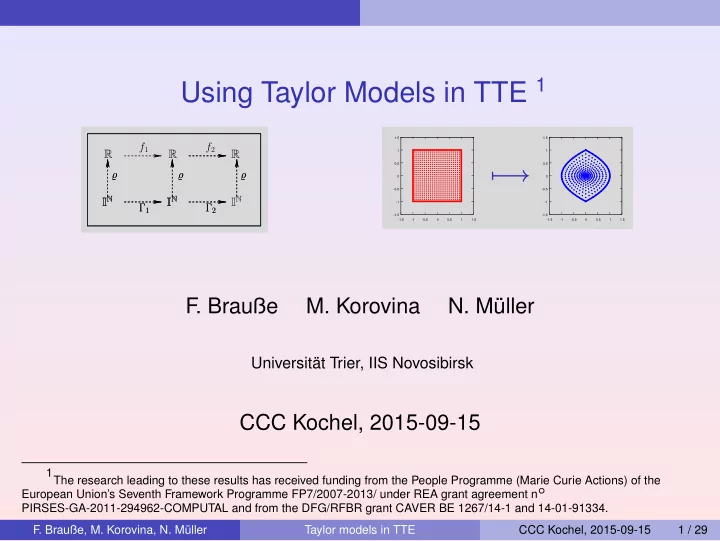
Using Taylor Models in TTE 1 1.5 1.5 f 1 f 2 R R R 1 1 0.5 0.5 0 0 -0.5 -0.5 I N I N I N I N I N -1 -1 1 1 2 2 -1.5 -1.5 -1.5 -1 -0.5 0 0.5 1 1.5 -1.5 -1 -0.5 0 0.5 1


slide-1
SLIDE 1

Using Taylor Models in TTE 1

R f1 f2 R R ̺ ̺ ̺ Γ1 Γ2 ̺ ̺ ̺ Γ1 Γ2 IN IN IN IN IN

  • 1.5
  • 1
  • 0.5
0.5 1 1.5
  • 1.5
  • 1
  • 0.5
0.5 1 1.5

− →

  • 1.5
  • 1
  • 0.5
0.5 1 1.5
  • 1.5
  • 1
  • 0.5
0.5 1 1.5

F . Brauße

  • M. Korovina
  • N. Müller

Universität Trier, IIS Novosibirsk

CCC Kochel, 2015-09-15

1The research leading to these results has received funding from the People Programme (Marie Curie Actions) of the European Union’s Seventh Framework Programme FP7/2007-2013/ under REA grant agreement n◦ PIRSES-GA-2011-294962-COMPUTAL and from the DFG/RFBR grant CAVER BE 1267/14-1 and 14-01-91334.

  • F. Brauße, M. Korovina, N. Müller

Taylor models in TTE CCC Kochel, 2015-09-15 1 / 29

slide-2
SLIDE 2

Computability on real numbers

1

Computability on real numbers

2

Wrapping Sets

3

Taylor Models

4

Examples

5

Closing remarks

  • F. Brauße, M. Korovina, N. Müller

Taylor models in TTE CCC Kochel, 2015-09-15 2 / 29

slide-3
SLIDE 3

Computability on real numbers

A real number x is usually represented as follows: use open intervals with dyadic endpoints I := m1 2k , m2 2k

  • | m1, m2 ∈ Z, k ∈ N
  • interpret word functions as sequences

and use OTM [Σ∗ → Σ∗] ∼ [N → I] = IN

queries answers input

  • utput

machine M

  • racle

define representation ̺ : ⊆IN → R: x ∈ R is represented by (Im)m∈N iff lim

m→∞ diam(Im) = 0

  • m∈N

Im = {x}

m ∈ N Im ∈ I

x

  • F. Brauße, M. Korovina, N. Müller

Taylor models in TTE CCC Kochel, 2015-09-15 3 / 29

slide-4
SLIDE 4

Computability on real numbers

A real function f is computed using a machine M as follows: If ̺

  • (Im)m∈N
  • = x

and ΓM : (Im)m∈N ❀ (Jn)n∈N then ̺

  • (Jn)n∈N
  • = f(x)

m ∈ N Im ∈ I

x

machine M Jn ∈ I n ∈ N

f (x)

  • F. Brauße, M. Korovina, N. Müller

Taylor models in TTE CCC Kochel, 2015-09-15 4 / 29

slide-5
SLIDE 5

Computability on real numbers

Computable analysis (via ‘representations’):

R

f1 f2

R R

̺ ̺ ̺ Γ1 Γ2 ̺ ̺ ̺ Γ1 Γ2

IN IN IN IN IN

̺ ̺ ̺ Γ2

IN

Γ1

IN IN

Remember: Computable functions are continuous!

  • F. Brauße, M. Korovina, N. Müller

Taylor models in TTE CCC Kochel, 2015-09-15 5 / 29

slide-6
SLIDE 6

Wrapping Sets

1

Computability on real numbers

2

Wrapping Sets

3

Taylor Models

4

Examples

5

Closing remarks

  • F. Brauße, M. Korovina, N. Müller

Taylor models in TTE CCC Kochel, 2015-09-15 6 / 29

slide-7
SLIDE 7

Wrapping Sets

Modified view on computations: Use vectors xi from Rd as states during a ‘real’ computation. Each step is a function fi : ⊆Rd → Rd computed by some Γi. Use sequences Oi.j of approximating vectors, i.e. xi = ̺d (Oi.j)j∈N

  • x0

f0

− → x1

f1

− → x2

f2

− → . . .

fn−1

− → xn ↑ ↑ ↑ ↑ . . . O0,2 O0,1 O0,0         

Γ0

− →          . . . O1,2 O1,1 O1,0         

Γ1

− →          . . . O2,2 O2,1 O2,0         

Γ2

− → · · ·

Γn−1

− →          . . . On,2 On,1 On,0 Optimized for memory (like in iRRAM): Work line by line... O0,j

Γ0(j)

− → O1,j

Γ1(j)

− → O2,j

Γ2(j)

− → · · ·

Γn−1(j)

− → On,j

  • F. Brauße, M. Korovina, N. Müller

Taylor models in TTE CCC Kochel, 2015-09-15 7 / 29

slide-8
SLIDE 8

Wrapping Sets

Necessary condition: fi(Oi,j) ⊆ Oi+1,j ... ... but there is overestimation in interval vector computations: images of boxes O ∈ Id aren’t boxes again... example: function f : R2 → R2 with f(x, y) = (x2 − y2, x · y)

  • 1.5
  • 1
  • 0.5

0.5 1 1.5

  • 1.5
  • 1
  • 0.5

0.5 1 1.5

− →

  • 1.5
  • 1
  • 0.5

0.5 1 1.5

  • 1.5
  • 1
  • 0.5

0.5 1 1.5

‘wrapping’ effects accumulate... so try to avoid or reduce them

  • F. Brauße, M. Korovina, N. Müller

Taylor models in TTE CCC Kochel, 2015-09-15 8 / 29

slide-9
SLIDE 9

Wrapping Sets

Replacement for open boxes Id:

Definition 2.1

A countable family A = {An | n ∈ N} of sets An ⊆ Rd is wrapping iff ∀x ∈ Rd ∀ε ∈ R>0 ∃A ∈ A, diam(A) ≤ ε ∧ x ∈ int(A) Corresponding representation τA : ⊆AN → Rd : τA(p) := x iff the sequence p ∈ AN satisfies lim

n∈N diam(pn) = 0

  • n∈N

pn = {x} Examples: Id, closed boxes (also with point intervals), unions of boxes... DAGs, symbolic representations, ... Taylor models

  • F. Brauße, M. Korovina, N. Müller

Taylor models in TTE CCC Kochel, 2015-09-15 9 / 29

slide-10
SLIDE 10

Wrapping Sets

Lemma 2.2

If A and B are wrapping, then τA and τB are topologically equivalent. Basic idea of topological reduction τA ≤ τB: W.l.o.g. Rd ∈ B For all A ∈ A, n ∈ N there is B ∈ B with A ⊆ B ∧ diam(B ) ≤ inf{diam(B′) | A ⊆ B′ ∈ B} + 2−n Use arbitrary such function wB

A : (A, n) → B.

Define W : AN → BN: W(p) := q where qn := wB

A(pn, n)

W is continuous, transformation stays strictly local! W is realizer for idRd.

  • F. Brauße, M. Korovina, N. Müller

Taylor models in TTE CCC Kochel, 2015-09-15 10 / 29

slide-11
SLIDE 11

Wrapping Sets

Special case:

Lemma 2.3

A, B wrapping families: Suppose there is a ((νA, νN), νB)-computable multivalued function wB

A : A × N ⇒ B

such that for all A ∈ A, n ∈ N, A ⊆ wB

A(A, n)∧

diam(wB

A(A, n) ) ≤ 2−n + inf{diam(B′) | A ⊆ B′ ∈ B}.

Then τA is computably reducible to τB.

  • F. Brauße, M. Korovina, N. Müller

Taylor models in TTE CCC Kochel, 2015-09-15 11 / 29

slide-12
SLIDE 12

Wrapping Sets

Remarks: We always(!) have topological equivalence to ̺d. In interesting cases we have computational equivalence to ̺d. ❀ wrapping is not important for computability ... but for efficiency! Computations will usually change only single component of a state in one step. Instead of general f : ⊆Rd → Rd we aim at f with f(x1, x2, . . . , xn) =         x1 . . . g(x1, x2, . . . , xn) . . . xn         for a corresponding computable function g : ⊆Rd → R

  • F. Brauße, M. Korovina, N. Müller

Taylor models in TTE CCC Kochel, 2015-09-15 12 / 29

slide-13
SLIDE 13

Taylor Models

1

Computability on real numbers

2

Wrapping Sets

3

Taylor Models

4

Examples

5

Closing remarks

  • F. Brauße, M. Korovina, N. Müller

Taylor models in TTE CCC Kochel, 2015-09-15 13 / 29

slide-14
SLIDE 14

Taylor Models

Taylor models [Makino/Berz]: aim at Rd with dynamical changeable d use hypercube Uk with U = [−1, 1], k independent from d use vectors λ = (λ1, . . . , λk) of ‘error symbols’ λi ∈ U consider T(λ) =

  • n

cn · λ

n of multivariate polynomials in λ

coefficients cn are vectors from Rd example with d = k = 2: T(λ) =

  • +

1

  • · λ1 · λ2 +

1

  • · λ2

1 +

−1

  • · λ2

2

U2

  • 1.5
  • 1
  • 0.5
0.5 1 1.5
  • 1.5
  • 1
  • 0.5
0.5 1 1.5

− →

  • 1.5
  • 1
  • 0.5
0.5 1 1.5
  • 1.5
  • 1
  • 0.5
0.5 1 1.5

⊆R2 ❀ Taylor models lead to wrapping families: A = T(Uk)

  • F. Brauße, M. Korovina, N. Müller

Taylor models in TTE CCC Kochel, 2015-09-15 14 / 29

slide-15
SLIDE 15

Taylor Models

Coefficient space K for components cn =    cn,1 . . . cn,d    ? in practice: coefficients cn,i are in double precision generalize to:

◮ dyadic numbers D ◮ rational numbers Q ◮ computable real numbers Rc ◮ computable complex numbers Cc

further generalizations:

◮ each/some cn,i might be an interval itself

in practice: coefficient c0 is usually vector of intervals

  • F. Brauße, M. Korovina, N. Müller

Taylor models in TTE CCC Kochel, 2015-09-15 15 / 29

slide-16
SLIDE 16

Taylor Models

Variants of Taylor models: Affine arithmetic:

  • rder 1, only c0,i as non-point intervals

Generalized interval arithmetic:

  • rder 1, all cn,i are arbitrary intervals

Classical Taylor models: arbitrary order, only c0,i as non-point intervals Interval Taylor models: arbitrary order, all cn,i are arbitrary intervals ❀ all versions of Taylor models yield same notion of computability!

  • F. Brauße, M. Korovina, N. Müller

Taylor models in TTE CCC Kochel, 2015-09-15 16 / 29

slide-17
SLIDE 17

Taylor Models

Functions on Rd are implemented as transformations of polynomials: Addition/subtraction on Rd ❀ polynomial addition/subtraction Example computation: x=...; y=...; y=x+y; x=y-x; use d = 2, here with linear Taylor model and k = 2 :

interval Taylor model x = ...; y = ...; [−2, 2] [−1, 1]

  • +

1

  • · λ1 +

2

  • · λ2
  • 4
  • 2
2 4
  • 6
  • 4
  • 2
2 4 6

y = x + y; [−2, 2] [−3, 3]

  • +

1

  • · λ1 +

2 2

  • · λ2
  • 4
  • 2
2 4
  • 6
  • 4
  • 2
2 4 6

x = y − x; [−5, 5] [−3, 3]

  • +

1 1

  • · λ1 +

2

  • · λ2
  • 4
  • 2
2 4
  • 6
  • 4
  • 2
2 4 6

here there is no overestimation functional dependencies are completely retained...

  • F. Brauße, M. Korovina, N. Müller

Taylor models in TTE CCC Kochel, 2015-09-15 17 / 29

slide-18
SLIDE 18

Taylor Models

multiplication: ❀ polynomial multiplication (increasing degrees!) further functions f: ❀ substitute (truncated) Taylor series f(x) = ∞

n=0 anxn series

◮ given x ∼ ck · λ

k

◮ implement y ∼ f(x) as

m

  • n=0

an

  • ck · λ

kn

◮ determine error interval [−ε, ε] due to truncation:

  • n=m+1

an

  • ck · λ

kn

  • ≤ ε

❀ allow interval coefficients at least for c0 ❀ or each time add monomial |ε| · λnew with new error symbol λnew

  • F. Brauße, M. Korovina, N. Müller

Taylor models in TTE CCC Kochel, 2015-09-15 18 / 29

slide-19
SLIDE 19

Taylor Models

Degrees grow very fast, ‘rounding’ to lower degree necessary! Important functions for Taylor models: Sweeping: Reduce degrees by replacing error symbols with intervals c · λ ❀ [0 ± c] Polishing: Sweep + introduce new error variables c = [d ± ε] ❀ d + ελnew ❀ Sweeping and polishing implement the identity function on Rd ❀ Sweeping and polishing reduce the internal data structure

  • F. Brauße, M. Korovina, N. Müller

Taylor models in TTE CCC Kochel, 2015-09-15 19 / 29

slide-20
SLIDE 20

Taylor Models

Taylor models in iRRAM library: Generalized interval arithmetic, order 1, interval coefficients Two real datatypes: REAL, TM Constructor REAL(TM T) sweeps T to basic coefficient used as interval for the REAL variable. Constructor TM(REAL R) takes interval from R, degree 0. Arithmetic on TM includes automatic sweeping for degree ≥2, reduces degree to linear. Polishing (combined with sweeping) must be triggered manually. Current version: Prototype, only addition/subtraction/multiplication/polish ∼ 500 lines of code

  • F. Brauße, M. Korovina, N. Müller

Taylor models in TTE CCC Kochel, 2015-09-15 20 / 29

slide-21
SLIDE 21

Examples

1

Computability on real numbers

2

Wrapping Sets

3

Taylor Models

4

Examples

5

Closing remarks

  • F. Brauße, M. Korovina, N. Müller

Taylor models in TTE CCC Kochel, 2015-09-15 21 / 29

slide-22
SLIDE 22

Examples

Example: Logistic map xn+1 = c · xn · (1 − xn) for x0 ∈ (0, 1), c ∈ (3, 4)

  • F. Brauße, M. Korovina, N. Müller

Taylor models in TTE CCC Kochel, 2015-09-15 22 / 29

slide-23
SLIDE 23

Examples

Example: Logistic map xn+1 = c · xn · (1 − xn) for x0 = 0.5, c = 3.75

  • 0.5

0.5 1 1.5 50 100 150 200 Using Double Exact Values

  • F. Brauße, M. Korovina, N. Müller

Taylor models in TTE CCC Kochel, 2015-09-15 23 / 29

slide-24
SLIDE 24

Examples

Example: Logistic map using Taylor models in iRRAM

void itsyst(REAL& c, int n){ TM x = REAL(0.125); for ( int i=0; i<=n; i++ ) { TM::polish(x); cout << REAL(x) << "\n"; x = x * c * (REAL(1)-x); } }

Data type TM Data type REAL n=10000 n=100000 n=10000 n=100000 c time precision time precision time precision time precision [s] [bits] [s] [bits] [s] [bits] [s] [bits] 3.125 0.09 double 0.90 double 1.08 18581 266 175466 3.56982421875 0.09 double 0.94 double 0.85 18581 363 219405 3.75 0.64 5894 115 57301 1.60 23299 400 219405 3.82 0.75 7440 148 71699 1.38 23299 340 219405 3.830078125 0.09 double 0.92 double 1.40 23299 337 219405 3.84 0.09 136 0.89 136 1.46 23299 354 219405

  • F. Brauße, M. Korovina, N. Müller

Taylor models in TTE CCC Kochel, 2015-09-15 24 / 29

slide-25
SLIDE 25

Examples

Example: Van der Pol oscillator nonlinear differential equation, d = 2 ˙ x = y ˙ y = αy − x − αx2y using α = 3 initial value (1, 1) discretized with ∆t = 0.01 to xn+1 = xn + ∆t · yn yn+1 = yn + ∆t · (αyn − xn − αx2

nyn)

Van−der−Pol, alpha=3 20 40 60 80 100 120−2.5 −2 −1.5 −1 −0.5 0.5 1 1.5 2 2.5 −6 −4 −2 2 4 6

  • 6
  • 4
  • 2

2 4 6 8 20 40 60 80 100 discretized solution for y(t) exact solution for y(t)

  • F. Brauße, M. Korovina, N. Müller

Taylor models in TTE CCC Kochel, 2015-09-15 25 / 29

slide-26
SLIDE 26

Examples

Example: Van der Pol oscillator

std::vector<TM> x, x_new; x_new.push_back(TM(REAL(1))); x_new.push_back(TM(REAL(1))); REAL alpha = 3; REAL t = 0.01; for( int i = 0; i <= n ; i++){ x = x_new; TM::polish(x); cout << setRwidth(15); cout << i*t <<" " << REAL(x[0]) <<" " << REAL(x[1]) <<"\n"; x_new[0] = x[0] + x[1]*t; x_new[1] = x[1] + (x[1]*alpha - x[0] - x[0]*x[0]*x[1]*alpha)*t; }

Van−der−Pol, alpha=3 20 40 60 80 100 120−2.5 −2 −1.5 −1 −0.5 0.5 1 1.5 2 2.5 −6 −4 −2 2 4 6

Data type TM Data type REAL tend n time precision time precision [s] [bits] [s] [bits] 10 1 000 0.05 double 0.01 136 100 10 000 0.42 double 0.18 1737 1 000 100 000 4.6 136 6.9 14807 10 000 1 000 000 32 136 2395 175466 100 000 10 000 000 305 136

  • F. Brauße, M. Korovina, N. Müller

Taylor models in TTE CCC Kochel, 2015-09-15 26 / 29

slide-27
SLIDE 27

Closing remarks

1

Computability on real numbers

2

Wrapping Sets

3

Taylor Models

4

Examples

5

Closing remarks

  • F. Brauße, M. Korovina, N. Müller

Taylor models in TTE CCC Kochel, 2015-09-15 27 / 29

slide-28
SLIDE 28

Closing remarks

Todo: enhancements

◮ Taylor model versions of further functions ◮ Taylor model versions of limit operators

  • ptimizations

◮ improve sweeping/polishing ◮ try higher order Taylor models ◮ specific treatment of symbols of form λ2

precise complexity analysis

◮ can we predict the effects of Taylor models?

  • F. Brauße, M. Korovina, N. Müller

Taylor models in TTE CCC Kochel, 2015-09-15 28 / 29

slide-29
SLIDE 29

Thank you for your attention! Questions? Remarks?