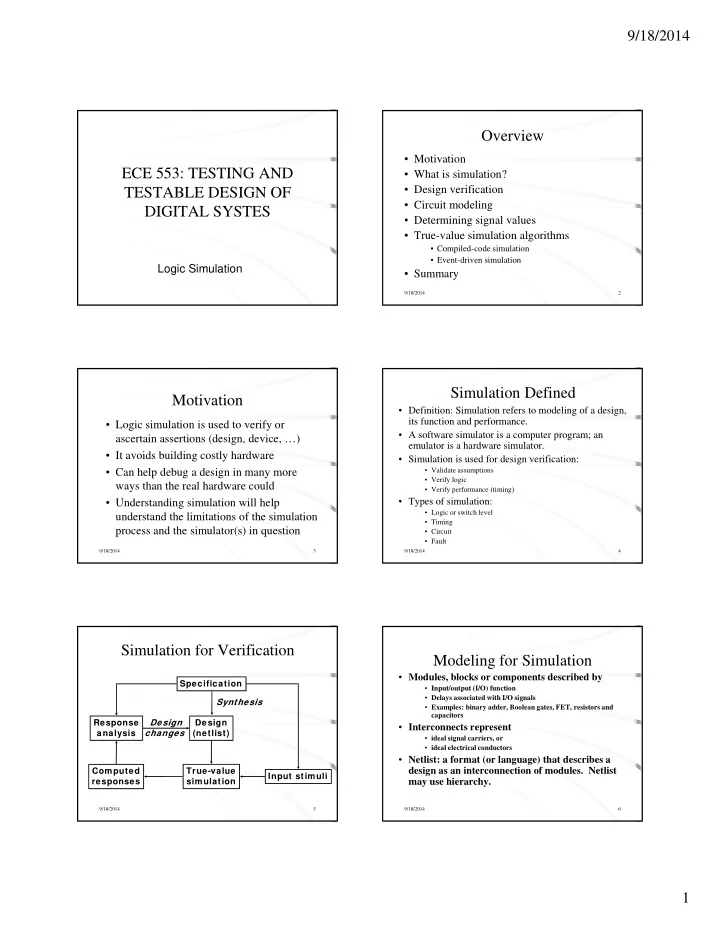

SLIDE 1
9/18/2014 1
ECE 553: TESTING AND TESTABLE DESIGN OF DIGITAL SYSTES DIGITAL SYSTES
Logic Simulation
Overview
- Motivation
- What is simulation?
- Design verification
- Circuit modeling
9/18/2014 2
Circuit modeling
- Determining signal values
- True-value simulation algorithms
- Compiled-code simulation
- Event-driven simulation
- Summary
Motivation
- Logic simulation is used to verify or
ascertain assertions (design, device, …)
- It avoids building costly hardware
9/18/2014 3
- Can help debug a design in many more
ways than the real hardware could
- Understanding simulation will help
understand the limitations of the simulation process and the simulator(s) in question
Simulation Defined
- Definition: Simulation refers to modeling of a design,
its function and performance.
- A software simulator is a computer program; an
emulator is a hardware simulator.
- Simulation is used for design verification:
9/18/2014 4
- Validate assumptions
- Verify logic
- Verify performance (timing)
- Types of simulation:
- Logic or switch level
- Timing
- Circuit
- Fault
Simulation for Verification
Specification Design Response Synthesis Design
9/18/2014 5
True-value simulation Design (netlist) Input stimuli Computed responses Response analysis Design changes
Modeling for Simulation
- Modules, blocks or components described by
- Input/output (I/O) function
- Delays associated with I/O signals
- Examples: binary adder, Boolean gates, FET, resistors and
capacitors
I
9/18/2014 6
- Interconnects represent
- ideal signal carriers, or
- ideal electrical conductors
- Netlist: a format (or language) that describes a