Overview of Presentation - Background on RCUP - Draft RCUP Maps - - PDF document

overview of presentation
SMART_READER_LITE
LIVE PREVIEW

Overview of Presentation - Background on RCUP - Draft RCUP Maps - - PDF document

12/19/2019 Caltrain Rail Corridor Use Policy Peninsula Corridor Joint Powers Board January 9, 2020 2 Overview of Presentation - Background on RCUP - Draft RCUP Maps - Draft Property Use Zones - Draft Service Vision Capital Project


slide-1
SLIDE 1

12/19/2019 1

2

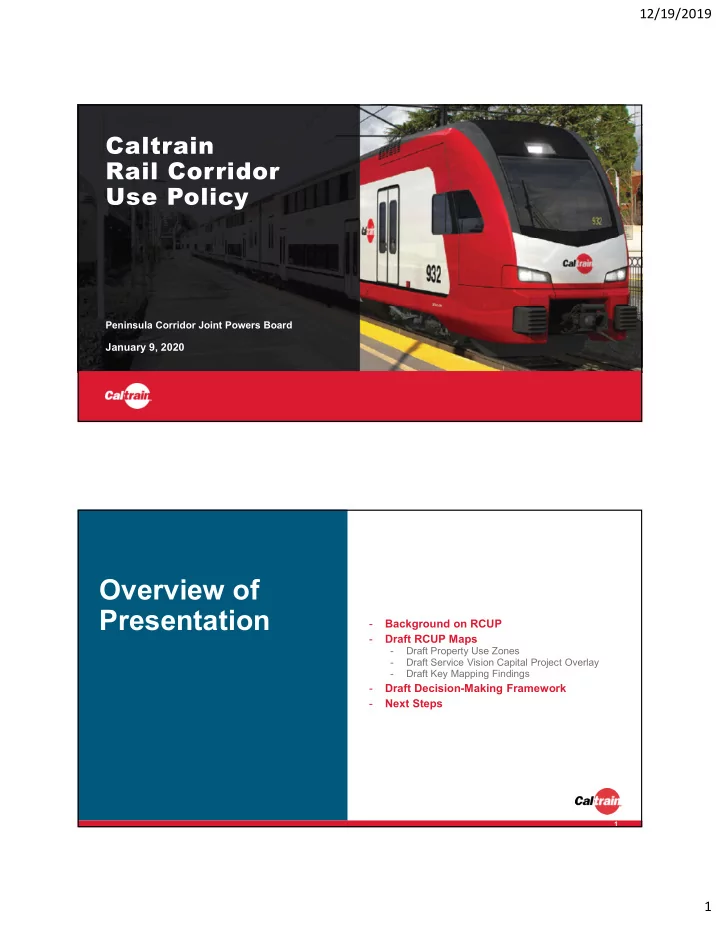
Caltrain Rail Corridor Use Policy

January 9, 2020 Peninsula Corridor Joint Powers Board 2

Overview of Presentation

  • Background on RCUP
  • Draft RCUP Maps
  • Draft Property Use Zones
  • Draft Service Vision Capital Project Overlay
  • Draft Key Mapping Findings
  • Draft Decision-Making Framework
  • Next Steps

2

1

slide-2
SLIDE 2

12/19/2019 2

2

Background and Context

2

2

Why is Caltrain developing the Rail Corridor Use Policy (RCUP)?

3

JPB staff frequently receive requests from third parties to use JPB property for all types

  • f “non-railroad uses,” such as:
  • Utilities
  • Development projects
  • Commercial businesses
  • Access facilities
  • Pop-up events
  • Farmers markets

A Board-adopted policy is needed to check compatibility

  • f proposed uses

and guide use of JPB property to achieve Caltrain’s Adopted Long-Term Service Vision Would the proposed use be compatible with the railroad’s current and future needs?

slide-3
SLIDE 3

12/19/2019 3

2

What will the RCUP contain?

Policy Framework Decision-Making Process Maps

4

  • Provide a Board-adopted policy framework that

supports the delivery of Caltrain’s Long-Term Service Vision while also clarifying nearer-term

  • pportunities for the use of JPB property
  • Develop a process for considering and

approving the range of proposed uses and projects on JPB property

  • Provide transparency on decision-making

process and outcomes

RCUP Objectives

2

RCUP Users and Applications

Primary Users

  • Caltrain staff
  • Joint Powers Board

Example Applications Checking the compatibility of proposed third party uses such as:

  • Proposed revenue-generating land uses of

JPB property, such as:

  • A potential long-term lease for a

joint development project, or

  • A potential commercial lease for a

business.

  • Proposed community land uses on JPB

property, such as:

  • A potential park, or
  • A potential access facility.
  • Other proposed uses of JPB property.

6

slide-4
SLIDE 4

12/19/2019 4

2

Connection to Caltrain’s Long-Term Service Vision

7

2

What are the preliminary conclusions from the RCUP analysis?

8

  • The RCUP analysis shows a

very limited number of sites that could be potential development

  • pportunities without

encroaching on area that is needed for potential future capital projects to support Caltrain’s Long-Term Service Vision.

  • Most of the JPB’s

property is needed for

  • perations and for

potential future capital projects to support delivery of Caltrain’s Long-Term Service Vision.

  • Looking to the future, there

could be additional potential opportunities to integrate development projects with potential future capital projects that support Caltrain’s Long-Term Service Vision.

slide-5
SLIDE 5

12/19/2019 5

2

What are the preliminary conclusions from the RCUP analysis?

9

  • The RCUP analysis shows

7 draft sites that are “other potential opportunity sites” – irregularly shaped, <1.5 acres in size, or have other issues – that could potentially be candidates for development, pending further analysis. The draft

  • ther potential
  • pportunity sites total 6.8

acres.

  • The RCUP analysis shows

2 draft sites that are “high potential opportunity sites” – regularly shaped and >1.5 acres in size – that could be candidates for standard, independent development projects. The draft high potential

  • pportunity sites total 4.8

acres.

  • The RCUP opportunity site

analysis is preliminary – additional real estate analysis is needed through the TOD Policy to refine the number and size

  • f the potential opportunity

sites.

2

Connection to Other Projects

How does the RCUP fit in with Caltrain’s

  • ther planning and policy tools and

documents?

8 ?

slide-6
SLIDE 6

12/19/2019 6

2

Draft RCUP Maps

11

2

RCUP Mapping Process

  • Draft maps have been developed for all

the JPB’s property and operating easements.

  • Two key components to the RCUP maps:
  • Property Use Zones serve as the

base land use districts for JPB property in the RCUP.

  • Service Vision Capital Project

Overlay is an overlay to the Property Use Zones and includes all potential future capital projects on JPB property that support the Business Plan’s service vision.

12

Service Vision Capital Project Overlay Property Use Zones

slide-7
SLIDE 7

12/19/2019 7

2

Property Use Zones

  • Applied to all JPB property on the

Caltrain corridor.

  • Each Property Use Zone has a list of

allowable land uses that could be located within each zone.

13

2

14

Property Use Zone 2: Station Right-of-Way

  • Property located at and near Caltrain

stations; includes facilities that support the functioning of the station.

  • Could include non-railroad land uses that

are compatible with the functioning of the station and safe operation of the railroad.

Note: This is a draft map that is for general information only. Peninsula Corridor Joint Powers Board property lines are approximate and for illustrative purposes

  • nly.

Property Use Zone 1: Operating Right-of-Way

  • Property reserved for the safe operation
  • f the railroad.
  • Generally unavailable for non-railroad

land uses, except compatible utility uses.

slide-8
SLIDE 8

12/19/2019 8

2

15

Property Use Zone 4: Special Study Area

  • Property that is involved in a defined,

complex planning process with multiple stakeholders (currently includes San Francisco and San Jose terminals).

  • Generally unavailable for non-railroad

land uses, except compatible utility uses.

Note: This is a draft map that is for general information only. Peninsula Corridor Joint Powers Board property lines are approximate and for illustrative purposes

  • nly.

Property Use Zone 3: Non-Operating Right-of- Way

  • Property that is not included in Property

Use Zones 1, 2, or 4.

  • Could include non-railroad land uses that

are compatible with the safe operation of the railroad. 2

Service Vision Capital Project Overlay

  • Conceptually represents areas of JPB

property that may be needed for potential future capital projects.

  • Before the start of the potential future

capital project, allowable non-railroad uses will be limited to ensure that the property does not become permanently encumbered.

  • Long-term non-railroad uses – such as a

development project – could be designed to be delivered with or after the construction of the potential future capital project.

16

slide-9
SLIDE 9

12/19/2019 9

2

Methodology for Service Vision Capital Project Overlay

  • Inclusive of all potential future capital

projects that may be needed to support delivery of Caltrain’s Long-Term Service Vision.

  • Deliberately taking a conservative

approach to mapping potential projects.

  • RCUP maps will be updated in the future

as conditions change (e.g., once a future project’s design has been finalized, or

  • nce a project has been delivered).
  • Worked with the Caltrain Business Plan

consultant team and Caltrain Engineering department to determine the dimensions for project “footprints” (including space for both construction and final project).

17

2

Methodology for Service Vision Capital Project Overlay

Service Vision Capital Project Overlay includes the following types of projects:

Near-term future maintenance and rehabilitation projects Potential future changes to facilitate a blended rail system with High Speed Rail Potential future passing tracks to support increased rail service, as described by the Caltrain Business Plan in Moderate and High Growth Scenarios Potential future terminal projects at San Francisco and San Jose Potential future grade separation projects at each current at-grade vehicular crossing Potential future grade separation projects for bikes and pedestrians only

18

1 2 3 4 5 6 1 2 3 4 5 6

slide-10
SLIDE 10

12/19/2019 10

2

Service Vision Capital Project Overlay on RCUP Map

Note: This is a draft map that is for general information only. Peninsula Corridor Joint Powers Board property lines are approximate and for illustrative purposes

  • nly.

19

  • Conceptually represents areas of JPB

property that may be needed for potential future capital projects.

  • Before the start of the potential future

capital project, allowable non-railroad uses will be limited to ensure that the property does not become permanently encumbered.

  • Long-term non-railroad uses – such as a

development project – could be designed to be delivered with or after the construction of the potential future capital project.

Maximum width

  • f remaining

land in Station Right-of-Way

  • utside of

Service Vision Capital Project Overlay is 25 feet.

2

Draft Mapping Results: Key Findings for Service Vision Capital Project Overlay

JPB Property Total Acres Percent of Total Acreage Within the Service Vision Capital Project Overlay 512.5 74% Outside of Service Vision Capital Project Overlay 177.3 26% Total 689.8 100%

Table 2: JPB Property by Service Vision Capital Project Overlay (DRAFT)

Note: These findings are draft and are subject to change.

20

slide-11
SLIDE 11

12/19/2019 11

2

Draft Mapping Results: Key Findings for Service Vision Capital Project Overlay

Table 3: JPB Property Not in Service Vision Capital Project Overlay, by Property Use Zone (DRAFT)

Note: These findings are draft and are subject to change.

Property Use Zone Total Acres Not in Service Vision Capital Project Overlay Percent of Total JPB Acreage

1: Operating ROW 110.1 16% 2: Station ROW 25.1 4% 3: Non-Operating ROW 42.1 6% 4: Special Study Area 0% Total 177.3 26%

  • Station Right-of-Way and Non-Operating

Right-of-Way are the two property use zones that could potentially have other non-railroad uses in them – but, these properties are not necessarily developable.

21

2

Draft Mapping Results: Preliminary Assessment of Potential Opportunity Sites

  • Strategic Economics completed this analysis.
  • Preliminary assessment of potential
  • pportunity sites included:
  • Property in Station Right-of-Way (Property Use

Zone 2) and Non-Operating Right-of-Way (Property Use Zone 3) outside of the Service Vision Capital Project Overlay, across entire corridor.

  • Identified the following types of sites:
  • “High Potential Opportunity Sites”: sites that are

>1.5 acres in size and regularly shaped; could be candidates for standard, independent development projects.

  • “Other Potential Opportunity Sites”: Sites that

are <1.5 acres in size, irregularly shaped, or have other issues and complications; pending further analysis through TOD Policy, could potentially be candidates for development.

  • Results show a limited number of sites that

could be independently developable without encroaching on area within the Service Vision Capital Project Overlay.

22

slide-12
SLIDE 12

12/19/2019 12

2

Much of the JPB’s property outside the Service Vision Capital Project Overlay is in the form of small, narrow sites

28

Example in Brisbane

Maximum width

  • f Non-Operating

Right-of-Way is 75 feet.

Note: This is a draft map that is for general information only. Peninsula Corridor Joint Powers Board property lines are approximate and for illustrative purposes

  • nly.

2

Much of the JPB’s property outside the Service Vision Capital Project Overlay is in the form of small, narrow sites

29

Example in San Bruno

Maximum width

  • f Non-

Operating ROW

  • utside of

Service Vision Capital Project Overlay is 40 feet.

Note: This is a draft map that is for general information only. Peninsula Corridor Joint Powers Board property lines are approximate and for illustrative purposes

  • nly.
slide-13
SLIDE 13

12/19/2019 13

2

Much of the JPB’s property outside the Service Vision Capital Project Overlay is in the form of small, narrow sites

30

Example in Palo Alto

Maximum width

  • f Station

Right-of-Way

  • utside of

Service Vision Capital Project Overlay is 25 feet.

Note: This is a draft map that is for general information only. Peninsula Corridor Joint Powers Board property lines are approximate and for illustrative purposes

  • nly.

2

Draft Potential Opportunity Sites

Location Estimated Site Area (acres) Draft High Potential Opportunity Sites Redwood City Station 1.7 Mountain View Station 3.1 Subtotal 4.8 Draft Other Potential Opportunity Sites Williams Ave & Diana St, SF 1.4 South San Francisco Station 1.3 San Mateo Station 1.1 2nd Avenue, San Mateo 0.3 Hillsdale Station 0.6 Menlo Park Station 1.2 Sunnyvale Station 0.9 Subtotal 6.8 Grand Total 11.6

  • This preliminary assessment is truly

preliminary – sites and actual developable area will be determined with additional real estate analysis through the TOD Policy.

  • This additional “developability” study will

include consideration of additional factors, including site constraints, parking, access needs, relationship to future potential capital projects, etc.

Note: These findings are draft and are subject to change.

Table 4: Preliminary Assessment of Potential Opportunity Sites – Draft and Subject to Future Analysis and Change

23

slide-14
SLIDE 14

12/19/2019 14

2

Draft Mapping Results: Preliminary Assessment of Potential Opportunity Sites

  • RCUP is the first, preliminary step of analysis.
  • TOD Policy process will complete additional

analysis to further refine this list and complete the initial assessment of potential opportunity sites.

  • Will consider additional factors, including site

constraints, need for replacement parking, site “developability,” relationship to future capital projects, product type, access needs, and other factors.

  • Actual developable area of potential
  • pportunity sites will be determined by this

further analysis.

24

2

High Potential Opportunity Site: Redwood City

33

Redwood City Station

  • Site is currently used for station access (bus

pick-up/drop-off and car parking)

  • 1.7 acres in Station Right-of-Way remaining

after Service Vision Capital Project Overlay

  • JPB’s potential future development to be

discussed in conjunction with potential future facilities for Caltrain, Dumbarton, Samtrans, City of Redwood City, etc.

Note: This is a draft map that is for general information only. Peninsula Corridor Joint Powers Board property lines are approximate and for illustrative purposes

  • nly.
slide-15
SLIDE 15

12/19/2019 15

2

High Potential Opportunity Site: Mountain View*

34

Mountain View Station

  • Site is currently used for station access (car

parking and pick-up/drop-off)

  • 3.1 acres remaining in Station Right-of-Way

after Service Vision Capital Project Overlay

  • JPB’s potential future development to be

discussed in conjunction with potential future plans for City of Mountain View, VTA, etc. *Part of the site is encumbered by an easement with VTA

Note: This is a draft map that is for general information only. Peninsula Corridor Joint Powers Board property lines are approximate and for illustrative purposes

  • nly.

2

Draft Mapping Results: Preliminary Conclusions

  • Most of the JPB’s property is needed for
  • perations and for potential future capital

projects to support delivery of the Long-Term Service Vision.

  • Of the limited areas that are outside of the

Service Vision Capital Project Overlay, most of the sites are small and narrow.

  • At this time, only 2 sites are considered to be

“High Potential Opportunity Sites,” but there may be more sites that are potentially developable (all or in part).

  • This analysis is preliminary and is subject to

further analysis by TOD Policy process. Preliminary results must be studied further to better understand actual developable area on Caltrain corridor.

  • There may be additional opportunities for

potential development projects that could be integrated with potential future capital projects.

25

slide-16
SLIDE 16

12/19/2019 16

2

TOD Policy Connection to RCUP Findings

26

2

Caltrain has a unique corridor

25

  • Legacy corridor:
  • Trains have been operating at the

corridor since 1883

  • Parking lots are much smaller than

those built in 1980s by other transit agencies

  • Dynamic corridor:
  • Business Plan envisions substantially

different service patterns than exist today, requiring many infrastructure improvements

slide-17
SLIDE 17

12/19/2019 17

2

Preliminary Opportunity Sites Reflect Caltrain’s Uniqueness

25

  • RCUP identified only two “typical sites:”
  • Mountain View
  • Redwood City
  • The remaining sites identified by RCUP are

not typical of development sites owned by

  • ther agencies
  • Generally smaller and less deep,
  • Not independently developable, and/or
  • Encumbered with other interests.

Draft Other Potential Opportunity Sites

Site Draft Acreage from RCUP Analysis Preliminary Real Estate Assessment Notes** Williams Avenue & Diana St., San Francisco 1.4 Site occupied with community garden and over tunnel South San Francisco Station 1.3 Most of site is under 101 and it is not independently developable San Mateo Station 1.1 Subject to long term lease with City

  • f San Mateo

2nd Avenue, San Mateo 0.3 Great location, very small site Hillsdale Station 0.6 Not independently developable Menlo Park Station 1.2 Very narrow, includes many parking spaces and is a historical station site Sunnyvale Station 0.9 Used as the station’s primary access point, shuttles and parking ** Note that these are potential sites; all sites will be subject to further study and analysis before JPB contemplates any potential joint development project.

2

TOD Policy will be responsive to the potential opportunity site inventory.

TOD Policy needs to be flexible.

  • Uniqueness requires that TOD

Policy must be flexible to address various types of potential development sites.

  • Example: If a site is too

small, a land lease is not feasible:

  • Policy needs to be flexible

enough to allow sale of sites under certain conditions such.

As staff continues to work with the Board on the TOD Policy, we will need to:

  • Be creative
  • Build relationships with

potential partners if sites are not independently developable

  • Find creative deal structures
  • Continue to analyze right-of-

way to find more potential sites

As capital projects are planned, there may be

  • pportunities to integrate

development projects.

  • Objectives of the capital project

would dictate the size, location and timing.

  • Real estate objectives would

be secondary.

  • Opportunities for such projects

will be identified through the planning process for each capital project.
slide-18
SLIDE 18

12/19/2019 18

2

Draft RCUP Decision-Making Framework

26

2

Background and Context

  • JPB staff frequently receive requests

from third parties to use JPB property for all types of “non-railroad uses,” such as:

  • Utilities
  • Commercial businesses
  • Access facilities
  • Development projects
  • Pop-up events
  • Farmers markets
  • For approved third party uses, the JPB will

issue an appropriate Property Access Agreement to the third party:

  • Depending on use, Property Access

Agreement could be a license agreement, right-of-entry permit agreement, service agreement, encroachment permit, lease agreement, or easement agreement.

27

slide-19
SLIDE 19

12/19/2019 19

2

Current Approval Process for Proposed Uses

28

JPB Resolution No. 2010-45 - Policy of Property Conveyance contains policies and procedures for granting Property Access Agreements.

<5 >5

Years on JPB Property:

Staff approval needed

Years on JPB Property:

Staff approval needed Board approval needed

Compatibility

Staff approval process for proposed uses involves ensuring compatibility with:

  • Current and potential future railroad needs
  • Caltrain Engineering Standards
  • CPUC regulations
  • State and federal regulations

2

Proposed Role of RCUP in Approval Process

29

JPB Resolution No. 2010-45 - Policy of Property Conveyance contains policies and procedures for granting Property Access Agreements.

<5 >5

Years on JPB Property:

Staff approval needed

Years on JPB Property:

Staff approval needed Board approval needed

Compatibility

Staff approval process for proposed uses involves ensuring compatibility with:

  • Current and potential future railroad needs

– using Rail Corridor Use Policy maps and administrative document

  • Caltrain Engineering Standards
  • CPUC regulations
  • State and federal regulations
slide-20
SLIDE 20

12/19/2019 20

2

RCUP Decision- Making Framework Overview

30

Purpose:

  • Provide a Board-adopted, clear,

transparent decision-making process to determine the compatibility of proposed third party uses with current and future railroad needs of JPB property.

  • Will be contained within an administrative

document that accompanies the RCUP maps.

  • Board will adopt a high-level decision-

making framework. A detailed, step-by- step guide will be developed for staff based on Board’s adopted decision- making framework, along with public- facing information and forms for proposed non-railroad uses. 2

RCUP Decision-Making Framework Overview

Decision-making framework will utilize:

Definitions

31

  • f Property Use Zones

and Service Vision Capital Project Overlay.

Allowable Uses

List of “allowable uses” that defines the range of uses that could be compatible with the railroad’s needs in each zone.

Process

to review, evaluate, and approve/reject proposed uses of JPB property, which will include:

  • Directions on how and when to reference

the RCUP maps;

  • Instructions on when to refer to and use

the TOD Policy and the Station Management Toolbox in the process; and,

  • Identification of which land use decisions

can be made by staff, and which should be made by the Board.

slide-21
SLIDE 21

12/19/2019 21

2

Location Allowable Use Determination Yes

  • Additional Analysis

(as needed)

  • Broader Approval Process

No

  • Notify Applicant
  • May Apply for Use

Variance that Requires Board Approval

Approval process begins by checking compatibility with current and future railroad needs using the RCUP.

Check Compatibility

32

RCUP Decision-Making Process for a Proposed Third-Party Use

2

Process to Update the RCUP

  • The RCUP is intended to be a “living”

document and to have the maps periodically updated.

  • Example circumstances for updating the

maps:

  • Completion of the Electrification Project –

Update Operating ROW (Property Use Zone 1) to ensure it includes all PCEP infrastructure within its borders.

  • Decision by a City Council for a preferred

alignment for a potential future grade separation project: Update the Service Vision Capital Project Overlay to include the new footprint of the potential project.

33

slide-22
SLIDE 22

12/19/2019 22

2

Next Steps

34

2

Upcoming Tasks and Board Updates

Ongoing Technical Work

  • RCUP:
  • Developing decision-making framework for

staff and public-facing materials.

  • TOD Policy:
  • Developing policy framework
  • Propose policy adoption in early 2020

Upcoming Board Updates on RCUP

  • January 2020: Propose Board adoption
  • f RCUP

35

slide-23
SLIDE 23

12/19/2019 23

2

Thank you!