our Skin Andrew McBain The University of Manchester 1 The - - PDF document

our skin
SMART_READER_LITE
LIVE PREVIEW

our Skin Andrew McBain The University of Manchester 1 The - - PDF document

31/10/19 Understanding the Microorganisms that Live on our Skin Andrew McBain The University of Manchester 1 The Microbial World 10 29 microbial cells on earth 10 19 insects on earth 10 14* microbial cells per human 10 13 human cells per human


slide-1
SLIDE 1

31/10/19 1

1

Understanding the Microorganisms that Live on

  • ur Skin

Andrew McBain

The University of Manchester

2
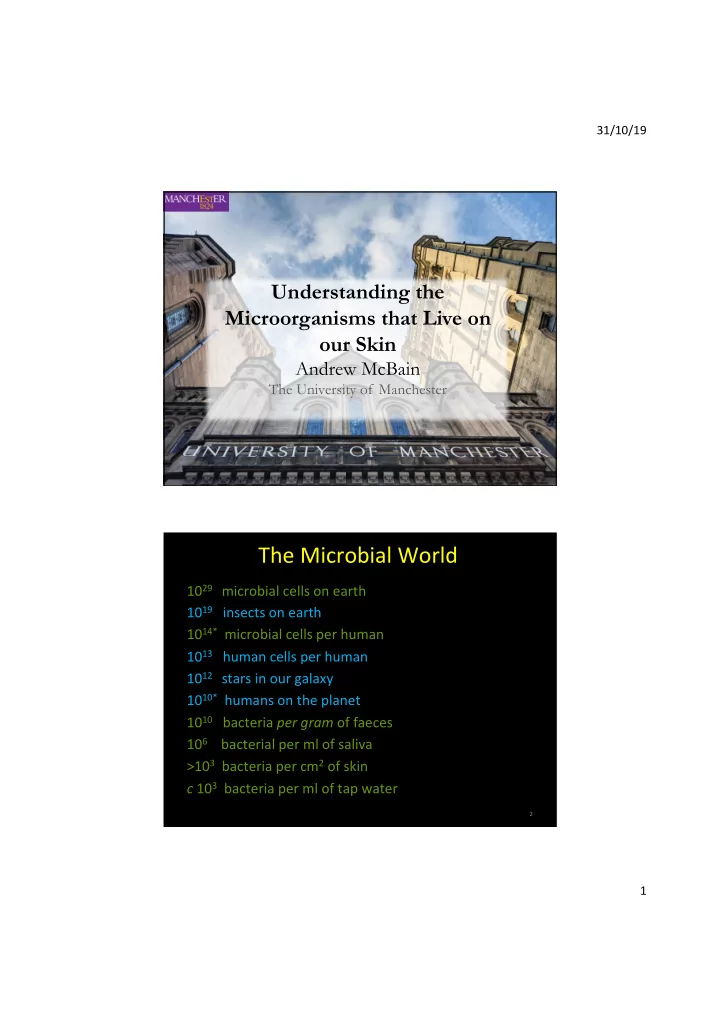
The Microbial World

1029 microbial cells on earth 1019 insects on earth 1014* microbial cells per human 1013 human cells per human 1012 stars in our galaxy 1010* humans on the planet 1010 bacteria per gram of faeces 106 bacterial per ml of saliva >103 bacteria per cm2 of skin c 103 bacteria per ml of tap water

slide-2
SLIDE 2

31/10/19 2

3

The Human Microbiome

Many (if not most) bacteria that associate with mammals do so as (mostly) sessile microbial communities

  • Oral
  • Nasal
  • Skin
  • Genitourinary
  • Intestinal

Microflora / Microbiota / Microbiome

4

The traditional method

slide-3
SLIDE 3

31/10/19 3

5

The microbiota- traditional view

Microbial inhabitants of humans. Michael Wilson Cambridge University Press, 2005.

6

Next generation sequencing

slide-4
SLIDE 4

31/10/19 4

  • The composition of the microbiome varies by anatomical

site

  • The primary determinant of community composition is

anatomical location:

  • Interpersonal variation is substantial and is higher than

the temporal variability seen at most sites in a single individual.

  • Minor perturbations such as dietary changes can rapidly

cause substantial intestinal metagenomic changes

  • Nasopharyngeal microbiota in children varies

seasonally

  • Vaginal microbiota varies with menses
  • Oral microbiota varies with hygiene/diet
  • Microbiota composition is extensively conserved at high

taxonomic levels

  • Variation increases at lower taxonomic levels
  • 85% of the sequences obtained from the distal gut of the

mouse represent genera that are not detected in humans

7

Cho and Blaser (2012) The Human Microbiome: at the interface of health and disease. Nat Rev Genet 13(4): 260–270

The microbiome- current view

8

slide-5
SLIDE 5

31/10/19 5

9

The colonic microbiota- very heavily studied

  • Ancient origins of symbiosis
  • c 1014 bacteria in the human gut

i.e. 100,000000,000000

  • Colonisation begins at birth
  • Stable dominant biota
  • Chemotherapeutic agents disrupt balance of

biota

  • Microbiota involved in drug metabolism
  • A metabolic organ

What is known about gut microbiota?

Thanks to George Macfarlane

10

Microbial gas metabolism in the colon

Carbohydrate VFA/SCFA Fermentation H2 CO2 Excretion (breath)/flatus

S u l p h a t e r e d u c i n g b a c t e r i a

H2S SO4

2-

CH3COOH

Acetogenic bacteria Methanogenic bacteria

CH4

slide-6
SLIDE 6

31/10/19 6

11

Bacteria living on the skin The Skin Microbiome

slide-7
SLIDE 7

31/10/19 7

Topographical distribution of bacteria on skin sites

Grice and Segre, 2011

slide-8
SLIDE 8

31/10/19 8

Factors contributing to variation in the skin microbiome

Grice and Segre, 2011

Functions

Positive Negative Colonisation resistance Infection Immune modulation Implicated in a range of skin diseases Metabolism Metabolism Protection Barrier augmentation

slide-9
SLIDE 9

31/10/19 9

Bouslimani et al., 2014

Mapping the skin

Bouslimani et al., 2014

Mapping the skin

slide-10
SLIDE 10

31/10/19 10

What about aging?

Here, we developed a method of predicting biological age of the host based on the microbiological profiles of gut microbiota using a curated dataset of 1,165 healthy individuals (3,663 microbiome samples). Our predictive model, a human microbiome clock, has an architecture of a deep neural network and achieves the accuracy of 3.94 years mean absolute error in cross-validation

slide-11
SLIDE 11

31/10/19 11

Dimitriu et al., 2019

Aging and the skin microbiome

slide-12
SLIDE 12

31/10/19 12

slide-13
SLIDE 13

31/10/19 13

Microbiome challenges and

  • pportunities
  • Over-interpretation of data
  • Linking composition to function (e.g. what is

dysbiosis?)

  • Understanding disease
  • Understanding health*
  • Manipulation for health benefits

25