
SLIDE 1
Our Moral Origins
Part 1/3
Objects Depth Number Geometry
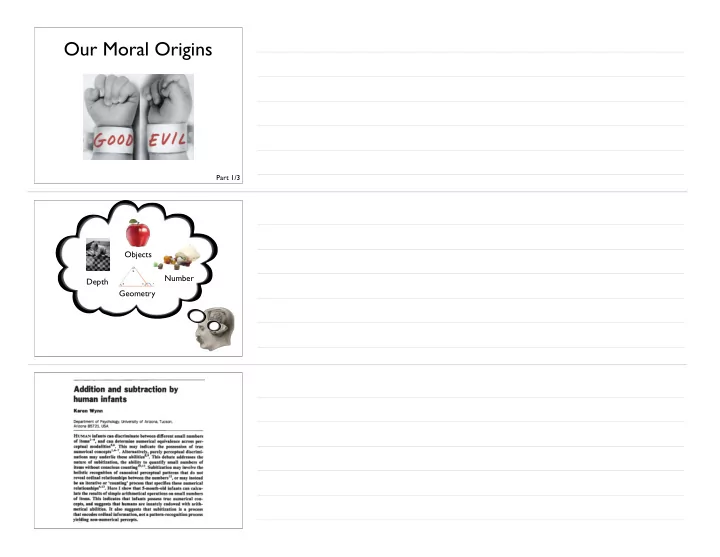
Our Moral Origins Part 1/3 Objects Number Depth Geometry - - PowerPoint PPT Presentation
Our Moral Origins Part 1/3 Objects Number Depth Geometry Objects Number Depth Geometry Other Minds? Knowledge Intention Morality Theory of Mind Egocentricism Three Mountains Task Mean Monkey Task False Belief Task
Part 1/3
Objects Depth Number Geometry
Objects Depth Number Geometry
Other Minds?
Knowledge Intention Morality
Up next: Part 2/3
Part 2/3
Looking Time (s)
6 12 18 24 30 “Believed” Location True Location
(Onishi & Baillargeon, 2005)
that’s what I expected…
no way!
Looking Time (s)
6 12 18 24 30 “Believed” Location True Location
(Onishi & Baillargeon, 2005)
Infants know that others have minds, and that those minds can be different from their own!
Preference (%)
16 32 48 64 80 French Infants American Infants French English
10-month old Toy Choices
Up next: Part 3/3
Part 3/3
major sexual orientation ethnic background view on abortion
Greg Johnson
(of Texas vs. Johnson)
Harm Fairness Group Loyalty Authority Purity
Harm Fairness Group Loyalty Authority Purity
Group Loyalty Authority
“independent-minded and relates to its owner as a friend and equal” “extremely loyal to its home and family, and doesn’t warm up quickly to strangers”
A woman is cleaning out her closet, and she finds her old American flag. She doesn't want the flag anymore, so she cuts it up into pieces and uses the rags to clean her bathroom.
Can there be “victimless crimes”?
Haidt et al. (1993)
25 50 75 100 OK Not OK
A woman was dying, and on her deathbed she asked her son to promise that he would visit her grave every week. The son loved his mother very much, so he promised to visit her grave every
keep his promise, because he was very busy.
Can there be “victimless crimes”?
Haidt et al. (1993)
25 50 75 100 OK Not OK
Can there be “victimless crimes”?
A family's dog was killed by a car in front of their
so they cut up the dog's body and cooked it and ate it for dinner.
Haidt et al. (1993)
25 50 75 100 OK Not OK
A brother and sister like to kiss each other on the
hiding place and kiss each other on the mouth, passionately.
Can there be “victimless crimes”?
Haidt et al. (1993)
25 50 75 100 OK Not OK
The trolley problem
The trolley problem
rules and obligations
“the greatest good for the greatest number”