Moral Hazard and Efficiency J. Parman (College of William & - - PowerPoint PPT Presentation

moral hazard and efficiency
SMART_READER_LITE
LIVE PREVIEW

Moral Hazard and Efficiency J. Parman (College of William & - - PowerPoint PPT Presentation

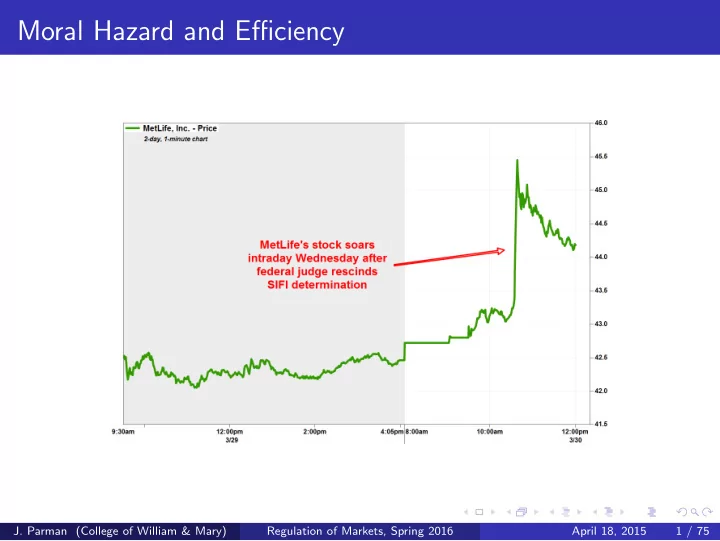
Moral Hazard and Efficiency J. Parman (College of William & Mary) Regulation of Markets, Spring 2016 April 18, 2015 1 / 75 Moral Hazard and Efficiency The notion of moral hazard leading to inefficiency in workplace safety gives us a nice

slide-1
SLIDE 1

Moral Hazard and Efficiency

  • J. Parman (College of William & Mary)

Regulation of Markets, Spring 2016 April 18, 2015 1 / 75

slide-2
SLIDE 2

Moral Hazard and Efficiency

The notion of moral hazard leading to inefficiency in workplace safety gives us a nice segue into financial regulation One of the main issues people have worried about recently is the possibility of financial institutions taking excessive risk Consider the concerns over the notion of ’too big to fail’

  • J. Parman (College of William & Mary)

Regulation of Markets, Spring 2016 April 18, 2015 2 / 75

slide-3
SLIDE 3

Moral Hazard and Efficiency

  • J. Parman (College of William & Mary)

Regulation of Markets, Spring 2016 April 18, 2015 3 / 75

slide-4
SLIDE 4

Moral Hazard and Efficiency

  • J. Parman (College of William & Mary)

Regulation of Markets, Spring 2016 April 18, 2015 4 / 75

slide-5
SLIDE 5

Moral Hazard and Efficiency

  • J. Parman (College of William & Mary)

Regulation of Markets, Spring 2016 April 18, 2015 5 / 75

slide-6
SLIDE 6

Moral Hazard and Efficiency

  • J. Parman (College of William & Mary)

Regulation of Markets, Spring 2016 April 18, 2015 6 / 75

slide-7
SLIDE 7

Moral Hazard and Efficiency

  • J. Parman (College of William & Mary)

Regulation of Markets, Spring 2016 April 18, 2015 7 / 75

slide-8
SLIDE 8

Moral Hazard and Efficiency

So if a firm thinks it will be deemed too big to fail, it will take on inefficiently risky assets This is a standard moral hazard problem that arises when agents are insulated from risk It’s not the only efficiency issue with too big to fail First, there are social benefits from financial sector stability (think of our externality discussions) Also there may be economies of scale (think of our natural monopoly discussions) But there are also other social costs (more highly correlated risk in the system)

  • J. Parman (College of William & Mary)

Regulation of Markets, Spring 2016 April 18, 2015 8 / 75

slide-9
SLIDE 9

Why Regulate Financial Markets?

  • J. Parman (College of William & Mary)

Regulation of Markets, Spring 2016 April 18, 2015 9 / 75

slide-10
SLIDE 10

Why Regulate Financial Markets?

We certainly regulate what Madoff did, this is why Madoff has a 150-year sentence (his lawyers asked for 7) We have a complicated set of regulations specifying accounting standards, what needs to be reported to investors, what information can be used for trading, and so on However, to a large extent these regulations are about fairness Are there any issues of efficiency in play? Without MB and MC on units of output, need a slightly different notion of efficiency

  • J. Parman (College of William & Mary)

Regulation of Markets, Spring 2016 April 18, 2015 10 / 75

slide-11
SLIDE 11

Why Regulate Financial Markets?

$36 billion was invested with Madoff $18 billion was returned to investors, $18 billion was not Over half of Madoff’s investors were net winners According to Madoff’s cooked account numbers, $57 billion was owed to investors So what is the loss to society here, the ∆TS? Is it the $18 billion unreturned? The theoretical $57 billion minus the $18 billion returned? Is it zero?

  • J. Parman (College of William & Mary)

Regulation of Markets, Spring 2016 April 18, 2015 11 / 75

slide-12
SLIDE 12

Why Regulate Financial Markets?

Hewlett-Packard stock price relative to electronic technology sector, 2008-2013 http://www.youtube.com/watch?v=Wo Ejfc5hW8

  • J. Parman (College of William & Mary)

Regulation of Markets, Spring 2016 April 18, 2015 12 / 75

slide-13
SLIDE 13

Why Regulate Financial Markets?

Apple stock price relative to electronic technology sector, 2008-2013

  • J. Parman (College of William & Mary)

Regulation of Markets, Spring 2016 April 18, 2015 13 / 75

slide-14
SLIDE 14

Why Regulate Financial Markets?

American Airlines stock price relative to transportation sector, 2008-2013

  • J. Parman (College of William & Mary)

Regulation of Markets, Spring 2016 April 18, 2015 14 / 75

slide-15
SLIDE 15

Why Regulate Financial Markets?

Delta Airlines stock price relative to transportation sector, 2008-2013

  • J. Parman (College of William & Mary)

Regulation of Markets, Spring 2016 April 18, 2015 15 / 75

slide-16
SLIDE 16

Why Regulate Financial Markets?

The big economic value of financial markets is getting financial capital to the firms that need it Given that there is a finite amount of financial capital

  • ut there, we want it to go to where it will be put to

best use In theory, financial markets help do that for us Another thing markets accomplish for society in terms

  • f efficiency is solving an issue of timing
  • J. Parman (College of William & Mary)

Regulation of Markets, Spring 2016 April 18, 2015 16 / 75

slide-17
SLIDE 17

Why Regulate Financial Markets?

  • J. Parman (College of William & Mary)

Regulation of Markets, Spring 2016 April 18, 2015 17 / 75

slide-18
SLIDE 18

Why Regulate Financial Markets?

STATE AID DEADLINES

FAFSA

SM

FREE APPLICATION for FEDERAL STUDENT AID

July 1, 2013 – June 30, 2014

Federal Student Aid logo and FAFSA are service marks or registered service marks of Federal Student Aid, U.S. Department of Education.

Use this form to apply free for federal and state student grants, work-study and loans. Or apply free online at www.fafsa.gov.

Applying by the Deadlines For federal aid, submit your application as early as possible, but no earlier than January 1, 2013. We must receive your application no later than June 30, 2014. Your college must have your correct, complete information by your last day of enrollment in the 2013-2014 school year. For state or college aid, the deadline may be as early as January 2013. See the table to the right for state deadlines. You may also need to complete additional forms. Check with your high school guidance counselor or a fjnancial aid administrator at your college about state and college sources of student aid and deadlines. If you are fjling close to one of these deadlines, we recommend you fjle online at www.fafsa.gov. This is the fastest and easiest way to apply for aid.

APPLICATION DEADLINES Federal Aid Deadline - June 30, 2014 State Aid Deadlines - See below. Pay attention to the symbols that may be listed after your state deadline. # For priority consideration, submit application by date specifjed. + Applicants encouraged to obtain proof of mailing. * Additional form may be required. Check with your fjnancial aid administrator for these states and territories: AL, AS *, AZ, CO, FM *, GA, GU *, HI *, MH *, MP *, NE, NM, NV *, PR, PW *, SD *, TX, UT, VA *, VI *, WI and WY *. AK AK Education Grant and AK Performance Scholarship - June 30, 2013 (date received) AR Academic Challenge - June 1, 2013 (date received) Workforce Grant - Contact the fjnancial aid offjce. Higher Education Opportunity Grant - June 1, 2013 (date received) CA Initial awards - March 2, 2013 + * Additional community college awards - September 2, 2013 (date postmarked) + * CT February 15, 2013 (date received) # * DC May 31, 2013 (date received) * For priority consideration, submit application by April 30, 2013. DE April 15, 2013 (date received) FL May 15, 2013 (date processed) IA July 1, 2013 (date received); earlier priority deadlines may exist for certain programs. * ID Opportunity Grant - March 1, 2013 (date received) # * IL As soon as possible after January 1, 2013. Awards made until funds are depleted. IN March 10, 2013 (date received) KS April 1, 2013 (date received) # * KY As soon as possible after January 1, 2013. Awards made until funds are depleted. LA June 30, 2014 (July 1, 2013 highly recommended) MA May 1, 2013 (date received) # MD March 1, 2013 (date received) ME May 1, 2013 (date received) MI March 1, 2013 (date received) MN 30 days after term starts (date received) MO April 1, 2013 (date received) MS MTAG and MESG Grants - September 15, 2013 (date received) HELP Scholarship - March 31, 2013 (date received) MT March 1, 2013 (date received) # NC As soon as possible after January 1, 2013. Awards made until funds are depleted. ND April 15, 2013 (date received) # Early priority deadlines may exist for institutional programs. NH NH is not ofgering a state grant this year. NJ 2012-2013 Tuition Aid Grant recipients - June 1, 2013 (date received) All other applicants

  • October 1, 2013, fall & spring terms (date received)
  • March 1, 2014, spring term only (date received)

NY June 30, 2014 (date received) * OH October 1, 2013 (date received) OK March 1, 2013 (date received) # OR OSAC Private Scholarships - March 1, 2013 (date received) Oregon Opportunity Grant - February 1, 2013 (date received) PA All fjrst-time applicants at a community college; a business/ trade/technical school; a hospital school of nursing; or enrolled in a non-transferable two-year program - August 1, 2013 (date received) All other applicants - May 1, 2013 (date received) RI March 1, 2013 (date received) # SC Tuition Grants - June 30, 2013 (date received) SC Commission on Higher Education - As soon as possible after January 1, 2013. Awards made until funds are depleted. TN State Grant - As soon as possible after January 1, 2013. Awards made until funds are depleted. State Lottery - September 1, 2013 (date received) # VT As soon as possible after January 1, 2013. Awards made until funds are depleted. * WA As soon as possible after January 1, 2013. Awards made until funds are depleted. WV Promise Scholarship - March 1, 2013 (date received) # * WV Higher Education Grant Program - April 15, 2013 (date received #

Using Your Tax Return If you (or your parents) need to fjle a 2012 income tax return with the Internal Revenue Service (IRS), we recommend that you complete it before fjlling out the FAFSA. If you have not completed your return yet, you can submit your FAFSA now using estimated tax information, and then correct that information after you fjle your return. The easiest way to complete or correct your FAFSA with accurate tax information is by using the IRS Data Retrieval Tool through www.fafsa.gov. In a few simple steps, you may be able to view your tax return information and transfer it directly into your FAFSA. Filling Out the FAFSA

SM

If you or your family has unusual circumstances that might afgect your fjnancial situation (such as loss of employment), complete this form to the extent you can, then submit it as instructed and consult with the fjnancial aid offjce at the college you plan to attend. For help in fjlling out the FAFSA, go to www.studentaid.gov/completefafsa or call 1-800-4-FED-AID (1-800-433-3243). TTY users (for the hearing impaired) may call 1-800-730-8913. Fill the answer fjelds directly on your screen or print the form and complete it by hand. Your answers will be read electronically; therefore if you complete the form by hand:

  • use black ink and fjll in circles completely:
  • print clearly in CAPITAL letters and skip a

box between words:

  • report dollar amounts (such as $12,356.41)

like this: Green is for student information and purple is for parent information. Correct Incorrect x √

1 5 E L M S T $ 1 2 3 5 6 no cents ,

Mailing Your FAFSA

SM

After you complete this application, make a copy of pages 3 through 8 for your

  • records. Then mail the original of pages 3 through 8 to:

Federal Student Aid Programs, P.O. Box 7002, Mt. Vernon, IL 62864-0072. After your application is processed, you will receive a summary of your information in your Student Aid Report (SAR). If you provide an e-mail address, your SAR will be sent by e-mail within 3-5 days. If you do not provide an e-mail address, your SAR will be mailed to you within three weeks. If you would like to check the status of your FAFSA, go to www.fafsa.gov or call 1-800-4-FED-AID. Let’s Get Started! Now go to page 3 of the application form and begin filling it out. Refer to the notes as instructed.

  • J. Parman (College of William & Mary)

Regulation of Markets, Spring 2016 April 18, 2015 18 / 75

slide-19
SLIDE 19

Why Regulate Financial Markets?

Britain, 1700 United States, 2010 Nominal annual earnings £12 $28,900 Cost of Atlantic passage £10

  • Four years of tuition and fees
  • $86,628

Ratio of debt to annual earnings 0.83 3.00 Credit constraints then and now

Notes: Annual income for US is the average of male and female median full-time earnings for 25- 34 year old high school grads. Tuition and fees is based on all 4-year institutions.

  • J. Parman (College of William & Mary)

Regulation of Markets, Spring 2016 April 18, 2015 19 / 75

slide-20
SLIDE 20

Why Regulate Financial Markets?

So financial markets have an important role in generating net gains for society They are a solution to intertemporal credit constraints They can get investments to the firms that will make best use of them However, maximizing those gains depends on a few of key things:

Fully informed investors No insider trading, cronyism Few frictions in terms of completing transactions The existence of these markets in the first place

There is a long history of regulation to both promote and reign in financial markets

  • J. Parman (College of William & Mary)

Regulation of Markets, Spring 2016 April 18, 2015 20 / 75

slide-21
SLIDE 21

The Foundations of Financial Regulation

  • J. Parman (College of William & Mary)

Regulation of Markets, Spring 2016 April 18, 2015 21 / 75

slide-22
SLIDE 22

The Foundations of Financial Regulation

  • J. Parman (College of William & Mary)

Regulation of Markets, Spring 2016 April 18, 2015 22 / 75

slide-23
SLIDE 23

The Foundations of Financial Regulation

The Congress shall have power to lay and collect taxes, duties, imposts and excises, to pay the debts and provide for the common defense and general welfare of the United States; but all duties, imposts and excises shall be uniform throughout the United States; ... To borrow money on the credit of the United States; ... To regulate commerce with foreign nations, and among the several states, and with the Indian tribes; ... To coin money, regulate the value thereof, and of foreign coin, and fix the standard of weights and measures; ... To provide for the punishment of counterfeiting the securities and current coin of the United States;

  • J. Parman (College of William & Mary)

Regulation of Markets, Spring 2016 April 18, 2015 23 / 75

slide-24
SLIDE 24

The Foundations of Financial Regulation

No state shall enter into any treaty, alliance, or confederation; grant letters of marque and reprisal; coin money; emit bills of credit; make anything but gold and silver coin a tender in payment of debts; pass any bill of attainder, ex post facto law, or law impairing the obligation

  • f contracts, or grant any title of nobility.
  • J. Parman (College of William & Mary)

Regulation of Markets, Spring 2016 April 18, 2015 24 / 75

slide-25
SLIDE 25

Timeline of Banking Before the Civil War

1600 1800 600 800 1000 1200 1400 Number of banks

First Bank Second Bank

200 400 1782 1786 1790 1794 1798 1802 1806 1810 1814 1818 1822 1826 1830 1834 1838 1842 1846 1850 1854 1858 N

Free Banking

  • J. Parman (College of William & Mary)

Regulation of Markets, Spring 2016 April 18, 2015 25 / 75

slide-26
SLIDE 26

The First and Second Bank of the United States

The three main advantages of a national bank, according to Hamilton: “First. The augmentation of the active or productive capital

  • f a country...Secondly–Greater facility to the Government in
  • btaining pecuniary aids, especially in sudden

emergencies...Thirdly–The facilitating of the payment of taxes.”

  • J. Parman (College of William & Mary)

Regulation of Markets, Spring 2016 April 18, 2015 26 / 75

slide-27
SLIDE 27

The First and Second Bank of the United States

First Bank of the United States Second Bank of the United States $2 million from government $7 million from government $8 million from private investors $28 million from private investors 1791 1816 1811 1836 Hamilton argues 'implied powers' Supreme Court confirms 'implied powers' Year Chartered Initial Seed Capital Year Closed Precendents

  • J. Parman (College of William & Mary)

Regulation of Markets, Spring 2016 April 18, 2015 27 / 75

slide-28
SLIDE 28

The First and Second Bank of the United States

Lithograph by Edward W. Clay, http://commons.wikimedia.org/wiki/File:1832bank1.jpg

  • J. Parman (College of William & Mary)

Regulation of Markets, Spring 2016 April 18, 2015 28 / 75

slide-29
SLIDE 29

Timeline of Banking Before the Civil War

1600 1800 600 800 1000 1200 1400 Number of banks

First Bank Second Bank

200 400 1782 1786 1790 1794 1798 1802 1806 1810 1814 1818 1822 1826 1830 1834 1838 1842 1846 1850 1854 1858 N

Free Banking

  • J. Parman (College of William & Mary)

Regulation of Markets, Spring 2016 April 18, 2015 29 / 75

slide-30
SLIDE 30

State Chartered Banking Before the Civil War

State chartered banks formed the bulk of the financial sector and were critical to the development of the economy The banks connected borrowers and savers The banks also effectively increased the money supply through fractional reserve banking Fractional reserve banking has its problems, namely bank runs Compounding the unavoidable issues of bank runs were shady banking practices, partially a product of lack of regulatory oversight

  • J. Parman (College of William & Mary)

Regulation of Markets, Spring 2016 April 18, 2015 30 / 75

slide-31
SLIDE 31

Wildcat Banks

  • J. Parman (College of William & Mary)

Regulation of Markets, Spring 2016 April 18, 2015 31 / 75

slide-32
SLIDE 32

Losses From Free Banking

  • J. Parman (College of William & Mary)

Regulation of Markets, Spring 2016 April 18, 2015 32 / 75

slide-33
SLIDE 33

Losses From Free Banking in Context

Noteholder Losses under Free Banking $1,851,600 Nominal GDP (1860) $4,350,000,000 Noteholder Losses as a % of GDP 0.04% Outstanding Subprime Loans $1,344,000,000,000 Nominal GDP (2007) $13,807,500,000,000 Subprime Loans as a % of GDP 9.73% The Impact of Free Banking Losses

  • J. Parman (College of William & Mary)

Regulation of Markets, Spring 2016 April 18, 2015 33 / 75

slide-34
SLIDE 34

Banking and Finance in the 19th Century

So there were some shady banking practices in the 19th century There were also a handful of panics However, there was also a lot of economic growth made possible by banks despite a lack of strict federal and state oversight A big role for government actually emerged in the form

  • f bond markets
  • J. Parman (College of William & Mary)

Regulation of Markets, Spring 2016 April 18, 2015 34 / 75

slide-35
SLIDE 35

Banking and Finance in the 19th Century

  • J. Parman (College of William & Mary)

Regulation of Markets, Spring 2016 April 18, 2015 35 / 75

slide-36
SLIDE 36

Banking and Finance in the 19th Century

  • J. Parman (College of William & Mary)

Regulation of Markets, Spring 2016 April 18, 2015 36 / 75

slide-37
SLIDE 37

Banking and Finance in the 19th Century

So by the start of the 20th century, we’ve got the banking sector, stocks and bonds roaring along We get a big panic in 1907 forcing us to rethink the monetary system The result is the Federal Reserve Act in 1913 Still relatively few restrictions on banks and markets By the Roaring 20s things look pretty good Then all hell breaks loose

  • J. Parman (College of William & Mary)

Regulation of Markets, Spring 2016 April 18, 2015 37 / 75

slide-38
SLIDE 38

Banks and Default

  • J. Parman (College of William & Mary)

Regulation of Markets, Spring 2016 April 18, 2015 38 / 75

slide-39
SLIDE 39

Banks and Default

  • J. Parman (College of William & Mary)

Regulation of Markets, Spring 2016 April 18, 2015 39 / 75

slide-40
SLIDE 40

The Rise of Modern Financial Regulation

  • J. Parman (College of William & Mary)

Regulation of Markets, Spring 2016 April 18, 2015 40 / 75

slide-41
SLIDE 41

The Rise of Modern Financial Regulation

  • J. Parman (College of William & Mary)

Regulation of Markets, Spring 2016 April 18, 2015 41 / 75

slide-42
SLIDE 42

The Rise of Modern Financial Regulation

The stock market crash of 1929 and the bank panics from 1930 to 1933 led to big changes in financial regulation The Pecora Commission examined the causes of the crash and found many problems Issues included conflicts of interest, underwriting unsound securities to pay off bad bank loans, and general excessive speculation To prevent these problems in the future, we get the Glass-Steagall Act

  • J. Parman (College of William & Mary)

Regulation of Markets, Spring 2016 April 18, 2015 42 / 75

slide-43
SLIDE 43

The Rise of Modern Financial Regulation

Main provisions of the Glass-Steagall Act Separation of investment and commercial banking Creation of the FDIC Restricted speculative uses of bank credit Restricted loans to banks’ executive officers

  • J. Parman (College of William & Mary)

Regulation of Markets, Spring 2016 April 18, 2015 43 / 75

slide-44
SLIDE 44

Banks and Default in Modern Times

http://www.thisamericanlife.org/radio-archives/episode/377/scenes-from-a-recession?act=2

  • J. Parman (College of William & Mary)

Regulation of Markets, Spring 2016 April 18, 2015 44 / 75

slide-45
SLIDE 45

Banks and Default in Modern Times

  • J. Parman (College of William & Mary)

Regulation of Markets, Spring 2016 April 18, 2015 45 / 75

slide-46
SLIDE 46

The Rise of Modern Financial Regulation

The other major legislation to arise out of the Great Depression relates to securities We get the Securities Act of 1933 and the Securities Exchange Act of 1934 What these add to the mix:

The Securities and Exchange Commission Public disclosure requirements Antifraud provisions

  • J. Parman (College of William & Mary)

Regulation of Markets, Spring 2016 April 18, 2015 46 / 75

slide-47
SLIDE 47

Modern Financial Regulation Put to the Test

  • J. Parman (College of William & Mary)

Regulation of Markets, Spring 2016 April 18, 2015 47 / 75

slide-48
SLIDE 48

Modern Financial Regulation Put to the Test

One of the major modern failures of financial regulation actually has very historical roots The savings and loan crisis in the 1980s Thrifts (buildings and loans, later savings and loans) emerged in the 1800s to help working class individuals save for and buy homes These organizations were designed to have long-term deposits used to finance long term loans (mortgages) Thrifts grew up alongside commercial banks but were smaller with different objectives, customers, assets and liabilities

  • J. Parman (College of William & Mary)

Regulation of Markets, Spring 2016 April 18, 2015 48 / 75

slide-49
SLIDE 49

The Rise of Modern Financial Regulation

  • J. Parman (College of William & Mary)

Regulation of Markets, Spring 2016 April 18, 2015 49 / 75

slide-50
SLIDE 50

Modern Financial Regulation Put to the Test

B & L’s were around since the 19th century but hit their stride after World War II with the housing boom One consequence of this timing is that B & L’s weren’t a big focus of the banking regulations put in place Entering the Great Depression, thrifts held long term deposits and made home loans to members The smaller size, greater attachment of the borrowers and lenders to the institution, and lack of demand deposits softened the blow of the financial crisis They also had pre-existing state regulation resulting from the nationals crisis in the late 1800s The structure seemed less in need of direct federal regulation and consequently received less What does arise if federal deposit insurance

  • J. Parman (College of William & Mary)

Regulation of Markets, Spring 2016 April 18, 2015 50 / 75

slide-51
SLIDE 51

Modern Financial Regulation Put to the Test

  • J. Parman (College of William & Mary)

Regulation of Markets, Spring 2016 April 18, 2015 51 / 75

slide-52
SLIDE 52

Modern Financial Regulation Put to the Test

  • J. Parman (College of William & Mary)

Regulation of Markets, Spring 2016 April 18, 2015 52 / 75

slide-53
SLIDE 53

Modern Financial Regulation Put to the Test

Unforeseen events after financial regulation is put in place fundamentally change the industry The GI Bill and Eisenhower’s highways create an explosion in demand for mortgages By 1965, S & L’s control 25 percent of consumer savings and provided 46 percent of single-family home loans To get depositors, S & L’s start engaging in interest rate wars In 1966, Congress actually sets limits on savings rates Then come the 1970s and some bad macroeconomic conditions

  • J. Parman (College of William & Mary)

Regulation of Markets, Spring 2016 April 18, 2015 53 / 75

slide-54
SLIDE 54

Oil Prices Over Time

  • J. Parman (College of William & Mary)

Regulation of Markets, Spring 2016 April 18, 2015 54 / 75

slide-55
SLIDE 55

Mortgage Rates Over Time

  • J. Parman (College of William & Mary)

Regulation of Markets, Spring 2016 April 18, 2015 55 / 75

slide-56
SLIDE 56

Paul Volcker

  • J. Parman (College of William & Mary)

Regulation of Markets, Spring 2016 April 18, 2015 56 / 75

slide-57
SLIDE 57

Paul Volcker

  • J. Parman (College of William & Mary)

Regulation of Markets, Spring 2016 April 18, 2015 57 / 75

slide-58
SLIDE 58

From Overshooting to Undershooting

Unintended consequences of regulation:

Rate caps mean deposits dry up as depositors take their money elsewhere High interest rates mean traditional mortgages dry up (thrifts can’t initially offer variable rate mortgages)

S & L’s feel like they have no means left to grow, some start going bankrupt They convince regulators they need more freedom and they get it Deregulation allowed them to offer wider range of savings products, expanded lending ability, relaxed reporting standards (Depository Institutions Deregulation and Monetary Control Act of 1980, Garn-St. Germain Act of 1982)

  • J. Parman (College of William & Mary)

Regulation of Markets, Spring 2016 April 18, 2015 58 / 75

slide-59
SLIDE 59

From Overshooting to Undershooting

So how do the S & L’s respond to their new regulatory environment? With reckless abandon. There is a shift from residential to commercial real estate. S & L’s start getting into more exotic lending, selling mortgages to Wall Street, buying back securities based

  • n bundles of these mortgages

S & L’s having trouble start making bad home loans

  • ut of desperation (still FSLIC backed)

When people start defaulting, S & L’s are way too

  • verextended and go under

End result: 1,307 S & L’s with $603 billion in assets go bankrupt, cost to taxpayers of $500 billion

  • J. Parman (College of William & Mary)

Regulation of Markets, Spring 2016 April 18, 2015 59 / 75

slide-60
SLIDE 60

Modern Financial Regulation Put to the Test

  • J. Parman (College of William & Mary)

Regulation of Markets, Spring 2016 April 18, 2015 60 / 75

slide-61
SLIDE 61

Modern Financial Regulation Put to the Test

“And always remember the weak, meek and ignorant are always good targets.” – Lincoln Savings and Loan sales document

  • J. Parman (College of William & Mary)

Regulation of Markets, Spring 2016 April 18, 2015 61 / 75

slide-62
SLIDE 62

Modern Financial Regulation Put to the Test

  • J. Parman (College of William & Mary)

Regulation of Markets, Spring 2016 April 18, 2015 62 / 75

slide-63
SLIDE 63

Lessons Learned?

Some of the key problems in the S & L crisis: Partial regulation with relaxed deposit restrictions but no variable-rate mortgages (reminiscent of CA electricity crisis) Unforeseen shifts in demand (also reminiscent of CA electricity crisis) Overswinging the regulatory pendulum (recall cable television regulation) Moral hazard from federal and state insurance Over-leveraged firms (aided by Wall Street) Misperception of risk by managers (also aided by Wall Street) Lack of regulatory oversight led to both bad decisions and fraud

  • J. Parman (College of William & Mary)

Regulation of Markets, Spring 2016 April 18, 2015 63 / 75

slide-64
SLIDE 64

Lessons Learned?

To fix these problems we get the Financial Institutions Reform Recovery and Enforcement Act in 1989 Bailed out the industry Created the Office of Thrift Supervision (abolishing the Federal Home Loan Bank Board) Ended the FSLIC, switching insurance role to FDIC Higher net worth standards, had to hold at least 70 percent of assets in residential real estate

  • J. Parman (College of William & Mary)

Regulation of Markets, Spring 2016 April 18, 2015 64 / 75

slide-65
SLIDE 65

Lessons Learned?

So we get some reform out of the savings and loan crisis But it turns out we have incredibly short memories The financial industry keeps pushing for deregulation and keeps getting it Alan Greenspan is a particularly sympathetic chairman

  • f the Fed (1987-2006)

In 1999, Glass-Steagal is repealed with the Gramm-Leach-Bliley Act So what could go wrong? Everything bad about the S&L’s and then some

  • J. Parman (College of William & Mary)

Regulation of Markets, Spring 2016 April 18, 2015 65 / 75

slide-66
SLIDE 66

Modern Financial Regulation Put to the Test, Again

Otters, the cause of the Great Recession?

  • J. Parman (College of William & Mary)

Regulation of Markets, Spring 2016 April 18, 2015 66 / 75

slide-67
SLIDE 67

Modern Financial Regulation Put to the Test, Again

  • J. Parman (College of William & Mary)

Regulation of Markets, Spring 2016 April 18, 2015 67 / 75

slide-68
SLIDE 68

Modern Financial Regulation Put to the Test, Again

  • J. Parman (College of William & Mary)

Regulation of Markets, Spring 2016 April 18, 2015 68 / 75

slide-69
SLIDE 69

Modern Financial Regulation Put to the Test, Again

  • J. Parman (College of William & Mary)

Regulation of Markets, Spring 2016 April 18, 2015 69 / 75

slide-70
SLIDE 70

Modern Financial Regulation Put to the Test, Again

  • J. Parman (College of William & Mary)

Regulation of Markets, Spring 2016 April 18, 2015 70 / 75

slide-71
SLIDE 71

Modern Financial Regulation Put to the Test, Again

  • J. Parman (College of William & Mary)

Regulation of Markets, Spring 2016 April 18, 2015 71 / 75

slide-72
SLIDE 72

Modern Financial Regulation Put to the Test, Again

  • J. Parman (College of William & Mary)

Regulation of Markets, Spring 2016 April 18, 2015 72 / 75

slide-73
SLIDE 73

Modern Financial Regulation Put to the Test, Again

  • J. Parman (College of William & Mary)

Regulation of Markets, Spring 2016 April 18, 2015 73 / 75

slide-74
SLIDE 74

Modern Financial Regulation Put to the Test, Again

  • J. Parman (College of William & Mary)

Regulation of Markets, Spring 2016 April 18, 2015 74 / 75

slide-75
SLIDE 75

Modern Financial Regulation Put to the Test, Again

There are many oddly familiar elements here:

Over-leveraged firms Exotic assets that are hard to assess in terms of risk Major moral hazard issues (credit rating agencies add a new wrinkle) The role of housing policy Lack of transparency

Credit default swaps add a new dimension of complexity Systemic risk becomes a big concern We learned some new lessons and relearned some old

  • nes
  • J. Parman (College of William & Mary)

Regulation of Markets, Spring 2016 April 18, 2015 75 / 75