SLIDE 1
1
LEGO 2006 Romain Teyssier
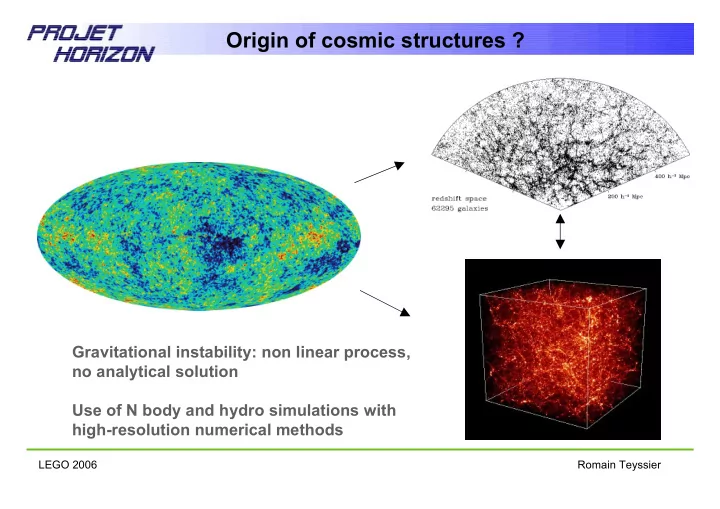
Origin of cosmic structures ?
Gravitational instability: non linear process, no analytical solution Use of N body and hydro simulations with high-resolution numerical methods
SLIDE 2
2
LEGO 2006 Romain Teyssier
From the cosmic web…
SSDS
SLIDE 3
3
LEGO 2006 Romain Teyssier
…to individual galaxies
Andromeda
SLIDE 4
4
LEGO 2006 Romain Teyssier
SLIDE 5
5
LEGO 2006 Romain Teyssier
SLIDE 6
6
LEGO 2006 Romain Teyssier
SLIDE 7
7
LEGO 2006 Romain Teyssier
SLIDE 8
8
LEGO 2006 Romain Teyssier
d
SLIDE 9
9
LEGO 2006 Romain Teyssier
SLIDE 10
10
LEGO 2006 Romain Teyssier
SLIDE 11
11
LEGO 2006 Romain Teyssier
SLIDE 12
12
LEGO 2006 Romain Teyssier
SLIDE 13
13
LEGO 2006 Romain Teyssier
10000h-1kpc 2500h-1kpc 630h-1kpc 160h-1kpc Dark matter density Gas temperature Gas density Stellar density z=3 comoving
SLIDE 14 14
LEGO 2006 Romain Teyssier
A French initiative to promote extreme computing in cosmology
Who ? 30 scientists 6 institutes 2 engineers, 5 post-docs 10 PhD students What ? Parallel computing Visualization tools Galaxy formation physics Theoretical Virtual Observatory How ? 1/2 M hardware support 1/2 TéraFlops dedicated computer 6 nodes grid of AMD 64 quads http://www.projet-horizon.fr Objectives of the Horizon Project:
- Prepare, run and analyze large and massively // cosmological simulations
- Build the necessary infrastructure to optimize their scientific exploitation
- Promote among French scientists the expertise in computational cosmology
Supercomputing in Europe: DEISA Extreme Computing Initiative
RAMSES Teyssier, R. A&A, 2002, 385, 337 Tree based AMR code Unsplit high-order Godunov Galaxy formation physics Adaptive domain decomposition using “space filling curve” MPI and F90 Horizon was selected with 27
extreme application on Mare Nostrum in Barcelona SC (5th computer worldwide) Source: http://www.deisa.org and http://www.top500.org Present: Good scalability up to 512 processors and 10243 particles Cooling & UV heating using external spectrum Star formation and supernovae feedback Objectives: run RAMSES up to 2048 processors Goal: 1010 AMR cells with self-consistent cooling & UV heating (spectrum & metals) Metal enrichment using galactic winds Sponsors: ANR Blanche INSU, IN2P3, CEA, CNRS Paris 6 & Paris 7 university Paris & Lyon Observatories
SLIDE 15
15
LEGO 2006 Romain Teyssier
Fin du diaporama