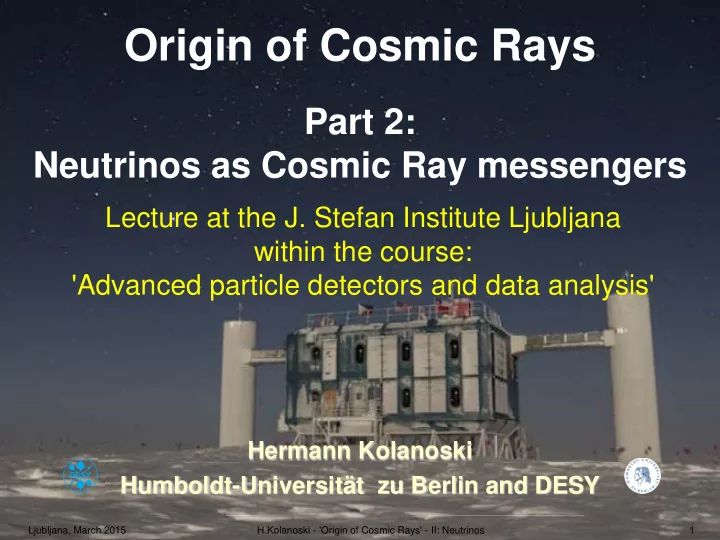
Origin of Cosmic Rays Part 2: Neutrinos as Cosmic Ray messengers - - PowerPoint PPT Presentation

origin of cosmic rays
SMART_READER_LITE
LIVE PREVIEW

Origin of Cosmic Rays Part 2: Neutrinos as Cosmic Ray messengers - - PowerPoint PPT Presentation

Origin of Cosmic Rays Part 2: Neutrinos as Cosmic Ray messengers Lecture at the J. Stefan Institute Ljubljana within the course: 'Advanced particle detectors and data analysis' Hermann Kolanoski Humboldt-Universitt zu Berlin and DESY


slide-1
SLIDE 1

Hermann Kolanoski Humboldt-Universität zu Berlin and DESY

Origin of Cosmic Rays

Ljubljana, March 2015 H.Kolanoski - 'Origin of Cosmic Rays' - II: Neutrinos 1

Lecture at the J. Stefan Institute Ljubljana within the course: 'Advanced particle detectors and data analysis'

Part 2: Neutrinos as Cosmic Ray messengers

slide-2
SLIDE 2

What I want to tell you:

Ljubljana, March 2015 H.Kolanoski - 'Origin of Cosmic Rays' - II: Neutrinos 2

– Candidates for cosmic ray accelerators – Neutrinos as messengers for CR sources – HE Neutrino telescopes – Neutrino detection – Point source searches – EHE neutrinos and the Muppet Show – Cosmic signals from contained events

want to you

Candidates for cosmic ray accelerators messengers for CR sources HE Neutrino telescopes Neutrino detection

slide-3
SLIDE 3

The „non-thermal Universe“

Ljubljana, March 2015 H.Kolanoski - 'Origin of Cosmic Rays' - II: Neutrinos 3
slide-4
SLIDE 4

Where could particles possibly be accelerated? Hillas diagram

Ljubljana, March 2015 H.Kolanoski - 'Origin of Cosmic Rays' - II: Neutrinos 4
slide-5
SLIDE 5

Active Galactic Nuclei

Ljubljana, March 2015 H.Kolanoski - 'Origin of Cosmic Rays' - II: Neutrinos 5

Hubble Heritage Picture of M87 Model of an AGN Origin of the HE cosmic radiation?

slide-6
SLIDE 6 Ljubljana, March 2015 H.Kolanoski - 'Origin of Cosmic Rays' - II: Neutrinos 6

Charged Particle

Twisted and Straight Paths

slide-7
SLIDE 7

Neutrino fluxes

Ljubljana, March 2015 H.Kolanoski - 'Origin of Cosmic Rays' - II: Neutrinos 7

Cosmic neutrinos should have a hard spectrum

F ~ E-2

atmospheric ν F ~ E-3.7

E-3.7 E-2

slide-8
SLIDE 8

Cosmic Rays, Gammas and Neutrinos

Ljubljana, March 2015 H.Kolanoski - 'Origin of Cosmic Rays' - II: Neutrinos 8

target accelerator CR – ν – γ connection the γ – ν connection for hadron accelerators

p

target ν ν ν

μ

±

π±

γ γ

π0

CMB 2.7 K → threshold Ep ≈ 4×10¹⁹ eV

slide-9
SLIDE 9

Three Pillars of HE-Astroparticle Physics

9

Astroparticle

CRs TeV γ‘s TeV-PeV ν‘s

  • Cosmic Rays
  • GeV-TeV γ‘s
  • TeV-PeV ν‘s
Ljubljana, March 2015 H.Kolanoski - 'Origin of Cosmic Rays' - II: Neutrinos
slide-10
SLIDE 10

How to detect cosmic high energy neutrinos?

Ljubljana, March 2015 H.Kolanoski - 'Origin of Cosmic Rays' - II: Neutrinos 10

quite difficult

Need something

  • large
  • transparent

⇒ water or ice

Absorption small  detection probability small

slide-11
SLIDE 11

Moisej Markov Bruno Pontecorvo

M.Maрков,1960: „We propose to install detectors deep in a lake or in the sea and to determine the direction of charged particles with the help

  • f Cherenkov radiation.“
Ljubljana, March 2015 H.Kolanoski - 'Origin of Cosmic Rays' - II: Neutrinos 11
slide-12
SLIDE 12

Amundsen – Scott Station

Ljubljana, March 2015 H.Kolanoski - 'Origin of Cosmic Rays' - II: Neutrinos 12
slide-13
SLIDE 13

IceCube

Ljubljana, March 2015 H.Kolanoski - 'Origin of Cosmic Rays' - II: Neutrinos 13

1000 m

  • 86 Strings, 2450 m deep
  • 5160 Optical Modules
  • Instrumented: 1 km3
  • IceTop: 1 km2
  • Installation: 2005-2011

IceCube DeepCore IceTop

air shower array gigaton-scale neutrino telescope

slide-14
SLIDE 14

DOM – Digital Optical Module

Ljubljana, March 2015 H.Kolanoski - 'Origin of Cosmic Rays' - II: Neutrinos 14

junction cable pressure glas sphere harness elektronics: high voltage, digitalization, data transfer photomultiplier = light sensor Ø 32cm

analog transient waveform digitizer (ATWD) 128 Samples in 422 ns

slide-15
SLIDE 15 Ljubljana, March 2015 H.Kolanoski - 'Origin of Cosmic Rays' - II: Neutrinos 15
slide-16
SLIDE 16

Hot Water Drilling

Ljubljana, March 2015 H.Kolanoski - 'Origin of Cosmic Rays' - II: Neutrinos 16

IceCube EHWD operation: entire drill camp setup, including generators, heater plants, fuel systems, and support workshops. 2 drill towers connect to central plants and leapfrog over holes.

slide-17
SLIDE 17

... und dann 2450 m tief versenkt

Ljubljana, March 2015 H.Kolanoski - 'Origin of Cosmic Rays' - II: Neutrinos 17
slide-18
SLIDE 18

Deployment

Ljubljana, March 2015 H.Kolanoski - 'Origin of Cosmic Rays' - II: Neutrinos 18

99% of DOMs survive deployment and freeze-in

slide-19
SLIDE 19

Detection of High Energy Neutrinos

Ljubljana, March 2015 H.Kolanoski - 'Origin of Cosmic Rays' - II: Neutrinos 19

extraterr. Neutrinos atmosph. Muons

Earth as filter

atmosph. Neutrinos

νµ

µ

km Energy

MeV GeV TeV PeV EeV ZeV Earth diameter

1012 102 104 106 108 1010

νµ + N → µ + X

1 lightyear Radius Erdbahn

mean free path

even for neutrinos the Earth becomes opaque above about 1 PeV ⇒ look upward – atm. background becomes less

slide-20
SLIDE 20

Detection of a Neutrino

Ljubljana, March 2015 H.Kolanoski - 'Origin of Cosmic Rays' - II: Neutrinos 20

cos θc = (βn)-1 θc(β=1) ≈ 40°

θc

slide-21
SLIDE 21

Was misst IceCube eigentlich?

Ljubljana, March 2015 H.Kolanoski - 'Origin of Cosmic Rays' - II: Neutrinos 21 21
slide-22
SLIDE 22

Was misst IceCube eigentlich?

Ljubljana, March 2015 H.Kolanoski - 'Origin of Cosmic Rays' - II: Neutrinos 22
slide-23
SLIDE 23

Particle Signatures

Ljubljana, March 2015 H.Kolanoski - 'Origin of Cosmic Rays' - II: Neutrinos 23

Particle Signatures

up-going νµ → point sources CR shower in IceTop light collection by DOMs νe cascade → all flavours µ bundle ν

µ

µ ν

e

µ background & physics

slide-24
SLIDE 24

Neutrino Signals in IceCube

Ljubljana, March 2015 H.Kolanoski - 'Origin of Cosmic Rays' - II: Neutrinos 24

e,μ,τ νe,μ,τ W N X νe,μ,τ Z N X νe,μ,τ

CC NC

slide-25
SLIDE 25

Neutrino induced muon tracks.

  • Only νμ CC interactions
  • Angular resolution: < 1˚
  • Energy measurement:
  • nly dE/dx

– μ might have lost significant fraction of energy before entering the detector

  • Effective volume larger than

instrumented volume

Ljubljana, March 2015 H.Kolanoski - 'Origin of Cosmic Rays' - II: Neutrinos 25
slide-26
SLIDE 26 Ljubljana, March 2015 H.Kolanoski - 'Origin of Cosmic Rays' - II: Neutrinos 26
slide-27
SLIDE 27

Muon Energy Loss

Ljubljana, March 2015 H.Kolanoski - 'Origin of Cosmic Rays' - II: Neutrinos 27

b(E)E = stochastic losses due to bremsstrahlung critical energy ~E  allows energy reconstruction

  • f muons, not of the neutrinos!
slide-28
SLIDE 28

Ljubljana, March 2015 H.Kolanoski - 'Origin of Cosmic Rays' - II: Neutrinos 28

νμ Angular and Energy Resolution

includes:

Moon shadow νμ energy estimated from dE/dx

  • f muon

(bremsstr.)

slide-29
SLIDE 29 Ljubljana, March 2015 H.Kolanoski - 'Origin of Cosmic Rays' - II: Neutrinos 29

Shower-Type Event (Cascade)

> νe + νμ NC + ντ interactions > Angular resolution: ≥10˚ > Energy resolution: 15% > Effective volume smaller

than instrumented volume

slide-30
SLIDE 30

Cascade Events

Ljubljana, March 2015 H.Kolanoski - 'Origin of Cosmic Rays' - II: Neutrinos 30

electron neutrinos produce electrons which deposit there energy locally spherical signal growth

slide-31
SLIDE 31

31

Angular & energy resolution for shower-type events.

> Full likelihood

reconstruction of observed waveforms.

> ~15% energy resolution. > ≳ 10º angular resolution. > Calibrated by artificial light

sources and CR air shower mons.

Ljubljana, March 2015 H.Kolanoski - 'Origin of Cosmic Rays' - II: Neutrinos

slide-32
SLIDE 32

Search for Diffuse Astrophysical Neutrino Flux Background: Atmospheric Neutrinos

Ljubljana, March 2015 H.Kolanoski - 'Origin of Cosmic Rays' - II: Neutrinos 32

~ 100,000 events per year “prompt” ν’s: from (semi-) leptonic decays of heavy hadrons (mainly charm). Flatter spectrum than “conventional” ν’s ⇒ large uncertainty for astro-ν’s IceCube has now constrained to ~ ERS model (Enberg et al.) E-2 astrophysical?

slide-33
SLIDE 33

Search for Pointsources: The Method

Ljubljana, March 2015 H.Kolanoski - 'Origin of Cosmic Rays' - II: Neutrinos 33

Source background ≈ 2° - 3°

background: atmospheric ν Search for event excess within 2° - 3°

  • somewhere in the Northern sky
  • from list of candidate sources

4282 events (small sample)

slide-34
SLIDE 34

The Statistics Problem

Ljubljana, March 2015 H.Kolanoski - 'Origin of Cosmic Rays' - II: Neutrinos 34

If you serach long enough we will for sure get an exces at some point “I only believe in statistics that I doctored myself”

Winston Churchill

Example: Expect 3 events background in a search window, but see 7. How significant is this?

0.05 0.1 0.15 0.2 0.25 1 2 3 4 5 6 7 8 9 10

w(n>6) = 3,3 % <n> = 3

Already for about 30 search windows the probability to see 7 or more events in any window is about 60% for background only. Significance is determined by ~10000-fold simulation of measurement

slide-35
SLIDE 35

Point Source Search 2008-2011

IC86+79+59+49

35

Hottest spot in South:

  • log10(p) = 5.95

Ra: 296.95 Dec: -75.75 Ns: 16.16 Gamma: 2.34 p-value ~9.3% (post trial)

Ljubljana, March 2015 H.Kolanoski - 'Origin of Cosmic Rays' - II: Neutrinos

The 4-year skymap:

No significant signal

slide-36
SLIDE 36

Improving Statistical Significance

Ljubljana, March 2015 H.Kolanoski - 'Origin of Cosmic Rays' - II: Neutrinos 36
  • pre-defined source positions
  • pre-defined time-window
  • „stacking“ of pre-defined sources

„Pre-Definition“ with „multi-messenger“ information of

  • ptical, gamma, X-ray, radio telescopes …
slide-37
SLIDE 37

Search for neutrinos which are in time and direction consistent with GRB

Ljubljana, March 2015 H.Kolanoski - 'Origin of Cosmic Rays' - II: Neutrinos 37
slide-38
SLIDE 38

GRB Model

Ljubljana, March 2015 H.Kolanoski - 'Origin of Cosmic Rays' - II: Neutrinos 38
slide-39
SLIDE 39

Are GRBs the main sources of Cosmic Rays?

Ljubljana, March 2015 H.Kolanoski - 'Origin of Cosmic Rays' - II: Neutrinos 39

225 GRB ... no coincidences observed Standard Fireball Models excluded [Nature 484 (2012) 351]

slide-40
SLIDE 40

EHE Neutrinos

(extremly high energy)

Ljubljana, March 2015 H.Kolanoski - 'Origin of Cosmic Rays' - II: Neutrinos 40

threshold ~ 5 × 10¹⁹ eV

GZK

Search for high number of C-photons = NPE Search region up-going down-going

slide-41
SLIDE 41

Search for cosmogenic neutrinos with 2010-2012 data.

  • Two shower type events found in 616 days of IceCube observations.
  • Neutrino energies could be higher than deposited energies, if neutral

current interaction.

Ljubljana, March 2015 H.Kolanoski - 'Origin of Cosmic Rays' - II: Neutrinos 41
  • Aug. 8, 2011

1.04 ± 0.14 PeV

  • Jan. 3, 2012

1.14 ± 0.14 PeV

deposited energies

slide-42
SLIDE 42 42 Markus Ackermann | 24.06.2013 | Page

Search for cosmogenic neutrinos with 2010-2012 data.

> Search targeted for multi-PeV to EeV events expected from cosmogenic neutrinos. > PeV events found at the brightness threshold for this analysis. > 2.8σ above expectations from atmospheric background.

slide-43
SLIDE 43

The Muppet Show

Ljubljana, March 2015 H.Kolanoski - 'Origin of Cosmic Rays' - II: Neutrinos 43

A detection of 1 neutrino is interesting … 2 is evidence … … and 3 is a spectrum!

A theoreticians view (Francis Halzen, IceCube PI) :

1.04 ± 0.14 PeV 1.14 ± 0.14 PeV 2.00 ± 0.26 PeV

slide-44
SLIDE 44

44 Alexander Kappes | Seminar, APC, Paris | 14.06.2013 |

Things we wanted to learn

  • Isolated events or tail of spectrum?
  • Spectral slope/cutoff
  • Flavor composition (ratio tracks/cascades)
  • Where do they come from?
  • Astrophysical or air-shower physics (e.g. charm)?

Ernie Bert

→ Needed more statistics to answer all of these

slide-45
SLIDE 45 45 Markus Ackermann | 24.06.2013 | Page

Search for contained and semi-contained events.

> Designed to find contained events below the

energy threshold of the “Bert-and-Ernie” analysis

▪ same dataset ▪ 662 days of livetime

> Use outer IceCube layers as incoming track veto

▪ Additional atmospheric muon veto ▪ Sensitive to all flavors in region above ~ 60TeV ▪ Muon background can be estimated from data

μ Veto μ νμ

✓ ✘

Effective volume

slide-46
SLIDE 46

Ice Properties

Ljubljana, March 2015 H.Kolanoski - 'Origin of Cosmic Rays' - II: Neutrinos 46

λeff = 20 m

challenge: modeling photon propagation in ice DeepCore

λeff length after which light is isotropic

slide-47
SLIDE 47

Some example events

Ljubljana, March 2015 H.Kolanoski - 'Origin of Cosmic Rays' - II: Neutrinos 47

declination: -0.4° deposited energy: 71TeV declination: -13.2° deposited energy: 82TeV declination: 40.3° deposited energy: 253TeV

IceCube Preliminary IceCube Preliminary IceCube Preliminary

slide-48
SLIDE 48

Excess of HE Starting Tracks

Ljubljana, March 2015 H.Kolanoski - 'Origin of Cosmic Rays' - II: Neutrinos 48

Significance about 5.7 σ

First observation of astrophysical flux of high energy neutrinos

Starting events depositing >60 TeV using 3 years of data, events up to ~2 PeV

  • Phys. Rev. Lett. 113, 101101
slide-49
SLIDE 49

Northern Sky Through-going Events

  • (Paper in internal review) Analysis of through-going events from the

northern sky using 2 years of data—νµ charged current only, >1 TeV

  • Excess over atmospheric background of 3.7σ
  • Signal looks similar in different channels and different parts of the sky

49

IceCube Preliminary

IceCube Preliminary

IceCube Preliminary

slide-50
SLIDE 50

Skymap

Ljubljana, March 2015 H.Kolanoski - 'Origin of Cosmic Rays' - II: Neutrinos 50

equatorial coordinates

no significant correlation with galactic plane

p-value: 7%

slide-51
SLIDE 51

Global Fit to 6 Different Measurements

Ljubljana, March 2015 H.Kolanoski - 'Origin of Cosmic Rays' - II: Neutrinos 51

Simplest model: flux and flavor ratio

Results:

Flavor ratio compatible with

„prompt“ < 2 × ERS

slide-52
SLIDE 52

Skymap

Ljubljana, March 2015 H.Kolanoski - 'Origin of Cosmic Rays' - II: Neutrinos 52

equatorial coordinates

no significant correlation with galactic plane

p-value: 7%

slide-53
SLIDE 53

Blazars or GRB as Sources?

Ljubljana, March 2015 H.Kolanoski - 'Origin of Cosmic Rays' - II: Neutrinos 53

Compare directions of the high energy νμ with directions of Blazars observed by Fermi Satellite at high γ luminosity Even more stringent for GRB: from analysis of 506 GRBs in four years it was found that no more than 1% of the high energy neutrinos could come from GRB 1% atmost from GRBs high luminosity 17% atmost from Blazars

slide-54
SLIDE 54 Ljubljana, March 2015 H.Kolanoski - 'Origin of Cosmic Rays' - II: Neutrinos 54