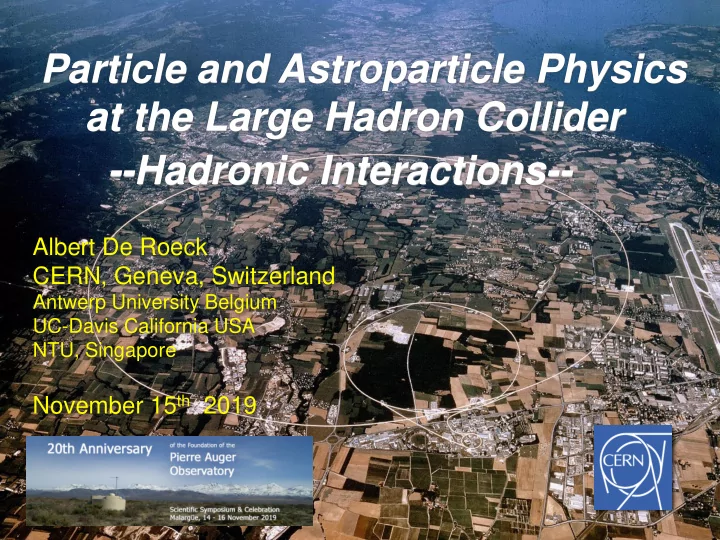
SLIDE 1 Particle and Astroparticle Physics at the Large Hadron Collider
Albert De Roeck CERN, Geneva, Switzerland
Antwerp University Belgium UC-Davis California USA NTU, Singapore
November 15th 2019
SLIDE 2 Outline
- Introduction on the LHC and
LHC physics program
- LHC results for Astroparticle
physics
characteristics at 13 TeV
- Forward measurements
- Cosmic ray measurements
- LHC and light ions?
- Summary
SLIDE 3 The LHC Machine and Experiments
LHCf
totem
MoEDAL
CM energy → Run-1: (2010-2012) 7/8 TeV Run-2: (2015-2018) 13 TeV
FASER
SLIDE 4
Run-2 starts
2010-2012: Run-1 at 7/8 TeV CM energy Collected ~ 27 fb-1 2015-2018: Run-2 at 13 TeV CM Energy Collected ~ 140 fb-1 2021-2023/24 : Run-3 Expect ⇨ 14 TeV CM Energy and ~ 200/300 fb-1
proton-proton Run-2 finished 24/10/18 6:00am
2018
SLIDE 5 4
The LHC is also a Heavy Ion Collider
Data taking during the HI run
- All experiments take AA or
pA data (except TOTEM) Expected for Run-3: in addition short pO and OO runs ⇨ pO certainly of interest for Cosmic Ray Physics Community!
ALICE
SLIDE 6 10 years of LHC Operation
- LHC: 7 TeV in March 2010
- >The highest energy in the lab!
- LHC @ 13 TeV from 2015 onwards
- Most important highlight so far:
The discovery of a Higgs boson
- Many results on Standard Model process
measurements, QCD and particle production, top-physics, b-physics, heavy ion physics, searches, Higgs physics
- Waiting for the next discovery…
- > Searches beyond the Standard Model
12:58 7 TeV collisions!!! March 30 2010 …waiting.. …since 4:00 am
SLIDE 7
New Physics Hunters @ the LHC
The ATLAS experiment The CMS experiment …And also LHCb and MoEDAL
SLIDE 8 Other Experiments @ the LHC
The LHCf experiment
Forward particle production
The ALICE experiment
Heavy Ion physics
The TOTEM experiment
Elastic, total & diffractive xsecs
New: the FASER experiment
Dark photons Approved March 2019
SLIDE 9 LHC: Future Running
All LHC experiments plan upgrades for either 2019-2020 or 2024-2026 for the High Luminosity LHC upgrade (ATLAS, CMS and LHCb, ALICE)
LHC will run till ~2037 Expect to collect 3000 fb-1
- > so far we have collected 5% only
High Luminosity LHC pile-up -> ~ 200 events per bunch crossing ⬅️⬅️ ↑ you are here
year
SLIDE 10
Proposals for New Experiments @LHC
MilliQan: searches for millicharged particles CODEX-b: searches for long lived weakly interacting neutral particles MATHUSLA: searches for long lived weakly interacting neutral particles ANUBIS: searches for long lived weakly interacting neutral particles + Experiment Proposals for TeV neutrinos
SLIDE 11 Cosmic Rays & TeV Neutrinos
10
MATHUSLA and ANUBIS ‘on surface’ Cosmic Ray measurements possible XSEN and FASER-Nu are 400m forward of the IPs and can study TeV-neutrinos with emulsion detectors
Cosmic rays
particle density in 1015 eV airshower
SLIDE 12 Observation of a Higgs Particle at the LHC, after about 40 years
- f experimental searches to find it
The Higgs particle was the last missing particle in the Standard Model and possibly our portal to physics Beyond the Standard Model
proton proton
2012: A Milestone in Particle Physics
2013
SLIDE 13 We continue to look for anomalies, i.e. unexpected decay modes or couplings, multi-Higgs production, heavier Higgses, charged Higgses…
We know already a lot on this brand New Higgs particle!! So far this Higgs particle looks very Standard-Model like
Mass = CMS+ATLAS
125.09 ±0.21(stat) ±0.11(syst) GeV
Width < 9 MeV (95%CL) Couplings are within ~10-20%
Spin = 0+(+) preferred
Brief Higgs Summary (so far)
SLIDE 14
New Physics?
Extra Dimensions? Black Holes??? Little Higgs? ZZ/WW resonances? Technicolor? Supersymmetry What stabelizes the Higgs Mass? Many ideas, not all viable anymore A large variety of possible signals. We have to search a wide phase space New Gauge Bosons? Hidden Valleys?
SLIDE 15
The SUSY SEARCH Chart So Far…
No evidence for SUSY found yet. More than 100 different analyses performed Excluded squark and gluino mass region:
Excluded!!
EPS19/LP19: Still no significant sign yet of SUSY with full run-2 data (140 fb-1)
SLIDE 16
LHC Results for Astroparticle Physics
SLIDE 17 Pierre Auger and LHC
In this book (2011) the author visits and lived in --what he calls extreme places-- where physics can or needs to be done, to make ultimate measurements to unlock the secrets
He visits seven experiments including Baikal, IceCube, Auger, telescopes in Chile... His conclusion: physicists are willing to suffer in order to extract the best possible results!! Interestingly: the LHC at CERN is one of the places he included in his book!!
SLIDE 18 LHC Results Relevant for Cosmic Rays
The LHC provides a significant lever-arm in providing data to constrain high energy cosmic ray Monte Carlo programs
From R. Engel
SLIDE 19 Hadronic Monte Carlos for UHECRs
SLIDE 20 Total and Elastic Cross Sections
19
TOTEM experiment: Total cross section and elastic/diffractive scattering 𝝇: the ratio of the real to imaginary part of the nuclear elastic scattering amplitude at t=0, is lower that expected First direct evidence for “odderon” exchange in elastic scattering?? +?
arXiv:1812.04732 arXiv:1712.06153
SLIDE 21 Inclusive Particle Spectra
LHC experiments have made measurements of charged particle spectra and energy flows in the central region for minimum bias pp collisions. Some examples for data at 13 TeV:
Useful for tuning of models. Any particular measurements still needed/required??
arXiv:1602.01633 arXiv:1706.10194 arXiv:1606.01133
SLIDE 22 Correlations Between Produced Particles
Study the correlation between two charged particles in the angles φ (transverse): Δφ and θ (longitudinal): Δθ in PbPb, pPb and pp
High multiplicity events
A new phenomenon in the ‘stronge force’? Multiple interactions? Glass condensates? Hydrodynamic models? …
High multiplicity events
JHEP 1009 (2010) 091
Heavy Ions @LHC!
SLIDE 23 Forward Coverage of the Experiments
Most of the energy flow is in regions at large |η|, ie beam directions Particle density is highest in the central region Forward energy/particle flow of particular interest for cosmic ray air showers! Detectors @LHC extending up to |η|<5 + special detectors for larger |η| Particle and energy flow as function of pseudorapidity (polar angle)
η= -ln tanθ/2
SLIDE 24
Forward Detectors in CMS
New: Precision Proton Spectrometer together with TOTEM (CT-PPS)
SLIDE 25
Forward Detectors in ATLAS
SLIDE 26 Event Characteristics in the Forward Region
Energy Flow in the extended forward region of CMS->compare with CR models
Pseudorapidity ranges: -6.6< η < -5.2
Central multiplicity
arXiv:1908.01750 arXiv:1812.04095 arXiv:1701.08695
SLIDE 27 Forward Particle Production
26
LHCf experiment: Forward measurements in pp (and pA) compared to Monte Carlos for Cosmic Ray studies No model reproduces the data well !!
Forward neutrons Forward Photons
arXiv:1808.09877 arXiv:1703.07678
𝜽>10.78
SLIDE 28 Single Diffractive Dissociation
27
Tagging Single Diffractive Dissociation via proton tagging in the ATLAS ALFA forward spectrometer, and with charged particles in the central detector
arXiv:1911.00453
Data cross section substantially smaller than predicted by models
SLIDE 29 Central and Forward Particle Density
A common CMS+TOTEM measurement A challenge for the phenomenological models?
arXiv:1405.0722
SLIDE 30 Combined ATLAS+LHCf Studies
29
Study of the contribution of proton diffractive dissociation to production of forward photons observed in LHCf
- Photon reconstruction in the LHCf-Arm1 detector, ATLAS for DD selection.
- Measure photons with 8.81< η < 8.99 or η > 10.94 for events with no
charged-particle tracks with pT > 100 MeV and |η| < 2.5.
A challenge for the phenomenological models
SLIDE 31 Does it Help? Yes!!
meeting in Kyoto Japan More ongoing by model tuners
- T. Pierog
- R. Engel
- S. Ostapchenko
- …
Expect continuous improvements!
SLIDE 32
Detection of Cosmic Rays at the LHC
SLIDE 33 Detection of Cosmic Rays at the LHC
- To measure the cosmic charge ratio wrt momentum for single
muons for two cases: near vertical and horizontal (central barrel)
- To measure the cosmic charge ratio wrt muon multiplicity.
- Study in detail the properties of muon bundles
LEP detectors @ CERN have been used to study cosmic muons and in particular muon bundles passing the detectors. These results were not understood at the time (even assuming pure Fe)
SLIDE 34 ALICE Detectors for Cosmic Rays
33
2010-2013 Recorded 30.8 days of cosmic triggers: ~7.5K events with > 4 μ’s 2015-2018 63 days collected, including high mult. Trigger. Now being analyzed
SLIDE 35 Muon Multiplicity Distribution
34
The observed rate is consistent with the predictions of CORSIKA 7350 with QGSJET II-04 model using pure Fe primary composition and energy >1016 eV 2010-2013 data
SLIDE 36 LHCb Fixed Target Data
35
Use “fixed target geometry” for… fixed target physics!
SLIDE 37 36
LHCb Fixed Target Data
Upgrade planned for Run 3 with more targets (eg Nitrogen, Oxygen, Hydrogen, Deuterium…) and 100 times higher density (storage cell)
SLIDE 38 pp, pPb, PbPb and XeXe at the LHC
37
lead-lead collision at 5 TeV/nucleon proton-lead collision at 8.2 TeV/nucleon
Many particle production results available by ALICE, CMS,ATLAS and LHCb examples p-Pb Xe-Xe
SLIDE 39 Summary
- LHC has lots of data at 7,8, and 13 TeV. 14 TeV is next!!
- Many measurements are made which are useful for CR
physics model tuning. LHC data has impact on these tunes.
- There are no doubt other measurements which can or should
be done. Input welcome! Lots of data on tape!
- ALICE & other new LHC experiments for CR measurements?
- pPb, PbPb, XeXe, collisons on tape. Oxygen plans for Run-III
- SMOG2 approved for more fixed target data with LHCb
- D. d’Enterria (2011)
Happy 20th Anniversary to the Pierre Auger Observatory
SLIDE 41 Event Characteristics in the Forward Region
Energy Flow in the extended forward region of CMS
Cosmic ray models Pythia variations
arXiv:1701.08695
Pseudorapidity ranges: -6.6< η < -5.5 Stable particle results
SLIDE 42 41
Forward energy flow
as function of the central track multiplicity in region |𝛉|<2 Total energy and relative EM/HAD fraction Compared to CR models: Larger EM fraction in data compared to the models
arXiv:1908.01750
Event Characteristics in the Forward Region
SLIDE 43 42
- Energy density as function of the pseudo-rapidity in 3.15 <|𝛉|<6.6
for collisions at 13 TeV, and comparison with lower energies
- Compared with models used in cosmic ray physics for inelastic and
non-single diffractive selected events
arXiv:1812.04095
Check limited fragmentation hypothesis
Event Characteristics in the Forward Region
SLIDE 44
Standard Model Measurements
Grand Summary: The Standard Model works very well at 13 TeV!!