Organic Compounds in Water and Wastewater Oil Spill Cleanup and - - PDF document

organic compounds in water and wastewater
SMART_READER_LITE
LIVE PREVIEW

Organic Compounds in Water and Wastewater Oil Spill Cleanup and - - PDF document

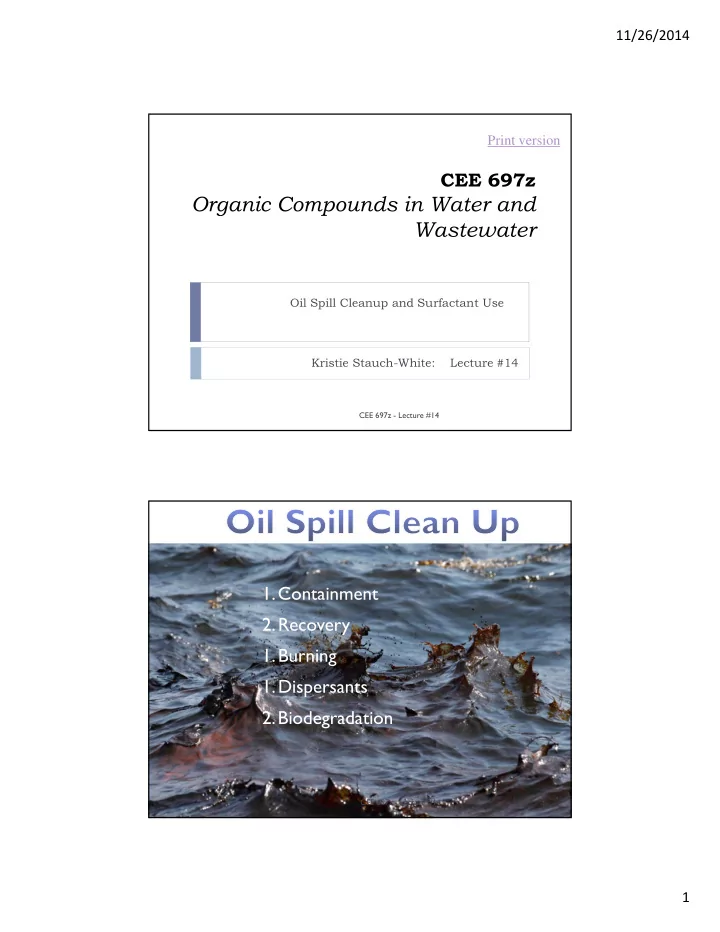
11/26/2014 Print version CEE 697z Organic Compounds in Water and Wastewater Oil Spill Cleanup and Surfactant Use Kristie Stauch-White: Lecture #14 CEE 697z - Lecture #14 1.Containment 2.Recovery 1.Burning 1.Dispersants


slide-1
SLIDE 1

11/26/2014 1

CEE 697z

Organic Compounds in Water and Wastewater

Oil Spill Cleanup and Surfactant Use

CEE 697z - Lecture #14

Print version

Kristie Stauch-White: Lecture #14

1.Containment 2.Recovery 1.Burning 1.Dispersants 2.Biodegradation

CEE 697z - Lecture #14

slide-2
SLIDE 2

11/26/2014 2

  • Booms and skimmers
  • Containment Dome

http://www.federallabs.org/flc/sandlg/state_profile/?state_id=127

CEE 697z - Lecture #14 CEE 697z - Lecture #14

slide-3
SLIDE 3

11/26/2014 3

Skimmers and Sorbent materials:

  • polyester Fiber Mats
  • Super-Hydrophobic Absorbents

– polyethylene mop-like pads

  • Hair Mats
  • Hay
  • Pine Shavings

CEE 697z - Lecture #14

Burning

Department of Defense

CEE 697z - Lecture #14

slide-4
SLIDE 4

11/26/2014 4

Helen K. White, 2014, Dept. of Chemistry, Haverford College

CEE 697z - Lecture #14

1.Containment 2.Recovery 1.Burning 1.Dispersants 2.Biodegradation

CEE 697z - Lecture #14

slide-5
SLIDE 5

11/26/2014 5

 Solvents – decrease viscosity  Surfactants – surround and emulsify oil

 Encourages oil to sink and come into contact with bacteria in

the water column

 Also encourages oil droplets to spread into fur and feathers of

marine animals

CEE 697z - Lecture #14

Surfactants

amphipathic

CEE 697z - Lecture #14

slide-6
SLIDE 6

11/26/2014 6

Tiny oil droplets suspended in the water column are more available for biodegradation

CEE 697z - Lecture #14

Oil Degrading Bacteria:

  • Alcanivorax borkumensis
  • Pseudomonas

Direct Interfacial Uptake of Oil/Surfactant Emulsion Droplets

Symbiotic Bacteria:

  • Azotobacter – provides fixed nitrogen
  • Cyanobacteria – provides fixed nitrogen and oxygen

CEE 697z - Lecture #14

slide-7
SLIDE 7

11/26/2014 7

 1.8 million gallons of Corexit 9500 applied at Deep Water

Horizon Oil Spill in 2010 Active Ingredients: dioctyl sodium sulfosuccinate (DOSS)

  • Reported to be quickly biodegradable (>90% in 12-19 days)
  • Found in Coral Beds 6 months after application
  • Found on Coastline 4 years later
  • T
  • xic to Marine Life
  • T
  • xicity increased when mixed with Oil

Helen K. White, Haverford College & Woods Hole Oceanographic Institute

CEE 697z - Lecture #14

Clearly, more research is needed to find less toxic and more biodegradable surfactants for Oil Spill Remediation

  • Commercial Lecithin & Cellulose Polymer based surfactant

– mixture of natural phospholipids in oil

Lisa Kemp, University of Mississippi

CEE 697z - Lecture #14

slide-8
SLIDE 8

11/26/2014 8

CEE 697z - Lecture #14

  • Soaps
  • Detergents
  • Household Cleaners
  • Foaming Agents

(sodium lauryl sulfate in toothpaste and shampoo)

Sodium Stearate

CEE 697z - Lecture #14

slide-9
SLIDE 9

11/26/2014 9

Soap – 1st Widely used Surfactant ABS – Alkylbenzene sulfonates used in laundry products*

  • left calcium and magnesium salt

precipitates

  • foaming in sewage water, treated sewage

and river water

  • led to ban in Germany and voluntary bans

in the U.S. LAS – Linear alkylbenzene sulfonates

  • introduced in 1960s
  • improved biodegradability
  • less foaming
  • levels of surfactants in aquatic

environments

CEE 697z - Lecture #14

 Anionic  Cationic  Non-ionic

Knepper & Eichhorn, 2006 General Structure of LAS (linear alkylbenzene sulfonate)

CEE 697z - Lecture #14

slide-10
SLIDE 10

11/26/2014 10

Dioctyl Sodium Sulfosuccinate Anionic Surfactant

CEE 697z - Lecture #14

Primary Biodegradation

– minor alterations in chemical structure of surfactant molecule – may result in loss of surface-active properties, lowering toxicity

Knepper & Eichhorn, 2006

CEE 697z - Lecture #14

slide-11
SLIDE 11

11/26/2014 11

 Anionic Surfactants are methylene blue-active substances

(MBAS)

 Non-ionic surfactants are bismuth iodide-active

substances (BiAS)

Additional testing required to determine the fate of surfactant molecules after primary degradation

CEE 697z - Lecture #14

Biodegradation of Surfactants

Organization of Economic Co-Operation and Development (OECD)

  • developed International Standard Methodologies for testing the

biodegradability of surfactants

  • Ready Biodegradability – real environmental conditions

(60% CO2 formation or 70% DOC removal within 28 days) *likely to be degraded

  • Inherent Biodegradability – ideal conditions

*potential to be degraded

  • Simulation Biodegradability –WWTP conditions

CEE 697z - Lecture #14

slide-12
SLIDE 12

11/26/2014 12

What happens to Surfactants from household and industrial use?

CEE 697z - Lecture #14

The majority reach Wastewater Treatment Plants where they are effectively eliminated. Some persistent compounds and their metabolites are found in raw water that is treated for drinking water.

CEE 697z - Lecture #14

slide-13
SLIDE 13

11/26/2014 13

Additional Research is needed to better understand the fate of these compounds and their metabolites.

Thank you

CEE 697z - Lecture #14 CEE 697z - Lecture #14

 To next lecture