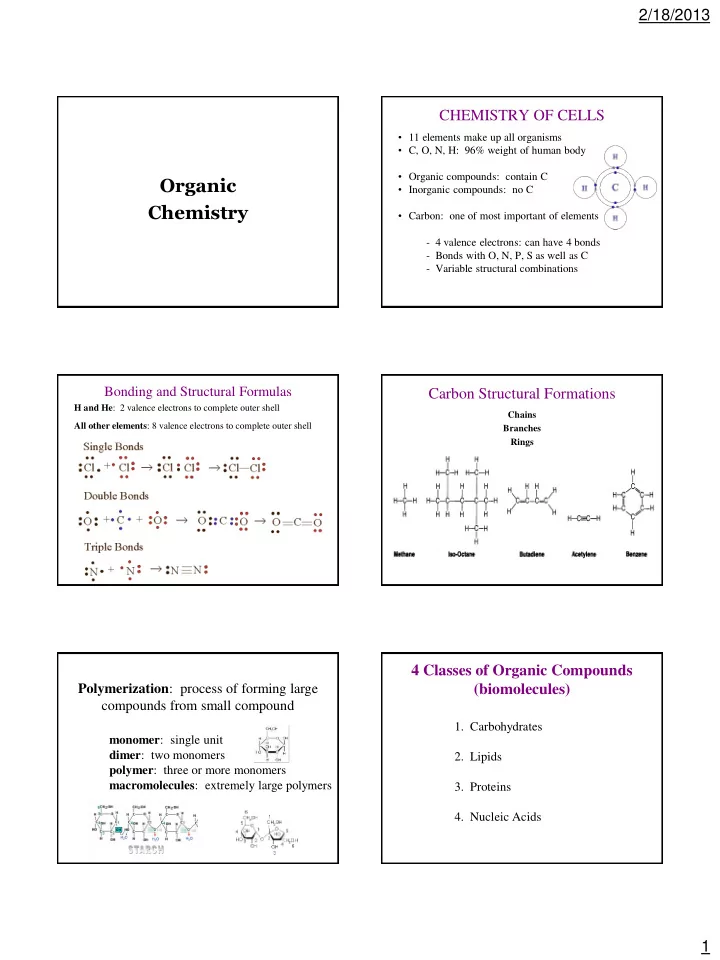
Organic compounds: contain C Organic Inorganic compounds: no C - - PDF document

organic compounds contain c organic inorganic compounds
SMART_READER_LITE
LIVE PREVIEW

Organic compounds: contain C Organic Inorganic compounds: no C - - PDF document

2/18/2013 CHEMISTRY OF CELLS 11 elements make up all organisms C, O, N, H: 96% weight of human body Organic compounds: contain C Organic Inorganic compounds: no C Chemistry Carbon: one of most important of elements - 4


slide-1
SLIDE 1

2/18/2013 1

Organic Chemistry

CHEMISTRY OF CELLS

  • 11 elements make up all organisms
  • C, O, N, H: 96% weight of human body
  • Organic compounds: contain C
  • Inorganic compounds: no C
  • Carbon: one of most important of elements
  • 4 valence electrons: can have 4 bonds
  • Bonds with O, N, P, S as well as C
  • Variable structural combinations

Bonding and Structural Formulas

H and He: 2 valence electrons to complete outer shell All other elements: 8 valence electrons to complete outer shell

Carbon Structural Formations

Chains Branches Rings

Polymerization: process of forming large compounds from small compound

monomer: single unit dimer: two monomers polymer: three or more monomers macromolecules: extremely large polymers

4 Classes of Organic Compounds (biomolecules)

  • 1. Carbohydrates
  • 2. Lipids
  • 3. Proteins
  • 4. Nucleic Acids
slide-2
SLIDE 2

2/18/2013 2 CARBOHYDRATES

(saccharo / Latin or Greek /sweet or sugar)

  • composed of C : H : O

1 : 2 : 1 ratio

  • function: energy and structure

Types of Carbohydrates

  • 1. Monosaccharides: (C6 H12 O6)
  • A. glucose – most important : used for energy
  • all di/polysaccharides broken down into glucose
  • B. galactose – milk
  • C. fructose – fruits

Isomers

Compounds that have same chemical formula but differ in the arrangement of groups around the carbon atoms

  • 2. Disaccharides: (C12 H22 O11) two monosaccharide units
  • A. sucrose – table sugar
  • B. maltose – malt sugar (beer)

(glucose + glucose)

  • C. lactose – milk sugar

3. Polysaccharides : very large saccharide chains (poly / Greek many) Cellulose

  • A. starch – energy storage for plants
  • 100’s of glucose molecules
  • B. glycogen – energy storage for

animals (muscles and liver)

  • C. cellulose – structure for plant stems
  • wood and bark
  • cell walls of plants

**Molecules of starch, cellulose, and glycogen- 1000s of glucose units, no fixed size**

Building and Breaking Organic Molecules

Dehydration synthesis/ Condensation chemically joining two molecules with loss of H2O Hydrolysis splitting of polysaccharide into monosaccharide units with consumption of water

slide-3
SLIDE 3

2/18/2013 3

LIPIDS (fats)

  • waxy or oily compounds
  • ratio of H to C is > 2:1
  • structure:

1 glycerol (alcohol) + 3 fatty acids + 3 H2O lost

  • functions:
  • energy storage
  • membrane formation

(phospholipids)

  • chemical messengers

(sterols/steroids)

Formation of a Triglyceride via Dehydration Synthesis Types of Lipids

  • Saturated - solid at RT
  • max number of H bonds

with C (saturated with bonds)

  • Unsaturated - liquid at RT
  • double bonds between C
  • Polyunsaturated - many double

bonds between C

  • cooking oils

** trans fats: heating unsaturated fats to become saturated - very bad ** hydrogenated oils: adding H to unsaturated fats to make solid - very bad

PROTEINS

  • most important of biomolecules
  • composed of C, O, H, and N
  • functions:
  • 1. structure, growth , repair
  • 2. carrier molecules
  • 3. enzymes- initiate chemical

reactions

  • 4. immunity- antibodies
  • 5. receptors- initiate and

receive messages between cells

  • structure:

amino acids: building blocks

NH2 amino group (base) COOH carboxyl group (acid) R functional group (determines a.a.)

Functional Group

Group that determines the nature of a molecule Amino Acid R Groups

(differentiate each amino acid)

GLYCINE PHENYLALANINE ALANINE

slide-4
SLIDE 4

2/18/2013 4

Peptide Bond

  • Covalent bond between two amino acids
  • Dehydration synthesis reaction
  • H from amino group bonds

with OH (hydroxyl) of another amino acid

  • water molecule is

removed animation

Structure of Proteins

Primary: sequence of amino acids in polypeptide chain Secondary: folds or twists in the protein chain (usually alpha helix or beta sheets) ( most common - DNA) Tertiary: globular or spherical due to more complex folds determines protein’s function (ex: myoglobin, enzymes) Quarternary: two more tertiary forms combined (hemoglobin)

Nucleic Acids

  • composed of C, O, H, N plus P
  • very large molecules
  • polymers of nucleotides

ATP (adenosine triphosphate)

  • Single nucleotide with two extra energy storing phosphate

groups.

  • energy from broken down food is stored temporarily in ATP
  • cells need ATP to function

Nucleic Acids

DNA: master molecule

  • f organisms

RNA: involved in protein synthesis

ENERGY AND CHEMICAL REACTIONS

  • All organisms need energy to carry on life processes

Energy: the ability to move or change matter (to do work)

  • Forms: heat, electrical, light, sound, chemical, etc
  • Energy can be stored or released by chemical

reactions (bonds are broken)

ENERGY AND CHEMICAL REACTIONS

Oxidation/ Reduction Reactions (Redox): reactions in which electrons are transferred between atoms

  • Oxidation: reactant loses one or more electrons

becomes positively charged

  • Reduction: reactant gains
  • ne or more electrons

becomes negatively charged

slide-5
SLIDE 5

2/18/2013 5

Biochemical pathway products of one reaction are used as reactants of next reaction

  • due to redox reactions

ENERGY AND CHEMICAL REACTIONS Activation energy: amount of energy needed to start a reaction

Types of Reactions

  • 1. Endothermic/ Endergonic:

absorbs energy Product moves to a higher energy state Ex: ice  water

  • 2. Exothermic/ Exergonic:

releases energy Product moves to a lower energy state Ex: steam  water

Catalyst: substance that speeds up chemical reaction without being changed or used up Lowers activation energy Enzyme: biological catalyst (ends in “ase”)

  • up to 200 types in each cell
  • globular proteins
  • specific catalytic action

Ex: lipase: lipids lactase: lactose amylase: starch  glucose

  • abnormal conditions cause reduced activity : dependent on environment
  • needed to maintain homeostasis
  • mode of action: enzyme substrate complex

Enzyme Mode of Action Models

Lock and Key Model

slide-6
SLIDE 6

2/18/2013 6

Enzyme Model of Action Models

Induced Fit Model

  • 1. Enzyme has pocket (active

site) in structure.

  • 2. Only one substrate fits into

the active site of enzyme molecule. 3. Enzyme active site changes shape to fit substrate (induced fit). Chemical reactions occur and new products are made. 4. New products are released. Enzyme returns to original shape to be used again. Enzyme animation

Factors that affect enzyme activity

1. temperature: (humans 35 – 40*C) 2. pH: (humans 6 – 8)

DENATURED ENZYME denatured enzyme animation

HOW ENZYMES ARE USED IN MEDICINE

Protease inhibitors: AIDs virus

  • virus needs HIV protease to complete protein

synthesis

  • protease inhibitors fits into substrate and prevents

enzyme from binding

  • prevents protein synthesis and production of

more virus

Study for the test!!