SLIDE 1 Organic Chemistry: Carbon and the Molecular Diversity of Life
Slide 1 / 97
Organic chemistry is the study of carbon compounds Organic compounds range from simple molecules to colossal
Most organic compounds contain hydrogen atoms in addition to carbon atoms. Compounds containing only carbon and hydrogen are called hydrocarbons; they are commonly used as a fuel source.
Organic Chemistry Slide 2 / 97
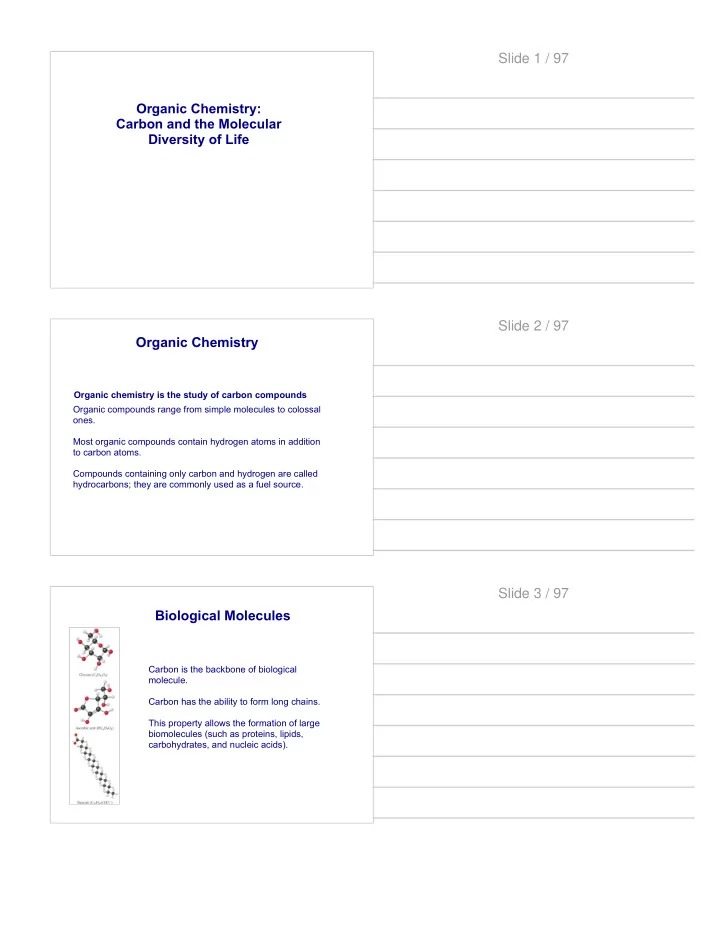
Carbon is the backbone of biological molecule. Carbon has the ability to form long chains. This property allows the formation of large biomolecules (such as proteins, lipids, carbohydrates, and nucleic acids).
Biological Molecules Slide 3 / 97
SLIDE 2 Carbon has four valence electrons to make covalent bonds Carbon atoms can form diverse molecules by bonding to four
Recall that electron configuration is the key to an atom’s characteristics because it determines the kinds of bonds and number of bonds an atom will form with other atoms
Carbon Slide 4 / 97
1 Organic chemistry is a science based on the study of ___________________.
A compounds that can only be made by living cells.
B vital forces interacting with matter. C carbon compounds. D water and its interaction with other kinds of molecules.
Slide 5 / 97
2 Which property of the carbon atom allows it to bond with many different elements? A Carbon has 6 to 8 neutrons. B Carbon has 4 valence electrons. C Carbon forms ionic bonds.
D
A and C only
E
A, B, and C
Slide 6 / 97
SLIDE 3 3 How many electron pairs does carbon share in order to
complete its valence shell?
A 1
B 2 C 3 D 4 E 8 Slide 7 / 97
4 What type/s of bond/s does carbon have a tendency to form?
A Ionic
B Hydrogen C Covalent D
A and B
E
A, B and C
Slide 8 / 97
Hydrocarbons are compounds made up of carbon and hydrogen atoms Aliphatic hydrocarbons: compounds with carbon atoms connected in a straight chain Aliphatic compounds consist of three classes of compounds: Alkanes Alkenes Alkynes Aromatic hydrocarbons: compounds with carbon atoms connected in cyclic (ringed) structures that have an odor
Hydrocarbons Slide 9 / 97
SLIDE 4
Hydrocarbon chains where all the bonds between carbons are SINGLE bonds They are also known as saturated hydrocarbons. They are “saturated” with hydrogens.
Aliphatic hydrocarbons: Alkanes
Examples: Methane, Propane, Butane, Octane Name uses the ending -ane
Slide 10 / 97 Alkanes Slide 11 / 97
The general formula CnH2n+2 n = number of carbon atoms
Alkanes
______ Hexane ______ Heptane ______ Octane ______ Nonane ______ Decane CH4 Methane C2H6 Ethane C3H8 Propane C4H10 Butane C5H12 Pentane
Slide 12 / 97
SLIDE 5
Straight Chain Alkanes
Straight chain alkanes are alkanes that have all their carbon atoms connected in a row. These are structural formulas. CH3-CH2-CH3 This is a condensed formula for propane.
Slide 13 / 97
Branched chain alkanes are alkanes that have a branching connection of carbons. For example, butane has the formula C4H10. Shown below are the straight chain and branched forms of butane.
Branched Chain Alkanes
CH3-CH2-CH2-CH3 Straight chain butane Branched chain butane
Slide 14 / 97
Hydrocarbons are non polar, since the difference in electronegativity between C and H is below 0.5. Note that larger molecules are more polarizable and therefore have stronger London dispersion forces which increases boiling point.
Alkanes Slide 15 / 97
SLIDE 6
5 What is the reason why hydrocarbons are not soluble in water?
A
The majority of their bonds are polar covalent C-H linkages
B
The majority of their bonds are nonpolar covalent C-H linkages
C
They are hydrophilic
D
They exhibit considerable molecular complexity and diversity
E
They are lighter than water
Slide 16 / 97
6 Gasoline and water do not mix because gasoline is __________.
A
less dense than water
B
less viscous than wtaer
C
nonpolar and water is polar
D
volatile and water is not
E
polar and water is nonpolar
Slide 17 / 97
7 Which substance would be the most soluble in gasoline?
A
water
B
sodium nitrate, NaNO3
C
hydochloric acid, HCl
D
hexane, C6H14
E
sodium chloride, NaCl
Slide 18 / 97
SLIDE 7 Ethene Alkenes have at least one double bond between two carbon
- atoms. General formula: CnH2n where n = # of carbon atoms
The name uses the ending -ene. The simplest alkenes are: C2H4 Ethene (from 2-carbon parent, ethane) C3H6 Propene (from 3-carbon parent, propane)
Aliphatic hydrocarbons: Alkenes Slide 19 / 97
Alkynes have at least one triple bond between two carbon atoms. General formula: CnH2n-2 where n = # of carbon atoms The name uses the ending -yne. The simplest alkynes are: C2H2 Ethyne (commonly known as acetylene) C3H4 Propyne or propylene
Aliphatic hydrocarbons: Alkynes
Ethyne
Slide 20 / 97
Ball and stick model Space filling model Molecular formula Structural formula
Representing Aliphatic Hydrocarbons Slide 21 / 97
SLIDE 8 Cycloalkanes
Carbon can also form ringed structures. Five- and six-membered rings are most stable. They can take on conformations in which their bond angles are very close to the tetrahedral angle. Smaller rings are quite strained
Slide 22 / 97 Aromatic hydrocarbons
They have benzene ring structure ( hexagon) and have particular aroma associated with it.
CH3 Benzene
Toluene ( methyl benzene)
Slide 23 / 97
8 Hydrocarbons
A are polar. B are held together by ionic bonds.
C contain nitrogen.
D contain only hydrogen and carbon atoms. E are held together by hydrogen bonds.
Slide 24 / 97
SLIDE 9 9 Hydrocarbons containing only single bonds between the carbon atoms are called __________.
A alkenes B alkynes C aromatics D alkanes E ketones
Slide 25 / 97
10 The general formula of an alkane is _______.
A
C2nH2n+2
B
CnH2n
C
CnH2n+2
D
CnH2n-2
E
CnHn
Slide 26 / 97
11 Which is the formula of an alkane?
A C10H10
B C10H18
C C10H20
D C10H22 E C10H24
Slide 27 / 97
SLIDE 10 12 The molecular geometry of each carbon aton in an alkane is ________.
A
B
sqaure planar
C
trigonal planar
D
tetrahedral
E
trigonal pyramidal
Slide 28 / 97
13 Hydrocarbons containing carbon-carbon triple bonds are called________.
A
alkenes
B
alkynes
C
aromatics
D
alkanes
E
ketones
Slide 29 / 97
14 Which is the formula of an alkyne?
A C10H10
B C10H18
C C10H20
D C10H22 E C10H24
Slide 30 / 97
SLIDE 11 15 An alkene has at least one ________ and has the general formula ______.
A C-C single bond, CnH2n+2 B C-C double bond, CnH2n C C-C triple bond, CnH2n D C-C double bond, CnH2n-2 E C-C triple bond, CnH2n-2
Slide 31 / 97
16 ________ could be the formula of an alkene.
A
C3H8
B
C3H6
C
C6H6
D
C17H36
E
CH8
Slide 32 / 97
17 Which of the following hydrocarbons has a double bond in its carbon skeleton?
A C3H8 B C2H6 C CH4 D C2H4 E C2H2
Slide 33 / 97
SLIDE 12 18 The compound below is an _________.
A
alkyne
B
alkene
C
alkane
D
aromatic compound
E
Slide 34 / 97
19 The gasoline consumed by an automobile is a fossil fuel consisting mostly of
A
aldehydes
B
amino acidd
C
alcohols
D
hydrocarbons
E
thiols
Slide 35 / 97
Structural isomers Geometric isomers Enantiomers
Isomers
Hydrocarbons exhibit a phenomenon called isomerism- existence of different molecular arrangement but same formula Isomers are compounds with the same molecular formula but different structures and properties. There are 3 different types of isomers:
click here for an animation
Slide 36 / 97
SLIDE 13 Structural Isomers
Structural isomers have different covalent arrangements
These three compounds all have the same molecular formula, but differ in which atoms are bonded together.
Slide 37 / 97
cis isomer The two CH3 groups are
trans isomer: The two CH3 groups are
Geometric Isomers
Geometric isomers must contain a C=C double bond. Geometric isomers have the same covalent arrangements but differ in spatial arrangements. Geometric isomers are referred to as either cis or trans.
Slide 38 / 97 Slide 39 / 97
SLIDE 14 20 Structural isomers are molecules that:
A are enantiomers. B are hydrocarbons.
C
have a ring structure. D are mirror images. E differ in the covalent arrangements of their atoms.
Slide 40 / 97
21 The two molecules shown are best described as
A optical isomers B radioactive isotopes C structural isomers D nonradioactive isotopes
E geometric isomers
Slide 41 / 97
Which of the following is true of geometric isomers? They have variations in arrangement around a double bond. They have an asymmetric carbon that makes them mirror images. They have the same chemical properties. They have different molecular formulas. Their atoms and bonds are arranged in different sequences
22
A B C D E
Slide 42 / 97
SLIDE 15
Functional groups
Haloalkanes/alkenes/alkynes Alcohols Acids Amines Ketones Aldehydes Esters Ether A functional group is an atom or group of atoms that imparts special physical and chemical properties to the compound Based on the functional group, the compounds are classified as follows.
Slide 43 / 97 Halo- alkanes/alkenes/alkynes
Haloalkanes, haloalkenes, and haloalkynes are characterized by the presence of a halogen atom (F, Cl, Br or I), in place of a hydrogen atom. CH3Cl, CH2Cl2 , CHCl3, CCl4, CBr4, F2C=CF2 , FC = CF They are formed when one or more H atoms are replaced by halogen atom/s.
Slide 44 / 97 Alcohols
Alcohols contain the functional group -OH (hydroxyl group). For example, in CH4, one H is replaced by -OH The name ends with -ol, drop the alkane "e" add "ol", So, methane becomes methyl alcohol or methanol, CH3OH. CH3CH2OH is called ethyl alcohol or ethanol. Thiols contain the functional group -SH, (sulfhydryl group)
Slide 45 / 97
SLIDE 16
Naming Alcohols
Alkane formula Alkane name Alcohol formula Alcohol name CH4 methane CH3OH methanol C2H6 ethane C2H5OH ethanol C3H8 propane C3H7OH propanol C4H10 butane C4H9OH butanol
Slide 46 / 97
23 Which of the following statements is true concerning a compound that contains a hydroxyl group?
A
It lacks an asymmetric carbon, and it is probably a fat or lipid. B It should dissolve in water. C It should dissolve in a nonpolar solvent. D It won't form hydrogen bonds with water. E
It is hydrophobic.
Slide 47 / 97
24 In which of the structures are the atoms bonded ionic bonds?
A A B B C C D C, D, E E None of the structures
Slide 48 / 97
SLIDE 17 Carboxylic acids
The functional group is -COOH Replace one H atom in the alkane by a -COOH group HCOOH = Methanoic acid or formic acid CH3COOH = Ethanoic acid or acetic acid or vinegar CH3CH2COOH = Propanoic acid Drop the "e" from the parent alkane and add "oic acid"
C C OH C
Slide 49 / 97 Amines
The functional group is - NH2 CH3NH2, replace one H by an -NH2 group CH3NH2 Amino methane or Methyl amine More than one functional groups, same or different are common in
example: amino acids. They have amine and acid groups
Slide 50 / 97
25 Which of the structures contain(s) a carboxyl group?
A A B B C C D C & E E None of the structures
Slide 51 / 97
SLIDE 18 What is the name of the functional group shown in the following figure?
26
A B C D E
carbonyl ketone aldehyde carboxyl hydroxyl
Slide 52 / 97
Which two functional groups are always found in amino acids? ketone and aldehyde carbonyl and carboxyl carboxyl and amino phosphate and sulfhydryl hydroxyl and aldehyde
27
A B C D E
Slide 53 / 97 Ketones
The functional group is -C=O or "carbonyl" group Usually sandwiched between two carbon groups CH3CH2CH3 = propane CH3CO CH3 propanone or acetone ( nail polish remover) Drop e and add none CH3COC2H5 Ethyl methyl ketone or butanone O H3C- C- CH3
Slide 54 / 97
SLIDE 19
A function the functional group can make!
Ketones
Estrogen- has two hydroxyl groups in it. Testosterone - one hydroxyl group is replaced by a ketone.
Slide 55 / 97 Aldehydes
The functional group is -CHO with a C=O bond drop 'e' of the parent alkane and add 'nal' HCHO - (1 carbon) Methanal or Formaldehyde CH3CHO- (2 carbon) Ethanal or Acetaldehyde
Slide 56 / 97 Aldehydes, Ketones and Acids
The way the carbonyl group is bonded to the main body of the molecule is different in acids, ketones and aldehydes The C=O is between two other carbon atoms ( alkyl groups) in the molecule The C=O group is at the end ( terminal carbon) of the molecule and should be connected to a H atom The C=O bond should be connected to an OH group
Slide 57 / 97
SLIDE 20 What is the name of the functional group shown in the following figure? R-C=O R carbonyl ketone aldehyde carboxyl hydroxyl
28
A B C D E
(R = any carbon group)
Slide 58 / 97 Ester
The functional group is -COOR where R could be another alkyl group. Esters are formed by the combination of an acid and an alcohol by eliminating one molecule of water. They are usually pleasant smelling compounds ( natural oils and essence) CH3COOH + CH3OH --> CH3COOCH3 CH3COOCH3 methyl acetate CH3COOC2H5 ethyl acetate C2H5COOCH3 methyl propanoate
Slide 59 / 97 Ether
The functional group is an O atom sandwiched between two carbon groups CH3-O- CH3 dimethyl ether They are highly flammable and used as solvents in organic synthesis
Slide 60 / 97
SLIDE 21 Groups with a Carbon–Oxygen Double Bond (Carbonyl Groups)
Slide 61 / 97 Amides
Amides are formed by the reaction of carboxylic acids with amines. RCOOH + H2NR' -->
CONH linkage is known as the amide linkage ( peptide) in proteins This linkage is formed when several amino acids join with their acid and amino groups together.
Slide 62 / 97
29 Which is the best description of a carbonyl group?
A an oxygen joined to a carbon by a single covalent bond B a nitrogen and two hydrogens joined to a carbon by covalent bonds C a carbon joined to two hydrogens by single covalent bonds D a sulfur and a hydrogen joined to a carbon by covalent bonds E a carbon atom joined to an oxygen by a double covalent bond
Slide 63 / 97
SLIDE 22
30 What is the name of the functional group shown below.
A
carbonyl B ketone C aldehyde D carboxyl
E
hydroxyl
Slide 64 / 97
31 Which of the following contains nitrogen in addition to carbon, oxygen, and hydrogen?
A an alcohol such as ethanol
B
a monosaccharide such as glucose
C a steroid such as testosterone D an amino acid such as glycine
E
a hydrocarbon such as benzene
Slide 65 / 97
32 What type of functional group is shown in the compound below?
A
carbonyl B ketone C aldehyde D carboxyl
E
hydroxyl
Slide 66 / 97
SLIDE 23
33 Which molecule contains an amine functional group?
Slide 67 / 97
34 Which molecule contains an aldehyde functional group?
Slide 68 / 97
35 Which molecule contains an alcohol functional group?
Slide 69 / 97
SLIDE 24
36 Which one of the following is not an alcohol?
A
acetone
B
glycerol
C
ethanol
D
cholesterol
E
ethylene glycol
Slide 70 / 97 Macromolecules
Macromolecules are large molecules composed of smaller molecules. They are complex in their structures. Carbon has the unique property of joining together via covalent bonding to form large (macro) molecules. Most macromolecules are polymers, built from monomers.
Slide 71 / 97 Macromolecules
Three of the classes of life’s organic molecules are polymers: There are some macromolecules that are not polymers: lipids phospholipids steroids Proteins Carbohydrates Nucleic acids
Slide 72 / 97
SLIDE 25 Although organisms share the same limited number of monomer types, each organism is unique based on the arrangement of monomers into polymers An immense variety of polymers can be built from a small set of monomers
Polymers
Polymer Made of these monomers
Proteins Amino acids
Carbohydrates
Simple sugars (monosaccharides)
Nucleic acids Nucleotides
Slide 73 / 97
Monomers form larger molecules by condensation reactions called dehydration reactions
Polymers
Is a long molecule consisting of many similar building blocks called monomers
longer polymer Monomer short polymer
Slide 74 / 97 Amino Acids and Proteins
Proteins are formed when several amino acids combine together Acid and amine end of the molecules join together to form long peptide chain Peptide chain with 50 or more amino acids can form an individual protein.
Slide 75 / 97
SLIDE 26 Carbohydrates (sugars)
Simple sugars are poly-hydroxy aldehydes or ketones. Table sugar, (sucrose) is made up of glucose and fructose. They all have several hydroxyl groups in their structure that makes them soluble in water.
C
glucose fructose
(monosaccharide)
Glucose and fructose are monosaccharides. Sucrose is a disaccharide.
Slide 76 / 97
In solution, they form cyclic structures. These can form chains of sugars that form structural molecules such as starch and cellulose.
Carbohydrates (sugars) Slide 77 / 97 Nucleic Acids
Nucleic acids are made up of monomer units called nucleotides Sugar + Base + PO4
3- = nucleotide
Slide 78 / 97
SLIDE 27
Two of the building blocks of RNA and DNA are sugars (ribose or deoxyribose) and cyclic bases (adenine, guanine, cytosine, and thymine or uracil)
Nucleic Acids Slide 79 / 97 RNA DNA
carry genetic code
A, C, G and T
deoxyribose Deoxyribonucleic acid make proteins
A, C, G and U ribose
Ribonucleic acid
Acid Sugar Bases Function
Slide 80 / 97
Nucleotides combine to form the familiar double-helix form of the nucleic acids The blue ribbon is the sugar/ phosphate backbone The bases are the rungs in the (spiral) ladder The nucleotides join together via hydrogen bonding through their bases A-T, C-G etc.
Nucleic Acids Slide 81 / 97
SLIDE 28 37 Which of the following is not one of the four major groups of macromolecules found in living
A glucose
B carbohydrates C lipids
D proteins
E nucleic acids
Slide 82 / 97
38 Glucose is a type of _______. A amino acid
B protein
C
carbohydrate
D
nucleotide E nucleic acids
Slide 83 / 97
39 Nucleic acids are made up of __________.
A amino acids B proteins
C carbohydrates
D nucleotides
E sugars
Slide 84 / 97
SLIDE 29 40 A nucleotide consists of _____________.
A glucose + fructose + amino acid B glucose + fructose + phosphate group
C amino acid + protein + phosphate group
D sugar + base + amino acid
E sugar + base + phosphate group
Slide 85 / 97
41 Polymers of polysaccharides and proteins are all synthesized from monomers by which process? A
connecting monosaccharides together (condensation reactions)
B
the addition of water to each monomer (hydrolysis)
C
the removal of water (dehydration reactions) D ionic bonding of the monomers
E
the formation of disulfide bridges between monomers
Slide 86 / 97 Other complex molecules of life
Fats and Lipids
Are a diverse group of hydrophobic molecules Are the one class of large biological molecules that do not consist of polymers Share the common trait of being hydrophobic
Slide 87 / 97
SLIDE 30 Fats Are constructed from two types of smaller molecules, a single glycerol and usually three fatty acids Fatty acids Carboxylic acids with a very long chain of carbon atoms. Vary in the length and number and locations of double bonds they contain
Fats and Fatty Acids
a fatty acid
CH2OH CH2OH CH2OH
glycerol
Slide 88 / 97 Dehydration Synthesis
The attachment of a fatty acid to glycerol results in a removal of a water molecule.
Slide 89 / 97
The diagram shows three fatty acids added to glycerol producing a fat molecule.
Slide 90 / 97
SLIDE 31 Saturated fatty acids Have the maximum number of hydrogen atoms possible Have no double bonds in their carbon chain Mainly animal origin Unsaturated fatty acids Have one or more double bonds When hydrogenated ( add more Hydrogen) they become solid and saturated Mainly plant origin
Saturated and Unsaturated Fatty Acids Slide 91 / 97
Have only two fatty acids Have a phosphate group instead of a third fatty acid Results in a bilayer arrangement found in cell membranes
Phospholipids Slide 92 / 97
Are lipids characterized by a carbon skeleton consisting of three
cholesterol
Steroids Slide 93 / 97
SLIDE 32
42 Which of the following is (are) true for the class of large biological molecules known as lipids? A
They are insoluble in water.
B
They are an important constituent of cell membranes. C They provide the least amount of energy in living organisms D Only A and B are correct. E A, B, and C are correct.
Slide 94 / 97
43 Saturated fatty acids A
are the predominant fatty acid in corn oil.
B
have double bonds between carbon atoms of the fatty acids.
C
have a higher ratio of hydrogen to carbon than do unsaturated fatty acids.
D
are usually liquid at room temperature. E are usually produced by plants.
Slide 95 / 97
44 The hydrogenation of vegetable oil would result in which of the following?
A
a decrease in the number of carbon-carbon double bonds in the oil (fat) molecules
B
an increase in the number of hydrogen atoms in the oil (fat) molecule
C
the oil (fat) being a solid at room temperature D A and C only E A, B, and C
Slide 96 / 97
SLIDE 33
Slide 97 / 97