
SLIDE 1
11/16/2014 1
CEE 697z
Organic Compounds in Water and Wastewater
Cyanotoxins Removal in Water Treatment
CEE 697z - Lecture #30
Organic Compounds in Water and Wastewater Cyanotoxins Removal in - - PDF document
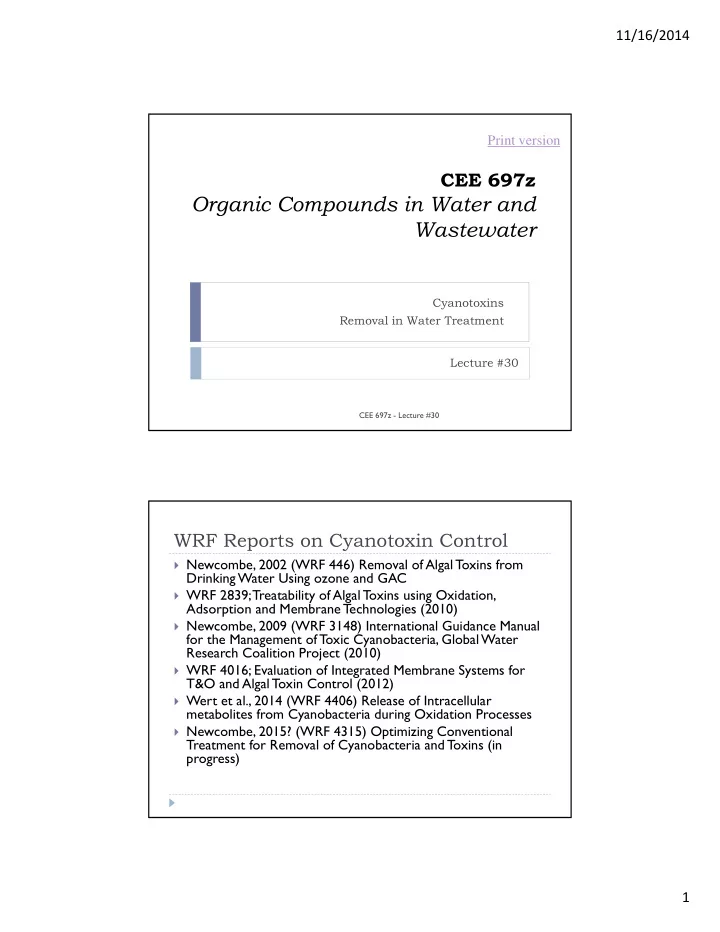
11/16/2014 Print version CEE 697z Organic Compounds in Water and Wastewater Cyanotoxins Removal in Water Treatment Lecture #30 CEE 697z - Lecture #30 WRF Reports on Cyanotoxin Control Newcombe, 2002 (WRF 446) Removal of Algal Toxins
CEE 697z - Lecture #30
water treatment and the
cyanobacteria and cyanotoxins.
Merel, S., Walker, D., Chicana, R., Snyder, S., Baures, E. and Thomas, O. (2013) State of knowledge and concerns on cyanobacterial blooms and
International 59, 303-327.
Merel, S., Walker, D., Chicana, R., Snyder, S., Baures, E. and Thomas, O. (2013) State of knowledge and concerns on cyanobacterial blooms and
International 59, 303-327.
5-chloro- cylindrospermopsin and cylindrospermopsic acid from reaction with chlorine
Merel, S., Walker, D., Chicana, R., Snyder, S., Baures, E. and Thomas, O. (2013) State of knowledge and concerns on cyanobacterial blooms and
International 59, 303-327.
Newcombe, 2002 (WRF 446) Removal of Algal T
Drinking Water Using ozone and GAC
Newcombe, 2002 (WRF 446) Removal
Drinking Water Using ozone and GAC
Newcombe, 2002 (WRF 446) Removal
Drinking Water Using ozone and GAC
Newcombe, 2002 (WRF 446) Removal
Drinking Water Using ozone and G C
CEE 697z - Lecture #30
Newcombe, 2002 (WRF 446) Removal
Drinking Water Using ozone and G C
Newcombe, 2002 (WRF 446) Removal of Algal T
Water Using ozone and GAC
Newcombe, 2002 (WRF 446) Removal of Algal T
Water Using ozone and GAC
Wert et al., 2014 (WRF 4406) Release of Intracellular metabolites from Cyanobacteria during O id i P
CEE 697z - Lecture #30
Wert et al., 2014 (WRF 4406) Release of Intracellular metabolites from Cyanobacteria during Oxidation Processes
Wert et al., 2014 (WRF 4406) Release of Intracellular metabolites from Cyanobacteria during Oxidation Processes
From: Cyanobacteria and Cyanotoxins: Information for Drinking Water Systems , USEPA , July 2012
From: Sklenar, Westrick & Szlag, 2014
From: Sklenar, Westrick & Szlag, 2014 From: Sklenar, Westrick & Szlag, 2014
From: Sklenar, Westrick & Szlag, 2014
Do not use pre‐chlorination for improved coagulation or reduced coagulant dosing during a cyanobacterial bloom unless comprehensive testing has identified a dose high enough to destroy released toxins. Do not apply pre‐chlorination when cyanobacteria producing MIB or geosmin are present.
Potassium permanganate dosing may be applied for the control of manganese and iron in the presence of A. circinalis and M. aeruginosa.
Practice pH control to pH > 6 if this is not part of normal operations. This will reduce the risk of cell lysis and metabolite release during treatment.
Optimize NOM removal using the criteria ∆C/C0 DOC, UV, and color ≤ 0.05 and the cell removal should be optimized as well.
While turbidity cannot be used as an indicator of the presence of cyanobacteria or cell concentration, use the decrease in settled water turbidity with coagulant dose as a surrogate for, or indicator of, cell removal if the initial turbidity is ≈10 NTU or above.
If the presence of cyanobacteria results in increased coagulant demand to achieve improved settled water turbidity the application of a particulate settling aid, or even powdered activated carbon, may lead to improvements.
Although removal of cyanobacteria through conventional coagulation can be very effective, 100% cell removal is unlikely in normal full scale operations. In the event of high cell numbers entering the plant monitor for cell carryover and accumulation in clarifiers, this can lead to serious water quality problems if not rectified.
Once captured in the sludge, cyanobacteria can remain viable and multiply over a period of at least 2‒3
Newcombe, 2014 (WRF 4315, in progress) Optimizing Conventional Treatment for Removal of Cyanobacteria and T
CEE 697z - Lecture #30