Organic Compounds in Water and Wastewater Origins of NOM II - - PDF document

organic compounds in water and wastewater
SMART_READER_LITE
LIVE PREVIEW

Organic Compounds in Water and Wastewater Origins of NOM II - - PDF document

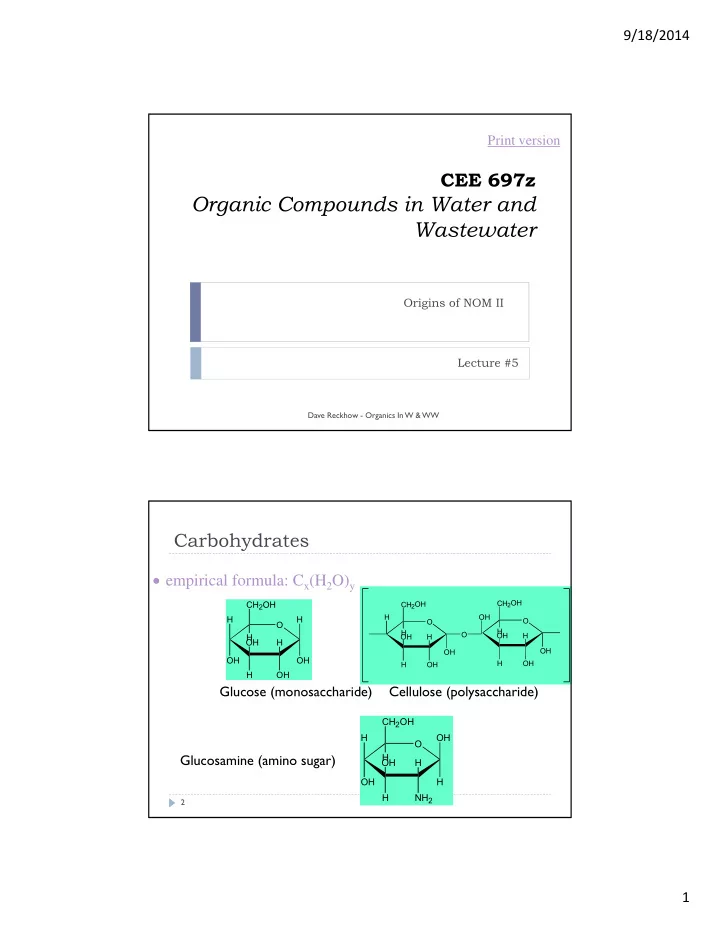
9/18/2014 Print version CEE 697z Organic Compounds in Water and Wastewater Origins of NOM II Lecture #5 Dave Reckhow - Organics In W & WW Carbohydrates empirical formula: C x (H 2 O) y CH 2 OH CH 2 OH CH 2 OH H OH H H O O O H


slide-1
SLIDE 1

9/18/2014 1

CEE 697z

Organic Compounds in Water and Wastewater

Origins of NOM II

Print version

Dave Reckhow - Organics In W & WW

Lecture #5

Carbohydrates

2

 empirical formula: Cx(H2O)y

O H OH H OH OH H OH CH2OH H H

O H H OH OH OH CH2OH H H O H OH OH OH CH2OH H H O OH

Glucose (monosaccharide) Cellulose (polysaccharide)

O H OH H OH NH2 OH H CH2OH H H

Glucosamine (amino sugar)

slide-2
SLIDE 2

9/18/2014 2

Carbohydrates, cont.

 Nomenclature

 Monosaccharide: 1 simple sugar

 1% of DOC

 Oligosaccharide: 10 simple sugars  Polysaccharide: > 10 simple sugars

 5% of DOC

 Special interest in distribution systems

 Food for microbial regrowth  Major constituents of:

 soluble metabolic byproducts  biofilms

Carbohydrates, cont.

 Function in plants

 Structural – cell walls

 Cellulose (~10,000 ᴅ-glucose units)

 Most abundant natural organic compound  Mostly in higher plants; some algae have none

 Hemicelluloses (50-2000 monosaccharides of many types)

 Forms a matrix around cellulose fibers in cell walls

 Chitin (N-acetyl-ᴅ-glucosamine units)

 Second most abundant natural organic (~tied with lignin)  Role of cellulose in most fungi, some algae & arthropods

 Murein or “peptidoglycan”, a major group of Acylheteropolysaccharides

 N-acetyl-ᴅ-glucosamine & N-acetylmuiramic acid cross linked by AA chains  Dominant in Eubacteria: up to 75% of bacterial dry mass

 Energy – polysaccharides

 Starch in plants (80% amylopectin, 20% amylose)

 Anti-dessicants

4

slide-3
SLIDE 3

9/18/2014 3

5

Carbohydrates, cont.

Algae etc., Heteropolysaccharides Nitrogen-containing

Carbohydrates, cont.

6

slide-4
SLIDE 4

9/18/2014 4

Acylheteropolysaccharides (APS)

 10-35% of river and lake water DOC  Produced by algae in fresh and salt waters  Similar to structural polysaccharides?  Comprised of a nearly fixed ratio of simple sugars, acetate

and lipids

 Refractory like humic substances

7 8 From: Perdue & Ritchie, 2004

Sugars in Natural Waters

slide-5
SLIDE 5

9/18/2014 5

Fatty Acids

9

maybe 4% of DOC other mixed acids may account for 2% H-COOH CH3-COOH CH3-CH2-COOH Formic Acid Acetic Acid Propionic Acid CH3-CH2-CH2-COOH H3-CH2-CH2-CH2-COOH Butyric Acid Valeric Acid Common Volatile Fatty Acids in Natural Waters

CH3-COO- At neutral pH’s most lose H+

Amino Acids and Proteins

 Simple Amino Acids

 some may form THMs and

HANs

 Proteins

 much larger, comprised of

many AAs

10

H2C C H COOH NH2

HO C H2 C H NH2 COOH

Tyrosine Alanine Special interests in DWT

– nutrients for bacterial regrowth – role in chlorine decay and DBP formation

slide-6
SLIDE 6

9/18/2014 6

11

Amino Acids

From: Perdue & Ritchie, 2004

Terpenes and Terpenoids

 The terpenoids, sometimes called isoprenoids, are a large and diverse class of

naturally occurring organics similar to terpenes, derived from five- carbon isoprene units assembled and modified in thousands of ways.

T erpenoids can be thought of as modified terpenes, wherein methyl groups have been moved or removed, or oxygen atoms added.

 Plant terpenoids are used extensively for their aromatic qualities. They play a role in

traditional herbal remedies and are under investigation for antibacterial, antineoplastic, and other pharmaceutical functions. Terpenoids contribute to the scent of eucalyptus, the flavors of cinnamon, cloves, and ginger, the yellow color in sunflowers, and the red color in tomatoes.

 Terpenoids can be classified according to the number of isoprene units used:

Hemiterpenoids, 1 isoprene unit (5 carbons)

Monoterpenoids, 2 isoprene units (10C)

Sesquiterpenoids, 3 isoprene units (15C)

Diterpenoids, 4 isoprene units (20C) (e.g. ginkgolides)

Sesterterpenoids, 5 isoprene units (25C)

Triterpenoids, 6 isoprene units (30C) (e.g. sterols)

T etraterpenoids, 8 isoprene units (40C) (e.g. carotenoids)

Polyterpenoid with a larger number of isoprene units

12

From Wikipedia
slide-7
SLIDE 7

9/18/2014 7

Terpenoids

13

Terpenoids, cont.

14

slide-8
SLIDE 8

9/18/2014 8

15

Iron Complexation Van Krevlin Plot

16

slide-9
SLIDE 9

9/18/2014 9

Putting it all together?

17

COOH O COOH COOH COOH HOOC HOOC HO OH COOH H3CO OH Hydroxy Acid Aromatic Dicarboxylic Acid Aromatic Acid Aliphatic Acid Aliphatic Dicarboxylic Acid Phenolic-OH HO

From Thurman, 1985

 Many identifiable precursor

structures

 Not practical or even possible

Concentrations: Pedogenic

 Land Sources

 From Woody & non-woody plants, lignin, etc.  Depends on vegetation, soil, hydrology

 Attenuated by adsorption to clay soils

 Parallel watersheds in Australia (Cotsaris et al., 1994 [Chamonix

proceedings])

 Clearwater Creek, high clay content: 2.5 mg/L TOC  Redwater Creek, sandy soil: 31.7 mg/L TOC

18

slide-10
SLIDE 10

9/18/2014 10

Concentrations: Aquagenic

 Algal & aquatic plant Sources

 Depend on nutrient levels / trophic state

 Concentrations in Lakes (mg/L) (Thurman, 1985)  Groundwater average: 0.7 mg/L

 No algae, much soil attenuation

19

Trophic State Mean DOC Range

Oligotrophic 2 1-3 Mesotrophic 3 2-4 Eutrophic 10 3-34 Dystrophic 30 20-50

MW vs type

20

Henderson et al., 2008

 Algogenic organic matter

(AOM)

 Proteins & carbohydrates  Large polymers with

monomers

slide-11
SLIDE 11

9/18/2014 11

Algae as THM Precursors

 From: Plummer & Edzwald, 2001

[ES&T:35:3661]

21

Scenedesmus quadricauda Cyclotella sp.

~25% from EOM

pH 7, 20-24ºC, chlorine excess Algae

Algae as TCAA Precursors

 Not much impact?

22

pH 7, 20-24ºC, chlorine excess Algae

slide-12
SLIDE 12

9/18/2014 12

Algae as DCAA Precursors

 Are Algae important sources of dihalo-AA precursors?

23

pH 7, 20-24ºC, chlorine excess Algae

Annual TOC Cycles

 Edisto River

 Former source

for Charleston’s (SC) Hanahan WTP

 Flushing of TOC

during high rainfall months (cold period)

24 ICR Month

2 4 6 8 10 12 14 16 18 20

TOC (mg/L) or SUVA (m-1)

2 4 6 8 10 12 14 16 18

Approximate Date

6/1/1997 7/1/1997 8/1/1997 9/1/1997 10/1/1997 11/1/1997 12/1/1997 1/1/1998 2/1/1998 3/1/1998 4/1/1998 5/1/1998 6/1/1998 7/1/1998 8/1/1998 9/1/1998 10/1/1998 11/1/1998 12/1/1998 1/1/1999 2/1/1999 TOC: Kornegay SUVA: ICR TOC: ICR

Hanahan WTP Charleston, SC

Influent Water

Period

  • f High

Runoff

slide-13
SLIDE 13

9/18/2014 13

Annual TOC Cycles

 Lake Lanier

 Source for

Gwinnett Co.’s (GA) Lanier WTP

 High clay content

in watershed

25 ICR Month

2 4 6 8 10 12 14 16 18 20

TOC (mg/L) or SUVA (m-1)

0.0 0.5 1.0 1.5 2.0 2.5 3.0 3.5 4.0

Approximate Date

6/1/1997 7/1/1997 8/1/1997 9/1/1997 10/1/1997 11/1/1997 12/1/1997 1/1/1998 2/1/1998 3/1/1998 4/1/1998 5/1/1998 6/1/1998 7/1/1998 8/1/1998 9/1/1998 10/1/1998 11/1/1998 12/1/1998 1/1/1999 2/1/1999 TOC: Kornegay data SUVA: ICR TOC: ICR

Lake Lanier WTP Gwinnet Co., GA

Influent Water

High photosynthetic activity

26

Day of Year

50 100 150 200 250 300 350

UV285 (cm

  • 1)

0.00 0.01 0.02 0.03 0.04 0.05 0.06 0.07 0.08 0.09 0.10 DOC (mg/L) 1 2 3 4 5 6

DOC (mg/L)

1 2 3 4 5

Depth (m)

2 4 6 8 10 12 14 16 18 20 UV285 (cm-1) 0.00 0.02 0.04 0.06 0.08 UV DOC

DOC (mg/L)

1 2 3 4 5

Depth (m)

2 4 6 8 10 12 14 16 18 20 UV285 (cm-1) 0.00 0.02 0.04 0.06 0.08 UV DOC DOC UV

Spatial and Temporal Distribution of DOC and UV absorbing Substances in Lake Bret (from Zumstein & Buffle, 1989; and Krasner et al., 1996)

slide-14
SLIDE 14

9/18/2014 14

THM Precursor Study

 Cannonsville

Reservoir

 Catskill-

Delaware water supply for NYC

 Stepczuk et al.,

1998

 J. Lake Res. Mgmt.

14(2-3)356

27

Both Epilimnion Epilimnion Hypolimnion

28

Plant biochemicals

 Sugars, starches  Proteins  Cellulose  Hemicellulose  Fats & waxes  Lignins & phenolics  Low  Moderate  Low  Low  Low  high Decreasing biodegradability Simplification: Doesn’t explicitly consider bacterial metabolites

Terpenoids - ??

slide-15
SLIDE 15

9/18/2014 15

29

Dihalo and Trihalo DBPs

 NOM Fractions

 Evidence for

greater importance of dihalo species in non-lignin based NOM

30 Specific UV absorbance @ 254 nm (L/m/mg-C)

1 2 3 4 5 6 7 8 9 10

CX2/CX3 Formation Potential (M/

0.0 0.2 0.4 0.6 0.8 1.0 1.2 1.4 Humic Acid Fulvic Acid Weak Hydrophobic Acids Hydrophobic Bases Hydrophobic Neutrals Hydrophilic Acids Ultra Hydrophilic Acids Hydrophilic Bases Hydrophilic Neutrals regression

Raw Waters

b[0]=0.4813029679 b[1]=-0.0290898677 r ²=0.1466315169

slide-16
SLIDE 16

9/18/2014 16

DHAN/THM Ratio vs SUVA

31

Specific UV absorbance @ 254 nm (L/m/mg-C)

1 2 3 4 5 6 7 8 9 10 11

DHAN/THM Formation Potential (g/g)

0.0 0.1 0.2 0.3 0.4 1.5 1.6 1.7 1.8 1.9 2.0 2.1 Humic Acid Fulvic Acid Weak Hydrophobic Acids Hydrophobic Bases Hydrophobic Neutrals Hydrophilic Acids Ultra Hydrophilic Acids Hydrophilic Bases Hydrophilic Neutrals regression

All Samples

b[0]=0.20 b[1]=-0.0177 r ²=9.2e-3

DOC and runoff

 Ogeechee River (GA)

 From Aiken & Cotsaris, 1995

 [JAWWA 87(1)36]

32

slide-17
SLIDE 17

9/18/2014 17

33

Drinking water source Water treatment plant Municipal use NOM, DBPs NOM, DBPs plant Wastewater treatment EfOM: NOM, DBPs SMPs Ambient water (river) NOM

Wastewater reclamation and reuse

What is EfOM?

EfOM  NOM + SMPs

from : Krasner & Am y Dave Reckhow - Organics In W & WW

 To next lecture