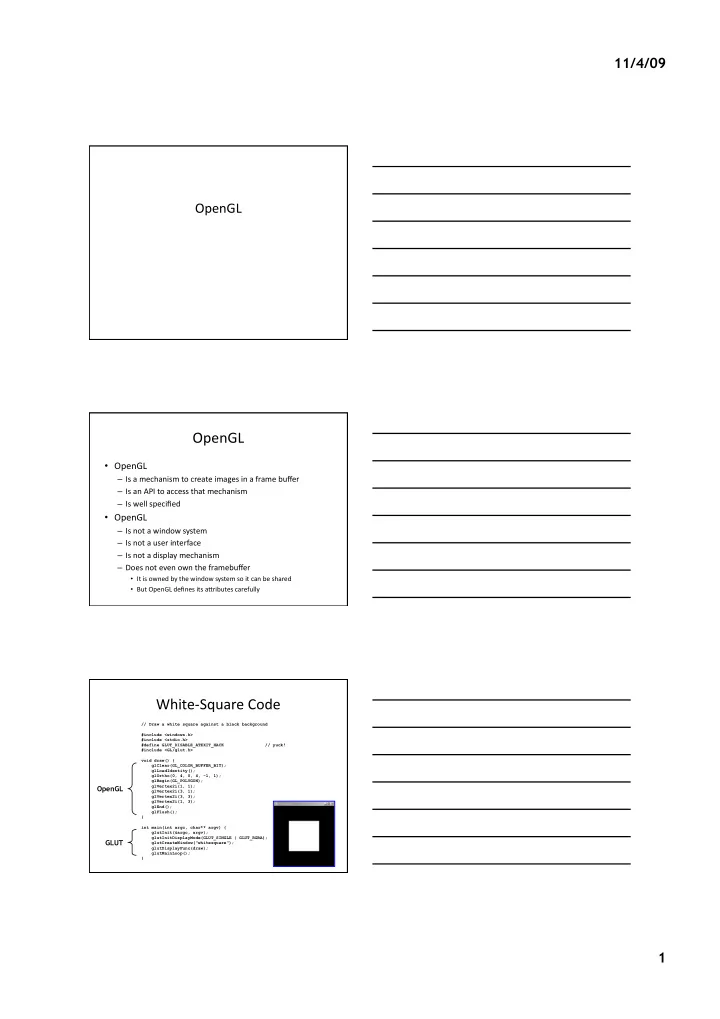
OpenGL OpenGL Isamechanismtocreateimagesinaframebuffer - - PDF document

opengl
SMART_READER_LITE
LIVE PREVIEW

OpenGL OpenGL Isamechanismtocreateimagesinaframebuffer - - PDF document

11/4/09 OpenGL OpenGL OpenGL Isamechanismtocreateimagesinaframebuffer IsanAPItoaccessthatmechanism Iswellspecified OpenGL


slide-1
SLIDE 1

11/4/09 1 OpenGL


OpenGL


  • OpenGL


– Is
a
mechanism
to
create
images
in
a
frame
buffer
 – Is
an
API
to
access
that
mechanism
 – Is
well
specified


  • OpenGL


– Is
not
a
window
system
 – Is
not
a
user
interface
 – Is
not
a
display
mechanism
 – Does
not
even
own
the
framebuffer


  • It
is
owned
by
the
window
system
so
it
can
be
shared

  • But
OpenGL
defines
its
aAributes
carefully


White‐Square
Code


// Draw a white square against a black background #include <windows.h> #include <stdio.h> #define GLUT_DISABLE_ATEXIT_HACK // yuck! #include <GL/glut.h> void draw() { glClear(GL_COLOR_BUFFER_BIT); glLoadIdentity(); glOrtho(0, 4, 0, 4, -1, 1); glBegin(GL_POLYGON); glVertex2i(1, 1); glVertex2i(3, 1); glVertex2i(3, 3); glVertex2i(1, 3); glEnd(); glFlush(); } int main(int argc, char** argv) { glutInit(&argc, argv); glutInitDisplayMode(GLUT_SINGLE | GLUT_RGBA); glutCreateWindow("whitesquare"); glutDisplayFunc(draw); glutMainLoop(); }

OpenGL GLUT

slide-2
SLIDE 2

11/4/09 2 OpenGL
PorGon
of
White‐Square
Code


glClear(GL_COLOR_BUFFER_BIT); // black background glLoadIdentity(); glOrtho(0, 4, 0, 4, -1, 1); // int cast to double glBegin(GL_POLYGON); // draw white square glVertex2i(1, 1); glVertex2i(3, 1); glVertex2i(3, 3); glVertex2i(1, 3); glEnd(); glFlush(); // force completion

Red‐Book
Example


glClearColor(0.0, 0.0, 0.0, 0.0); glClear(GL_COLOR_BUFFER_BIT); glColor3f(1.0, 1.0, 1.0); glOrtho(0.0, 1.0, 0.0, 1.0, -1.0, 1.0); glBegin(GL_POLYGON); glVertex3f(0.25, 0.25, 0.0); glVertex3f(0.75, 0.25, 0.0); glVertex3f(0.75, 0.75, 0.0); glVertex3f(0.25, 0.75, 0.0); glEnd(); glFlush(); // force completion

State
tables


OpenGL 2.0 Spec, Table 6.21. Framebuffer Control COLOR_CLEAR_VALUE 0,0,0,0

slide-3
SLIDE 3

11/4/09 3

State
tables


OpenGL
2.0,
Table
6.5.
Current
Values
and
Associated
Data 


Snippet
From
the
OpenGL
2.0
Spec


  • VerGces
are
specified
by
giving
their
coordinates
in
two,
three,

  • r
four
dimensions.
This
is
done
using
one
of
several
versions

  • f
the
Vertex
command:

  • void
Vertex{234}{sifd}(
T
coords
);

  • void
Vertex{234}{sifd}v(
T
coords
);

  • A
call
to
any
Vertex
command
specifies
four
coordinates:
x,
y,


z,
and
w.
The
x
coordinate
is
the
first
coordinate,
y
is
second,
z
 is
third,
and
w
is
fourth.
A
call
to
Vertex2
sets
the
x
and
y
 coordinates;
the
z
coordinate
is
implicitly
set
to
zero
and
the
 w
coordinate
to
one.


OpenGL
Philosophy


  • PlaXorm
and
window
system
independent

  • Rendering
only

  • Aims
to
be
real‐Gme

  • Takes
advantage
of
graphics
hardware
where


it
exists


  • State
system

  • Client‐server
system


  • Immediate
mode

slide-4
SLIDE 4

11/4/09 4

The
OpenGL
Pipeline
 OpenGL
Shaded‐Quad
Code


glClearColor(1, 1, 1, 1); // white glClear(GL_COLOR_BUFFER_BIT); glLoadIdentity(); glOrtho(0, 100, 0, 100, -1, 1); glBegin(GL_TRIANGLE_STRIP); glColor3f(0, 0.5, 0); // dark green glVertex2i(11, 31); glVertex2i(37, 71); glColor3f(0.5, 0, 0); // dark red glVertex2i(91, 38); glVertex2i(65, 71); glEnd(); glFlush();

OpenGL
Pipeline


  • Emphasis
is
on
data
types

  • Diagram
ignores


– Pixel
pipeline
 – Texture
memory
 – Display
lists
 – …


  • Display
is
not
part
of
OpenGL


Vertex assembly Primitive assembly Rasterization Fragment operations Display Vertex operations

Application

Primitive operations Framebuffer

slide-5
SLIDE 5

11/4/09 5

Vertex
Assembly
(data
types)


struct { float x,y,z,w; float r,g,b,a; } vertex;

Vertex assembly Primitive assembly Rasterization Fragment operations Display Vertex operations

Application

Primitive operations Framebuffer

Vertex
Assembly
(OpenGL)


  • Vertex
assembly


– Force
input
to
canonical
format


  • Convert
to
internal
representaGon


– E.g.,
x,
y
to
float


  • IniGalize
unspecified
values


– E.g.,
z
=
0,
w=1


  • Insert
current
modal
state


– E.g.,
color
to
0,0.5,0,1


– Or
create
using
evaluators


  • Error
detecGon


– INVALID_ENUM
 – INVALID_VALUE
 – INVALID_OPERATION


  • Especially
between
Begin
and
End


Vertex assembly Primitive assembly Rasterization Fragment operations Display Vertex operations

Application

Primitive operations Framebuffer struct { float x,y,z,w; // 11, 31, 0, 1 float r,g,b,a; // 0, 0.5, 0, 1 } vertex; Vertex assembly Primitive assembly Rasterization Fragment operations Display Vertex operations

Application

Primitive operations glColor3f(0, 0.5, 0); glVertex2i(11, 31); glVertex2i(37, 71); glColor3f(0.5, 0, 0); // no effect struct { float x,y,z,w; // 37, 71, 0, 1 float r,g,b,a; // 0, 0.5, 0, 1 } vertex; Framebuffer

Vertex
Assembly
(OpenGL)


slide-6
SLIDE 6

11/4/09 6

Vertex
OperaGons


  • OpenGL


– Transform
coordinates


  • 4x4
matrix
arithmeGc


– Compute
(vertex)
lighGng
 – Compute
texture
coordinates
 – …


  • In
our
case:


– Scale
(arbitrary
100x100)
coordinates

 to
fit
window
 – No
lighGng,
no
texture
coordinates


Vertex assembly Primitive assembly Rasterization Fragment operations Display Vertex operations

Application

Primitive operations Framebuffer

PrimiGve
Assembly
(data
types)


Vertex assembly Primitive assembly Rasterization Fragment operations Display Vertex operations

Application

Primitive operations

struct { float x,y,z,w; float r,g,b,a; } vertex; struct { vertex v0,v1,v2; } triangle; struct { vertex v0,v1; } line; struct { vertex v0; } point;

  • r
  • r

Framebuffer

PrimiGve
Assembly


  • OpenGL


– Group
verGces
into
primiGves:


  • points,

  • lines,
or

  • triangles


– Decompose
polygons
to
triangles
 – Duplicate
verGces
in
strips
or
fans


  • In
our
case:


– Create
two
triangles
from
a
strip:
 Vertex assembly Primitive assembly Rasterization Fragment operations Display Vertex operations

Application

Primitive operations

glBegin(GL_TRIANGLE_STRIP); glColor(green); glVertex2i(…); // 0 glVertex2i(…); // 1 glColor(red); glVertex2i(…); // 2 glVertex2i(…); // 3 glEnd();

1 3 2 Framebuffer

slide-7
SLIDE 7

11/4/09 7

PrimiGve
OperaGons


  • OpenGL


– Clip
to
the
window
boundaries


  • Actually
to
the
frustum
surfaces


– Perform
back‐face
/
front‐face
ops


  • Culling

  • Color
assignment
for
2‐side
lighGng

  • In
our
case


– Nothing
happens


Vertex assembly Primitive assembly Rasterization Fragment operations Display Vertex operations

Application

Primitive operations Framebuffer

RasterizaGon
(data
types)


Vertex assembly Primitive assembly Rasterization Fragment operations Display Vertex operations

Application

Primitive operations

struct { float x,y,z,w; float r,g,b,a; } vertex; struct { vertex v0,v1,v2 } triangle; struct { short int x,y; float depth; float r,g,b,a; } fragment;

Framebuffer

RasterizaGon


OpenGL
 – Determine
which
pixels
are
included
in
 the
primiGve


  • Generate
a
fragment
for
each
such
pixel


– Assign
aAributes
(e.g.,
color)
to
each
 fragment
 In
our
case:


Vertex assembly Primitive assembly Rasterization Fragment operations Display Vertex operations

Application

Primitive operations Framebuffer

slide-8
SLIDE 8

11/4/09 8

Fragment
OperaGons


OpenGL
 – Texture
mapping
 – Fragment
lighGng
(OpenGL
2.0)
 – Fog
 – Scissor
test
 – Alpha
test
 In
our
case,
nothing
happens:


Vertex assembly Primitive assembly Rasterization Fragment operations Display Vertex operations

Application

Primitive operations Framebuffer

Framebuffer
(2‐D
array
of
pixels)


Vertex assembly Primitive assembly Rasterization Fragment operations Display Vertex operations

Application

Primitive operations

struct { float x,y,z,w; float r,g,b,a; } vertex; struct { vertex v0,v1,v2 } triangle; struct { short int x,y; float depth; float r,g,b,a; } fragment; struct { int depth; byte r,g,b,a; } pixel;

Framebuffer

Fragment

Framebuffer
Ops


OpenGL


– Color
blending
 – Depth
tesGng
(aka
z‐buffering)
 – Conversion
to
pixels


In
our
case,
conversion
to
pixels:


Vertex assembly Primitive assembly Rasterization Fragment operations Display Vertex operations

Application

Primitive operations

Key
idea:
images
are
 built
in
the
 framebuffer,
not
just
 placed
there! 


Framebuffer

slide-9
SLIDE 9

11/4/09 9

Some
more
detail…
 Modeling
and
Viewing


  • OpenGL
provides
no
funcGons
itself
for


directly
specifying
a
view


– it
has
no
‘policy’
for
how
a
‘camera’
is
to
be
 specified


  • It
provides
no
data
structures
for
model


hierarchies.


  • Instead
it
provides
fundamental
tools
that


allow
the
construcGon
of
many
different
 camera
models
and
hierachies.


Modelview
Matrix


  • A
stack
of
matrices
is
maintained
called
the


‘modelview’
stack.


  • The
current
modelview
matrix
is
used
to


mulGply
verGces
at
the
first
stage
of
the
 rendering
pipeline


– equivalent
to
matrix
C.M


(OpenGL
notaGon)


  • C
=
CTM,
M:
WC‐>VC

  • glMatrixMode(GL_MODELVIEW)


– making
changes
to
modelview


slide-10
SLIDE 10

11/4/09 10

Matrix
OperaGons


  • glLoadMatrix{f}{d}(const
GLfloat
*m);


– replaces
current
matrix


  • glMultMatrix{f}{d}
(const
GLfloat
*m);


– if
c
is
current
matrix
then
cm
is
the
new
one


  • glPushMatrix{f}{d}
();


– pushes
copy
of
current
matrix
down
on
stack;


  • glPopMatrix();


– restores
top
of
stack
to
be
current
matrix.


Example:
Object
Hierarchy


  • Suppose
the
current
modelview
matrix
is
M:


WC‐>VC
(i.e.,
based
on
VRP,
VPN,VUV).


  • GObject
*object;
//pointer
to
graphics
object


– glMatrixModel(GL_MODELVIEW);
 – glPushMatrix();
//
push
and
duplicate
current
matrix
 – glMultMatrix(object‐>CTM);
//
mulGply
M
by
CTM
 – myDraw(
object
);

//
now
draw
all
faces
in
object
 – glPopMatrix();
//restore
original
M


The
ProjecGon
Matrix


  • glMatrixMode(GL_PROJECTION);


– subsequent
matrix
ops
affect
this
stack
(only
2
 deep)


  • A
perspecGve
projecGon
can
be
specified
by:‐


– glLoadIdenGty();
 – glFrustum(len,
right,
boAom,
top,
near,
far);


  • each
argument
is
GLdouble


slide-11
SLIDE 11

11/4/09 11

TransformaGons


  • glTranslate{d}{f}(x,y,z);


– translaGon
matrix
T(x,y,z)


  • glScale{d}{f}(x,y,z);


– scaling
matrix
S(x,y,z)


  • glRotate{d}{f}(angle,
x,
y,
z);


– matrix
for
posiGve
(anG‐clockwise)
rotaGon


  • f
angle
degrees
about
vector
(x,y,z)

  • If
C
is
current
matrix,
and
Q
is
transformaGon


matrix,
then
new
current
matrix
is
CQ

 (OpenGL
notaGon)


CauGons


  • OpenGL
uses
a
RH
coordinate
system


throughout
(hence
the
default
VPN
is
the
 negaGve
z‐axis).


  • It
adopts
the
convenGon
of
points
as
column


vectors
and
post‐mulGplicaGon:


  • The
transpose
of
all
our


matrices
should
be
used!


Shading
and
Colours


  • Shading
properGes


– glShadeModel(GL_SMOOTH
|
GL_FLAT)


  • Colour


– glColorNT{V}(r,g,b,{a})


  • N=3,4

  • T=b,s,i,ub,ui,us

  • v
implies
passing
a
pointer
to
array
of
colours

slide-12
SLIDE 12

11/4/09 12

LighGng
and
Materials


  • Many
lighGng
parameters

  • Specify
a
material
for
primiGves


– emissive,
ambient,
shininess,
specular
 – GLfloat
mat_spec
=
{
0.5,
0.5,
1.0,
1.0};
 – glMaterialfv(GL_FRONT,
GL_SPECULAR,
mat_spec)
 – glColorMaterial(GL_FRONT,
GL_DIFFUSE)


Lights


  • Must
enable
a
light
with
materials


– GLfloat
light_pos
={
1.0,
2.0,
1.0,
0.0}
 – glLighXv(GL_LIGHT0,
GL_POSITION,
light_pos)
 – glEnable(GL_LIGHTING)
 – glEnable(GL_LIGHT0)


Fixed
OpenGL
Pipeline


Geometry
 ModelView
 TransformaPon
 PerspecPve
 TransformaPon
 Viewport
 TransformaPon
 and
Clipping
 LighPng


Geometry
Processing
(T&L)


(MulP‐)Texturing
 Scan‐Conversion
 Fog Scissor
|
Alpha
|
Stencil
|
Depth
|
Blending
|
Dither
|
LogicOp


RasterizaPon
 Per
Fragment
OperaPons


Frame‐Buffer


slide-13
SLIDE 13

11/4/09 13

  • Vertex
Shader
has
to
do
everything


(except
clipping)


Vertex
Shaders


Geometry
 ModelView
 TransformaPon
 PerspecPve
 TransformaPon
 Viewport
 TransformaPon
 and
Clipping
 LighPng


Geometry
Processing
(T&L)
 SubsPtute
fixed
 funcPon
pipeline
with
 programmable
version


User‐Defined

 Vertex
Processing


Vertex
Shaders:
What
for?


  • Custom
transform,
lighGng,
and
skinning


Vertex
Programs:
What
for?


  • Custom
cartoon‐style
lighGng

slide-14
SLIDE 14

11/4/09 14

Vertex
Shaders:
What
for?


  • Dynamic
displacements
of
surfaces
by
objects


Vertex
Shaders


  • What
is
a
vertex
shader?


– A
small
program
running
on
GPU
for
each
vertex
 – GPU
instrucGon
set
to
perform
all
vertex
math
 – Reads
an
untransformed,
unlit
vertex
 – Creates
a
transformed
vertex
 – OpGonally
…


  • Lights
a
vertex

  • Creates
texture
coordinates

  • Creates
fog
coordinates

  • Creates
point
sizes

  • Latest
GPUs:
can
read
from
texture


Pixel
Shaders


(MulP‐)Texturing
 Scan‐Conversion
 Fog


RasterizaPon


SubsPtute
fixed
funcPon
 pipeline
with
 programmable
version


User‐Defined

 Fragment
Processing


(MulP)‐Texturing 


slide-15
SLIDE 15

11/4/09 15

Pixel
Shaders


  • LiAle
assembly
program
for
every
pixel

  • What
for?


E.g.,
per‐pixel
lighGng


Pixel
Shaders


  • What
is
a
pixel
shader?


– A
small
program
running
on
GPU
for
each
fragment
 – GPU
instrucGon
set
to
perform
math
(lin.
algebra,
…)
 – Takes
a
fragment
(depth/color)
and
texture
coordinates
 – Creates
an
output
color
(or
discard)
 – OpGonally
…


  • Read
texture

  • Perform
computaGon


Summary


  • OpenGL
is
an
architecture


– Mechanism
(the
OpenGL
pipeline)
 – Interface
(API)
to
feed
and
manage
the
mechanism


  • The
pipeline
is
best
understood
in
terms
of
data


types:


– Vertex
 – PrimiGve
(point,
line,
triangle)
 – Fragment
 – Pixel


slide-16
SLIDE 16

11/4/09 16

Coursework 


  • Second
coursework:
OpenGL

  • Due:
Wednesday


16/Dec/2009


  • Hand
in
both:


– Write‐up
 – Code
(‘handin’)


End