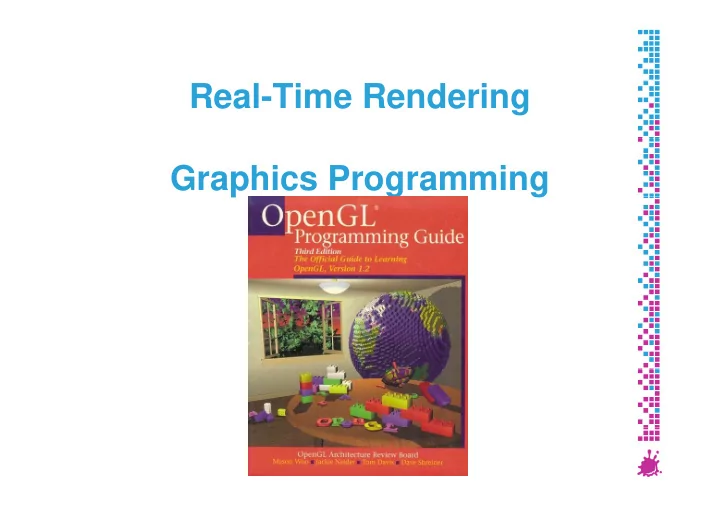
Real-Time Rendering Graphics Programming p g g Graphics - - PowerPoint PPT Presentation
Real-Time Rendering Graphics Programming p g g Graphics Libraries (APIs) Give access to graphics hardware D Declarative (What, not How) l ti (Wh t t H ) Describe the scene (e.g., scene graphs) SGI Open Inventor, SGI Performer,
Graphics Libraries (APIs) Give access to graphics hardware… D l ti (Wh t t H ) Declarative (What, not How)
Describe the scene (e.g., scene graphs) SGI Open Inventor, SGI Performer, Renderman OpenSceneGraph Renderman, OpenSceneGraph…
Imperative (How, not What)
Sequence of drawing commands OpenGL, DirectX (Direct3D), Postscript OpenGL, DirectX (Direct3D), Postscript More direct control
Vienna University of Technology 2
Graphics Libraries (APIs) Using a scene graph API… Application Application Application Application Scenegraph Scenegraph Scenegraph Scenegraph Application Application Application Application Windows/Linux Windows/Linux Windows/Linux Windows/Linux OpenGL OpenGL OpenGL OpenGL Scenegraph Scenegraph Scenegraph Scenegraph Windows/Linux Windows/Linux Windows/Linux Windows/Linux OpenGL OpenGL OpenGL OpenGL Hardware Hardware Hardware Hardware
Vienna University of Technology 3
Graphics Libraries (APIs) Using an immediate-mode API… Application Application Application Application GLUT GLUT GLUT GLUT Application Application Application Application Windows/Linux Windows/Linux Windows/Linux Windows/Linux OpenGL OpenGL OpenGL OpenGL GLUT GLUT GLUT GLUT Windows/Linux Windows/Linux Windows/Linux Windows/Linux OpenGL OpenGL OpenGL OpenGL Hardware Hardware Hardware Hardware
Vienna University of Technology 4
Immediate vs. Retained Immediate (OpenGL)
Total control over rendering Total control over rendering
traversal and data structures and formats
Many subroutine calls Driver cannot optimize Driver cannot optimize
Retained (scene graph, display lists)
Driver can optimize execution of display lists API can optimize traversal of scene graph API can optimize traversal of scene graph
for different platforms!
T l i diffi lt t h
Vienna University of Technology 5
Traversal is difficult to change
The OpenGL Graphics System Web site: www.opengl.org O GL t d k d b SGI OpenGL trademark owned by SGI
More than 70 licensees
OpenGL is controlled by the “ARB”
Architecture Review Board Architecture Review Board Members: Compaq, IBM, Intel, Microsoft, SGI, Evans & Sutherland, HP, Sun, NVidia, ATI, Apple pp Meeting notes on the Web follow ARB decisions discussions
Vienna University of Technology 6
follow ARB decisions, discussions, …
A Short OpenGL Freshup All primitives made up of vertices…
G O S GL POINTS GL_LINES GL_LINES GL_POLYGON GL_POLYGON GL LINE LOOP GL LINE LOOP GL LINE STRIP GL LINE STRIP GL_POINTS GL_POINTS _ _ _ _ _ _ _ _ GL_TRIANGLES GL_TRIANGLES GL QUAD STRIP GL QUAD STRIP GL TRIANGLE FAN GL TRIANGLE FAN GL TRIANGLE STRIP GL TRIANGLE STRIP GL_QUADS GL_QUADS
Vienna University of Technology 7
GL_QUAD_STRIP GL_QUAD_STRIP _ _ _ _ GL_TRIANGLE_STRIP GL_TRIANGLE_STRIP
A Short OpenGL Freshup Shading: From wire frame to texture mapped From wire frame to texture mapped…
Wire frame (hidden line) flat shading Gouraud Textured (Combination)
Vienna University of Technology 8
Gouraud Textured (Combination)
Short History of OpenGL
1982 Silicon Graphics (SGI) incorporated 1983 IRIS GL on IRIS 1000 terminal (the predecessor to OpenGL) (the predecessor to OpenGL) 1991 OpenGL ARB created 1992 OpenGL 1.0 (June 30) 1995 OpenGL 1 1 1995 OpenGL 1.1 1996 OpenGL specification made public 1998 OpenGL 1.2 O G 2000 OpenGL goes open source 2001 OpenGL 1.3 2002 OpenGL 1.4 2002 OpenGL 1.4 2003 OpenGL 1.5 2004 OpenGL 2.0 (Shaders) 2008 OpenGL 3 0 (Depreciation model) 2008 OpenGL 3.0 (Depreciation model) 2008 OpenGL 3.0 (Depreciation model) 2009 OpenGL 3.2 (Geometry shaders) 2010 O GL 4 0 (T l ti )
Vienna University of Technology 9
2010 OpenGL 4.0 (Tesselation)
Modern Graphics Pipeline
Application Command Geometry Rasterization Texture Texture Fragment Display
Vienna University of Technology 10
OpenGL Programing Model OpenGL is a state machine
All command change state All command change state Only glVertex causes action
Vienna University of Technology 11
Vienna University of Technology 12
OpenGL Design Goals
Platform independent (unlike DirectX)
Window-system dependent code separate (GLX Window system dependent code separate (GLX, WGL) Implementations on Windows Linux MacOS Be Implementations on Windows, Linux, MacOS, Be, OS/2, Unix, … Language independent (bindings for C Java Language independent (bindings for C, Java, Fortran, …)
Consistency (unlike DirectX 9) Consistency (unlike DirectX 9)
Tightly written specification Conformance tests and required verification Not too tight: not pixel exact
Vienna University of Technology 13
Invariance across passes (for correct multipass)
OpenGL Design Goals Complete implementations (unlike DirectX 9)
Missing hardware features emulated in Missing hardware features emulated in software Silent error recovery Silent error recovery
Clean interface (unlike DirectX 9)
State machine Most states are orthogonal (i.e., don’t g ( , influence each other, no side effects!)
Extensibility (unlike DirectX 9) Extensibility (unlike DirectX 9)
Favors innovation N HW f t fi t il bl O GL!
Vienna University of Technology 14
New HW features first available on OpenGL!
More Goals High quality I t iti bilit (b t t ) Intuitive usability (beauty counts) Good documentation (Programming Guide) ( g g ) Long life…
Vienna University of Technology 15
OpenGL Problems
Extensibility
Different extensions for different GPUs Different extensions for different GPUs Hell for production code (games)
D i b itt Design by committee
Unified extension interfaces take long time Very slow to adopt non-GPU specific features (e.g.,
- ffscreen buffers)
Non-existent toolset
Shading debuggers (but: gDebugger) g gg ( g gg ) Performance tools (but: NVPerfKit) Mesh tools (already included in DirectX)
Vienna University of Technology 16
Mesh tools (already included in DirectX)
Mediocre driver support
OpenGL Extensions SGI maintains central registry C f ll d t d Carefully documented
Takes into account previous extensions New OpenGL version could be implemented by applying all extensions by applying all extensions
A bit difficult to read
Read overview, then “Additions to…”
Very stable process Very stable process
Extensions are refined and improved…
Vienna University of Technology 17
OpenGL Extension Categories
Proprietary: suffixed with vendor
e g SGIS texture lod NV fragment program e.g., SGIS_texture_lod, NV_fragment_program
EXT suffix
I l t d b t l t 2 d ( ll NV AMD) Implemented by at least 2 vendors (usually NV,AMD) e.g. EXT_blend_func_separate
ARB suffix
Specification controlled by ARB p y ARB_multitexture
1 x: no suffix 1.x: no suffix
Required feature for version 1.x
Vienna University of Technology 18
Vienna University of Technology 19
Vienna University of Technology 20
Vienna University of Technology 21
Vienna University of Technology 22
Using Extensions Get glext.h from www.opengl.org Ch k f t i il bilit Check for extension availability Acquire function pointer(s) (only Win32) q p ( ) ( y ) Easier: use glew or glee
Vienna University of Technology 23
OpenGL 2.0 Main novelty: shading language GLSL V t d f t h d Vertex and fragment shaders
Replace fixed functionality
Shader: high-level language (C-like) O GL d i il d li k f OpenGL driver: compiler and linker for shaders Vertex-, texture coordinates etc.: abstract input values to shader function abstract input values to shader function Arbitrary calculations possible
Vienna University of Technology 24
Requires DX9 (GeforceFX/6) cards
OpenGL 3.0 Not much new V t A Obj t Vertex Array Objects
Encapsulate VBO state
sRGB framebuffers T t Texture arrays Transform feedback Extensions: geometry shaders, instancing, ... D i ti h i ! Depreciation mechanism!
Vienna University of Technology 25
OpenGL 3.2 Geometry shaders
Vienna University of Technology 26
OpenGL 4.0/3.3 Tesselation Ti i Timer queries Double precision floating point p g p Etc. O GL 3 3 f tibilit ith ld OpenGL 3.3: for compatibility with older hardware
Vienna University of Technology 27
OpenGL ES For embedded systems R d d i t ti t Reduced instruction set Developers love it p OpenGL 4.1 is backwards compatible with OpenGL ES! OpenGL ES!
Vienna University of Technology 28
OpenGL Architecture Symmetric geometry and image paths O ti i d d t (“ th l”) Operations independent (“orthogonal”)
Unpack Pixels Pixel Operations Image Rasterization Pack Texture Fragment Image Pack Pixels Memory Operations Point, Line, Polygon Rasterization Unpack Vertexes Vertex Operations Frame Buffer Geometry
Vienna University of Technology 29
Rasterization
Typical OpenGL Block Diagram
Vienna University of Technology 30
They match!
Application Command Geometry Rasterization Rasterization Texture Fragment Display
Vienna University of Technology 31