observations during CHUVA H. Hller 1 , H.-D. Betz 2,3 , C. Morales 4 - - PowerPoint PPT Presentation

observations during chuva
SMART_READER_LITE
LIVE PREVIEW

observations during CHUVA H. Hller 1 , H.-D. Betz 2,3 , C. Morales 4 - - PowerPoint PPT Presentation

Ground-based and space-borne lightning observations during CHUVA H. Hller 1 , H.-D. Betz 2,3 , C. Morales 4 , R.J. Blakeslee 5 , J.C. Bailey 6 , R.I. Albrecht 7 (1) DLR, Institut fr Physik der Atmosphre, Germany, (2) Physics Department,


slide-1
SLIDE 1

Institut für Physik der Atmosphäre

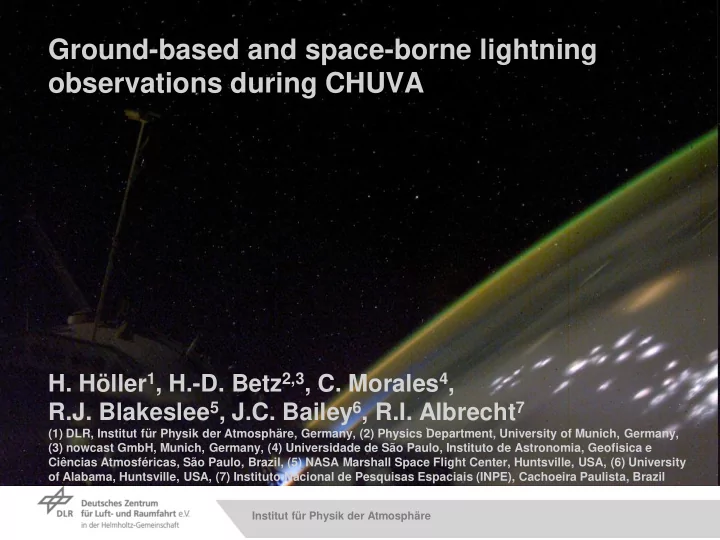
Ground-based and space-borne lightning

  • bservations during CHUVA
  • H. Höller1, H.-D. Betz2,3, C. Morales4,

R.J. Blakeslee5, J.C. Bailey6, R.I. Albrecht7

(1) DLR, Institut für Physik der Atmosphäre, Germany, (2) Physics Department, University of Munich, Germany, (3) nowcast GmbH, Munich, Germany, (4) Universidade de São Paulo, Instituto de Astronomia, Geofisica e Ciências Atmosféricas, São Paulo, Brazil, (5) NASA Marshall Space Flight Center, Huntsville, USA, (6) University

  • f Alabama, Huntsville, USA, (7) Instituto Nacional de Pesquisas Espaciais (INPE), Cachoeira Paulista, Brazil
slide-2
SLIDE 2

Institut für Physik der Atmosphäre

Slide 2 > > Hartmut Höller

MTG and GOES-R New Geostationary Satellite Systems

Meteosat Third Generation > 2018 Geostationary Operational Environmental Satellite-R Series (GOES-R) > 2015

slide-3
SLIDE 3

Institut für Physik der Atmosphäre

Slide 3 > > Hartmut Höller

TRMM (Tropical Rainfall Measuring Mission) TRMM Instruments

Visible and InfraRed Scanner (VIRS)

TRMM Microwave Imager (TMI)

Precipitation Radar (PR)

Lightning Imaging Sensor (LIS)

slide-4
SLIDE 4

Institut für Physik der Atmosphäre

Slide 4 > EUMETSAT 2010 > Hartmut Höller

Flash Types and Emissions CG, IC and VLF/LF, VHF, Light

Intra-cloud (IC) and cloud-to- ground flashes emit VLF/LF, VHF and optical radiation Long wavelength VLF/LF signals have one or several source points per flash arising from long channel segments Short wavelength VHF signal have many source points per flash and allow for reconstructing short scale channel details

Optical Pulse Optical Pulse Optical Pulse

slide-5
SLIDE 5

Institut für Physik der Atmosphäre

Slide 5 > EUMETSAT 2010 > Hartmut Höller

LINET (Lightning Detection Network) System Characteristics

Measurement of magnetic field

TOA Method for lightning location

IC - CG discrimination

Height of IC events

slide-6
SLIDE 6

Institut für Physik der Atmosphäre

Slide 6 > > Hartmut Höller

LMA and LINET Sites XPOL and operational radars

LMA and LINET LMA and LINET configuration, XPOL and operational radars

slide-7
SLIDE 7

Institut für Physik der Atmosphäre

Slide 7 > I > Hartmut Höller

LINET Sites CHUVA, Sao Paulo

slide-8
SLIDE 8

Institut für Physik der Atmosphäre

Slide 8 > LIST Meeting Helsinki 20121023 > Hartmut Höller

LIS Overpasses Summary

1.

((29.10.2011 23:36 UTC))

2.

(11.11.2011 16:24 UTC)

3.

((7.12.2011 20:15 UTC))

4.

((10.12.2011 02:40 UTC))

5.

(28.12.2011 17:11 UTC)

6.

(17.1.2012 23:19 UTC)

7.

19.1.2012 23:03 UTC

8.

(20.1.2012 22:10 UTC)

9.

(21.1.2012 21:16 UTC)

  • 10. (23.1.2012 21:00 UTC)
  • 11. 24.1.2012 20:02 UTC
  • 12. 7.2.2012 20:13 UTC
  • 13. 8.2.2012 19:17 UTC
  • 14. 10.2.2012 19:05 UTC
  • 15. 11.2.2012 18:10 UTC
  • 16. (14.2.2012 17:01 UTC)
  • 17. 27.2.2012 03:15 UTC
  • 18. 11.3.2012 20:50 UTC
  • 19. 12.3.2012 19:54 UTC
  • 20. (15.3.2012 18:45 UTC)
  • 21. 27.3.2012 19:07 UTC
  • 22. ((30.3.2012 17:55 UTC))

Priority High Normal (Low) ((lowest))

slide-9
SLIDE 9

Institut für Physik der Atmosphäre

Slide 9 > LIST Meeting Helsinki 20121023 > Hartmut Höller

Case Studies 27 March 2012

slide-10
SLIDE 10

Institut für Physik der Atmosphäre

Slide 10 > LIST Meeting Helsinki 20121023 > Hartmut Höller

Case Studies 10 Feb 2012

slide-11
SLIDE 11

Institut für Physik der Atmosphäre

Slide 11 > LIST Meeting Helsinki 20121023 > Hartmut Höller

Case Studies 10 Feb 2012

slide-12
SLIDE 12

Institut für Physik der Atmosphäre

Slide 12 > IPA Seminar 25 Okt 2010 > Hartmut Höller

Case Studies 10 Feb 2012

slide-13
SLIDE 13

Institut für Physik der Atmosphäre

Slide 13 > LIST Meeting Helsinki 20121023 > Hartmut Höller

Case Studies 7 Feb 2012

XPOL Radar 20:10 UTC

slide-14
SLIDE 14

Institut für Physik der Atmosphäre

Slide 14 > LIST Meeting Helsinki 20121023 > Hartmut Höller

Case Studies 7 Feb 2012

slide-15
SLIDE 15

Institut für Physik der Atmosphäre

Slide 15 > LIST Meeting Helsinki 20121023 > Hartmut Höller

Case Studies 7 Feb 2012

Flash 01

slide-16
SLIDE 16

Institut für Physik der Atmosphäre

Slide 16 > LIST Meeting Helsinki 20121023 > Hartmut Höller

Case Studies 7 Feb 2012

Flash 01

slide-17
SLIDE 17

Institut für Physik der Atmosphäre

Slide 17 > LIST Meeting Helsinki 20121023 > Hartmut Höller

Case Studies 7 Feb 2012

Flash 01 LIS group radiance LMA and LINET source height No optical signal from low level part

  • f flash
slide-18
SLIDE 18

Institut für Physik der Atmosphäre

Slide 18 > LIST Meeting Helsinki 20121023 > Hartmut Höller

Case Studies 7 Feb 2012

Flash 06

slide-19
SLIDE 19

Institut für Physik der Atmosphäre

Slide 19 > LIST Meeting Helsinki 20121023 > Hartmut Höller

Case Studies 7 Feb 2012

Flash 06

slide-20
SLIDE 20

Institut für Physik der Atmosphäre

Slide 20 > LIST Meeting Helsinki 20121023 > Hartmut Höller

Case Studies 7 Feb 2012

Flash 06 LIS group radiance LMA and LINET source height No optical signal from low level part

  • f flash
slide-21
SLIDE 21

Institut für Physik der Atmosphäre

Slide 21 > LIST Meeting Helsinki 20121023 > Hartmut Höller

Case Studies 08 Feb 2012

slide-22
SLIDE 22

Institut für Physik der Atmosphäre

Slide 22 > LIST Meeting Helsinki 20121023 > Hartmut Höller

Case Studies 08 Feb 2012

slide-23
SLIDE 23

Institut für Physik der Atmosphäre

Slide 23 > LIST Meeting Helsinki 20121023 > Hartmut Höller

Case Studies 08 Feb 2012

LIS Flash 137 LIS group radiance LMA and LINET source strengths correlate to some extent

slide-24
SLIDE 24

Institut für Physik der Atmosphäre

Slide 24 > LIST Meeting Helsinki 20121023 > Hartmut Höller

Case Studies 19 Jan 2012

Time differences of closest signals LMA followed by LINET and LIS LINET and LIS correspond well LINET-LIS LMA-LIS LMA-LINET

slide-25
SLIDE 25

Institut für Physik der Atmosphäre

Slide 25 > GLM-CHUVA April 2013> Hartmut Höller

Modeling of MTG-LI Optical Signals Model Strategy

Transformation of LINET RF stroke data into optical groups by a 2-step process:

 Model of cloud top optical emission

  • Number of optical flashes equals number of LINET flashes
  • One direct coincident optical group per LINET stroke
  • Distribution of additional optical groups per LINET flash

according to a log-normal model for radiance, footprint and time

 Projection of group areas to optical plane of LI pixel matrix

Generation of optical events from RF stroke data

slide-26
SLIDE 26

Institut für Physik der Atmosphäre

Slide 26 > GLM-CHUVA April 2013> Hartmut Höller

LIS Groups per LINET Stroke Relation to Network Sensitivity

LIS groups per LINET stroke (GPS) from coincident flash

  • bservations for

LIS overpasses in different areas CHUVA data add additional information in the low peak current regime

slide-27
SLIDE 27

Institut für Physik der Atmosphäre

Slide 27 > LIST Meeting Helsinki 20121023 > Hartmut Höller

Summary and Conclusions (1)

 CHUVA lightning campaign was very successful with respect to

the objectives

  • 7 months (Oct 2011 – April 2012) of lightning data available

for analysis complemented by XPOL radar data

  • 4-6 good cases with LIS overpasses of the inner network

area (more than 20 cases in a wider area)

 As found in previous study, LINET strokes and LIS groups are

  • ften coincident

 LINET strokes map the flash branches similar to LMA (but with

considerably less data points)

 An initial breakdown phase of vertically propagating sources can

be often found in LINET and LMA data

slide-28
SLIDE 28

Institut für Physik der Atmosphäre

Slide 28 > LIST Meeting Helsinki 20121023 > Hartmut Höller

Summary and Conclusions (2)

 Higher level LINET and LMA signals have higher probability to be

  • ptically detected

 Lower level LINET and LMA signals are optically detected from

above in case of missing high level precipitation (e.g. from radar)

 XPOL radar helps in interpretation of 3D cloud structure important

for scattering of light

 Improvement of proxy data generation

  • a small baseline (~30 km) LINET configuration provided a

high DE network thus closing the gap in coverage at weak LINET strokes (flashes)

  • The number of LIS groups per LINET stroke should not be

considered as constant but rather as dependent on minimum peak current