Recent Highlights from AGN Observations with Fermi-LAT Observations - - PowerPoint PPT Presentation

recent highlights from agn observations with fermi lat
SMART_READER_LITE
LIVE PREVIEW

Recent Highlights from AGN Observations with Fermi-LAT Observations - - PowerPoint PPT Presentation

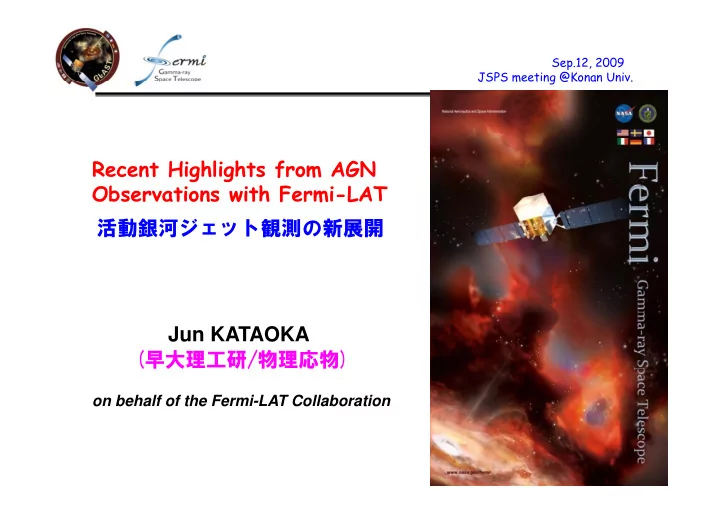
Sep.12, 2009 JSPS meeting @Konan Univ. JSPS meet ng @Konan Un v. Recent Highlights from AGN Observations with Fermi-LAT Observations with Fermi-LAT Jun KATAOKA (/) on


slide-1
SLIDE 1

Sep.12, 2009 JSPS meeting @Konan Univ. JSPS meet ng @Konan Un v.

Recent Highlights from AGN Observations with Fermi-LAT Observations with Fermi-LAT 活動銀河ジェット観測の新展開 Jun KATAOKA (早大理工研/物理応物)

  • n behalf of the Fermi-LAT Collaboration

1

slide-2
SLIDE 2

AGNs: EGRET View AGNs: EGRET View

EGRET discovered about 70 (3rd Catalog, Hartman et al 1999;

100 S d E d t l 2003 2004) AGN

itti

>100 Sowards-Emmerd et al. 2003,2004) AGNs emitting γ-rays.

About 20 sources were detected at E>200 GeV by the ACTs. Except for a few marginal detection of RGs all sources are

2

Except for a few marginal detection of RGs, all sources are “flarting AGNs, classified as “blazars”.

slide-3
SLIDE 3

Blazars Blazars Overview Overview

JK 02

FSRQ FSRQ LBL LBL HBL

Synchrotron Inverse Compton Urry & Padovan 95 Urry & Padovan 95

SL i id d j β 0 99 10 Blazars: jet closely aligned to our line of sight.

  • SL motion, one-sided jet βjet ~ 0.99 c or Γjet 10

“Double peaks” over two decades in ν

  • Sync + Inv Compton but wide variety BL Lac FSRQs

3

  • Most powerful objects peaks at lower ν

“Blazar Sequence”

  • Sync + Inv. Compton, but wide variety BL Lac , FSRQs
slide-4
SLIDE 4

Key Questions for Key Questions for Blazars Blazars

Emission mechanisms (especially for high-E component)

y

Leptonic (IC of sync or ext photons) vs hadronic (π0→γγ, proton synchrotron) Emission location Single zone for all ν (constraining for simplest leptonic models) Opacity effects and E-dependent p y p photospheres Particle acceleration mechanisms Shocks Blandford-Znajek process Shocks, Blandford Znajek process Jet composition Poynting flux, leptonic, ions Jet confinement

?

Jet confinement External pressure, B stresses Accretion disk—BH—jet connection p b s f th xt l BGD li ht (EBL)

?

4

probes of the extragal BGD light (EBL) Effect on host galaxies and galaxy clusters

slide-5
SLIDE 5

5

AGNs: Fermi View AGNs: Fermi View (3 month) (3 month)

205 preliminary bright LAT sources ( >10 σ)

( ) ( )

FSRQ FSRQ BLLac BLLac Uncertain Uncertain class class Uncertain Uncertain class class Radio Radio Galaxies Galaxies

Abdo+ 2009 (contact: G.Tosti,B.Lott)

57 FSRQs, 42 BL Lac (HBL+LBL), 2 RGs and 6 unID class. (34 % BL Lac fraction vs 19 % by EGRET) Note, EGRET found fewer than 30 src above 10 σ in its lifetime.

5

(34 % BL Lac fraction vs 19 % by EGRET) Typical 95 % error is less than 10’ .

slide-6
SLIDE 6

Flux Distributions Flux Distributions

peak/mean

Fermi

peak/mean flux ratio

F rm EGRET

mean vs peak flux

D t it li it d iti it EGRET b ti t l Fermi can observe quiescent nature of flaring AGNs everyday, Due to its limited sensitivity, EGRET observations were strongly “biased” to blazars’ flaring states.

6

Fermi can observe quiescent nature of flaring AGNs everyday, even in its low activity states.

slide-7
SLIDE 7

Redshift Redshift (z) Distributions (z) Distributions ( ) ( )

Most distant Fermi blazar at

EGRET

Most distant Fermi blazar at z = 2.944. More and more faint (i.e. distant)

FSRQ BLLac

Clear separation of photon index di t ib ti b t FSRQ d BL Lac visible! distribution between FSRQs and BL LACs.

F i LAT

FSRQs <Γ>= 2 33±0 01

Fermi LAT

<Γ>= 2.33±0.01 BL Lacs <Γ>=1.99±0.01

7

slide-8
SLIDE 8

Typical Gamma Typical Gamma-

  • ray

ray Spectra Spectra

3C454.3 (FSRQ) AO 0235+165 (LBL) Mkn501 (HBL)

yp yp y p

FSRQ LBL HBL FSRQ LBL HBL

8

Significant departures from single PL for bright blazars.

slide-9
SLIDE 9

Luminosity Functions Luminosity Functions

FSRQs St l ti

y

FSRQ

  • Strong evolution
  • The 3 month LAT AGN

sample measures the p bright end of the luminosity distribution.

z = 0.0 – 0.9 z = 0.9 – 1.4 z > 1.4

BL Lac objects

  • No evidence of evolution

Combined emission from individual blazars in 3 month

z = 0.0 – 0.3 z > 0.3

sample corresponds to 7%

  • f EGRET extragalactic

diffuse gamma BGD

BLLac

9

diffuse gamma BGD.

slide-10
SLIDE 10

10

HBL: PKS 2155 HBL: PKS 2155-

  • 304

304

Aharonian+ 2009 (contact: J.Chiang) TeV GeV

Fermi

keV eV

Joint obs with H E S S and Fermi – the first multi MeV-TeV SEDs X i d d tl f VHE i i

i

Joint obs with H.E.S.S and Fermi – the first multi MeV-TeV SEDs. Relatively little variability, but clear optical/VHE correlation.

10

X-rays may vary independently of VHE emission - serious

challenges to the standard picture of SSC model.

slide-11
SLIDE 11

HBL: HBL: Mrk Mrk 421 421

Contact: D.Paneque

Significant variability, but not as impressive as those in X-rays. H d G t ith Γ 1 79±0 03 i l l / Hard Gamma-ray spectrum with Γ =1.79±0.03 – nicely overlap w/ the energy ranges covered by the ground Cherenkov telescopes. MAGIC data simultaneously taken during a low state nicely

11

MAGIC data, simultaneously taken during a low state nicely connects w/ Fermi-LAT data - spectral break at ~ 100 GeV?

slide-12
SLIDE 12

QHB: 3C 279 QHB: 3C 279

Contact: G.Madejski & M.Hayashida

Preliminary Preliminary Preliminary

Significant flux variability over an order of magnitude with flux doubling time scale of Δt 5 days flux doubling time scale of Δt ~ 5 days. Interestingly, no significant “energy-dependent” variability, meaning that spectra do NOT change/evolve even among its

12

meaning that spectra do NOT change/evolve even among its historical low and high states.

slide-13
SLIDE 13

Cutoff in the QHB Spectra Cutoff in the QHB Spectra p

In many FSRQs clear

Abdo+ 2009 (contact: G.Madejski)

In many FSRQs, clear spectral signature, i.e., high energy cutoff has b b d b

3C 454.3 AO 0235+164

been observed between 1 - 10 GeV. In case of 3C 454 3 In case of 3C 454.3, spectrum breaks from Γ1 = 2.3 to Γ2 = 3.5. (not very smooth as (not very smooth as an exponential cutoff) Not consistent with typical cooling break of ΔΓ = 0.5, but i t i i t l b k i th di t ib ti f l t

13

intrinsic spectral break in the energy distribution of electrons.

slide-14
SLIDE 14

MW campaigns: on going! MW campaigns: on going! p g g g p g g g

Contact: R.Sato & J.Kataoka

A number of MW campaigns A number of MW campaigns from radio to TeV energy bands have been conducted and ongoing.

Preliminary (Suzaku-Fermi collab)

Thanks to Fermi’s all-sky monitor, scheduling the MW campaigns now become easier than in EGRET era

14

become easier than in EGRET era.

slide-15
SLIDE 15

Surprise! : Narrow Line Sy1 Surprise! : Narrow Line Sy1 p y p y

Abdo+ 2009 (contact: L.Foschini)

Narrow line Sy-1 are usually radio quiet and hosted in spiral galaxy. Radio emission of PMN J0948 is, however, strongly variable, suggesting Doppler boosting w/ jet - now confirmed by LAT.

15

SED modeling shows this is a typical FSRQ, although with a relatively low power.

slide-16
SLIDE 16

Radio Galaxies w/ Fermi Radio Galaxies w/ Fermi

M87 Cen A NGC1275 (3C 84) 3 month catalog

2 radio galaxies, NGC 1275 and Cen A have been detected in the first 3 month catalog (Abdo et al. 2009) Very recently M 87 also detected at 10 σ level based on

16

Very recently, M 87 also detected at 10 σ level based on ten-months of all sky LAT data. (ApJ submitted)

slide-17
SLIDE 17

NGC 1275: close NGC 1275: close-

  • up

up p

Abdo+ 2009 (contact: J.Kataoka)

E> 200 MeV

Clear excess at the position of Perseus/NGC 1275 complex . About an order of magnitude brighter than EGRET UL – significant brightening on decade time scale.

17

The positional center of the γ-ray emission is only 2.3’ apart from the nucleus, 3C 84, well within the 95% LAT error circle.

slide-18
SLIDE 18

NGC 1275: MW spectrum NGC 1275: MW spectrum p

(1) one-zone SSC B= 0 05 G B= 0.05 G R= 0.7 pc δ= 2.3, Γ = 1.8 L = 2 3e45 erg/s Ljet = 2.3e45 erg/s (2) Decelerating flow B = 0 2 G B = 0.2 G D = 0.2 pc R = 0.01 pc Γ = 10 -> 2 Γ 10 2 Ljet = 6.0e43 erg/s

Possible unification of BL Lac and Radio Galaxies ! Jet power close to the power required to inflate the l b f 4 h f h h l

18

lobes of 3C 84 against the pressure of the hot cluster gas.

(0.3-1.2)x 1044 erg/s: Dunn & Fabian 2004

slide-19
SLIDE 19

Centaurus Centaurus A: Fermi Detection A: Fermi Detection

preliminary

contact: F.Justin,C.Cheung,Y.Fukazawa

preliminary Fermi Fermi 10 month

Only clearly associated EGRET radio galaxy but was limited Only clearly associated EGRET radio galaxy, but was limited to 2.1σ – 3.9σ detections on yr to sub-yr time-scale. Fermi error circle includes pc-scale core, jet, and the kpc-scale

19

jet, but other sources like kpc-scale lobes may contribute.

slide-20
SLIDE 20

Additional Challenges Additional Challenges g

γ-ray signature of UHECRs? Preliminary

Haslam image with directions of Auger UHECR events indicated Possible variability from NC emission detected

20

Auger UHECR events indicated (r=3.2d) (Moskalenko et al. 2009) emission detected.

slide-21
SLIDE 21

M87: NEW Detection! M87: NEW Detection!

contact: C.C.Cheung & W.McConville

preliminary preliminary preliminary

Comparable w/ previous EGRET UL of 2.18x10⁻⁸ ph/cm2/s – no significant variability on decade time scale? LAT t thl t / hi t i l i i T V

21

LAT spectrum smoothly connects w/ historical minimum TeV

  • emission. (paper just submitted to ApJ!)
slide-22
SLIDE 22

Future Challenges: Galaxy Clusters Future Challenges: Galaxy Clusters

Coma A1367 M49

g y g y

NGC5846 Centaurus Hydra A0754 NGC4636 3C129 Perseus AWM7 Ophiuchus Norma Triangulum A0754 AWM7 g Fornax

contact: K.Bechtol

Apparently, galaxy clusters are very interesting and important

  • p-p interactions of high energy

CRs w/ intercluster medium?

(Berezinsky+97;Atoyan&Volk 00)

Apparently, galaxy clusters are very interesting and important targets near future, but special care must be paid, e.g.,

  • 3C 129 on galactic plane, b = 0.1deg

P s s l st i d mi t d b NGC 1275 (Berezinsky+97;Atoyan&Volk 00)

  • Large scale shock in forming CG?

(Totani & Kitayama 00)

22

  • Perseus cluster region dominated by NGC 1275
  • NGC 4636 region contains 3C273 , about 3.5 deg away … and so on!
  • Dark matter annihilation? (Totani 04)
slide-23
SLIDE 23

UL from 7month Survey UL from 7month Survey

Compare the Fermi 7-month flux UL to EGRET results and predicted flux

Note, Fermi searches for extended GC emission becomes already

23

Note, Fermi searches for extended GC emission becomes already deeper than EGRET UL, comparable to the theoretical prediction.

slide-24
SLIDE 24

Summary Summary

I have reported most recent highlights from Fermi observations f AGN j t i l di f t h ll t l l t

  • f AGN jets, including future challenges to galaxy clusters.

Excellent Fermi sensitivity and all sky monitor allow us “non-bias” y y survey of blazars, even in their quiescent states. Various MW campaigns are ongoing, providing for the first time lti M V T V SED ith t d t multi MeV-TeV SED without any data gaps. Surprisingly, three radio galaxies and one NLSy1 have been detected so far allowing new challenges for the unification Searches for diffuse and extended emission from CGs is an detected so far, allowing new challenges for the unification theory of AGNs. Searches for diffuse and extended emission from CGs is an important challenge for future GeV gamma-ray astronomy.

24