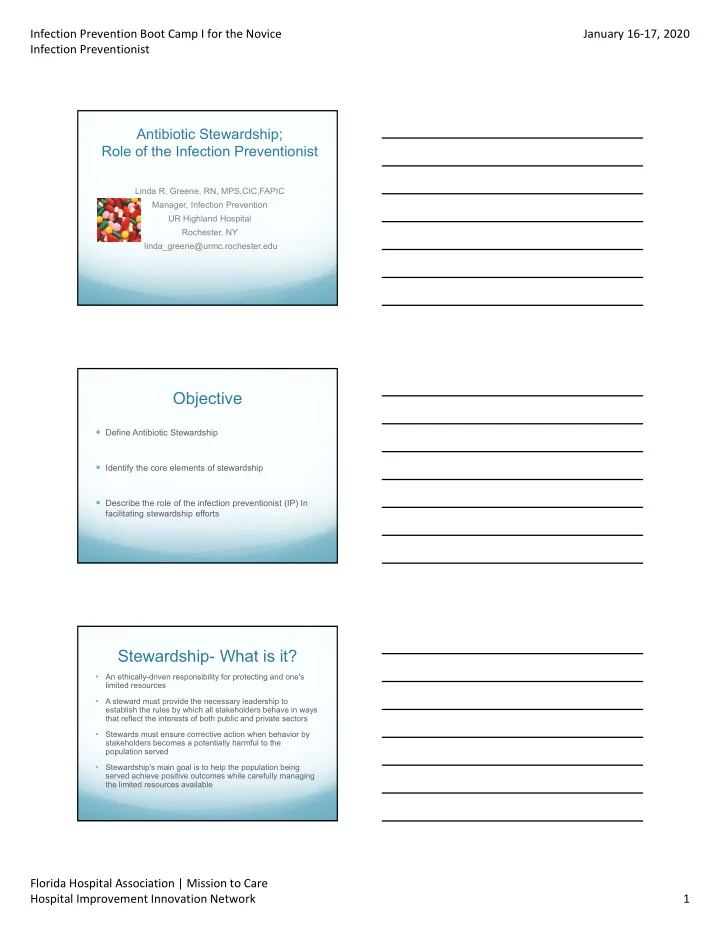
Objective Define Antibiotic Stewardship Identify the core elements - - PDF document

objective
SMART_READER_LITE
LIVE PREVIEW

Objective Define Antibiotic Stewardship Identify the core elements - - PDF document

Infection Prevention Boot Camp I for the Novice January 16 17, 2020 Infection Preventionist Antibiotic Stewardship; Role of the Infection Preventionist Linda R. Greene, RN, MPS,CIC,FAPIC Manager, Infection Prevention UR Highland Hospital


slide-1
SLIDE 1

Infection Prevention Boot Camp I for the Novice Infection Preventionist January 16‐17, 2020 Florida Hospital Association | Mission to Care Hospital Improvement Innovation Network 1

Antibiotic Stewardship; Role of the Infection Preventionist

Linda R. Greene, RN, MPS,CIC,FAPIC Manager, Infection Prevention UR Highland Hospital Rochester, NY linda_greene@urmc.rochester.edu

Objective

 Define Antibiotic Stewardship  Identify the core elements of stewardship  Describe the role of the infection preventionist (IP) In

facilitating stewardship efforts

Stewardship- What is it?

  • An ethically-driven responsibility for protecting and one's

limited resources

  • A steward must provide the necessary leadership to

establish the rules by which all stakeholders behave in ways that reflect the interests of both public and private sectors

  • Stewards must ensure corrective action when behavior by

stakeholders becomes a potentially harmful to the population served

  • Stewardship's main goal is to help the population being

served achieve positive outcomes while carefully managing the limited resources available

slide-2
SLIDE 2

Infection Prevention Boot Camp I for the Novice Infection Preventionist January 16‐17, 2020 Florida Hospital Association | Mission to Care Hospital Improvement Innovation Network 2

Antibiotic Stewardship

Consensus statement from the Infectious Diseases Society of America (IDSA), the Society for Healthcare Epidemiology of America (SHEA), and the Pediatric Infectious Diseases Society: “ Coordinated interventions designed to improve and measure the appropriate use of (antibiotic) agents by promoting the selection of the optimal (antibiotic) drug regimen, including dosing, duration of therapy, and route

  • f administration.”

Fishman, N. Policy statement on antimicrobial stewardship by the Society for Healthcare Epidemiology of America (SHEA), the Infectious Diseases Society of America (IDSA), and the Pediatric Diseases Society (PIDS). Infect Control Hosp Epidemiol 2012; 33:322–7.

Goals of Antibiotic Stewardship

 Prevent or slow emergence of antibiotic resistance  Optimize selection, dose, duration of treatment  Reduce adverse drug events  Reduce secondary infection (e.g. CDI,MDROs)  Reduce morbidity and mortality  Reduce length of stay  Reduce health care expenditure

Why Antibiotic Stewardship ?

 Multiple Drug Resistant Organisms (MDROs) cause a

significant proportion of serious healthcare-associated infections and pose a serious risk to patient safety

 Regulatory, accrediting agencies and legislative bodies

continue to make MDROs a priority

 Integrated, multidisciplinary ASPs are crucial to

promoting the prudent use of antimicrobials

slide-3
SLIDE 3

Infection Prevention Boot Camp I for the Novice Infection Preventionist January 16‐17, 2020 Florida Hospital Association | Mission to Care Hospital Improvement Innovation Network 3

The idea that penicillin and the subsequent “miracle drugs” were the end of any threat from infection led to increased use, overuse, and abuse – flooding the environment with antibiotics and POTENTIATING RESISTANCE.

Historical Perspective

Since the 1960’s there have been increasingly frequent reports

  • f antibiotic resistant bacteria in hospitalized patients

(and consequently in long-term care).

CMS

Requirements for an IP program functioning under the infection control and prevention program Demonstrates coordination among all components of the hospital responsible for antibiotic use and resistance, including, but not limited to, the infection prevention and control program, the QAPI program, the medical staff, nursing services, and pharmacy services;

slide-4
SLIDE 4

Infection Prevention Boot Camp I for the Novice Infection Preventionist January 16‐17, 2020 Florida Hospital Association | Mission to Care Hospital Improvement Innovation Network 4

Enhancing the Role of the IP

Awareness Assessment Behavior Communication Collaboration

Stewardship's main goal is to help the population being served achieve positive outcomes while carefully managing the limited resources available.

slide-5
SLIDE 5

Infection Prevention Boot Camp I for the Novice Infection Preventionist January 16‐17, 2020 Florida Hospital Association | Mission to Care Hospital Improvement Innovation Network 5

Knowledge Gaps

 Unfamiliar with the concept of antibiotic stewardship  Insecure with knowledge of antibiotics  Lack of metrics regarding association between direct

impact on stewardship activities

Antibiotic Use

Prevent Infection Appropriate Culture techniques Prevent Uneccesary cultures Appropriate communication signs/symptoms

slide-6
SLIDE 6

Infection Prevention Boot Camp I for the Novice Infection Preventionist January 16‐17, 2020 Florida Hospital Association | Mission to Care Hospital Improvement Innovation Network 6

IP Role Appropriate Cultures

Role of IP in educating on appropriate cultures Examples:

Urine cultures

Appropriate C. difficile specimens

What is bacteriuria ?

Bacteriuria means a positive urine culture Bacteriuria

18

ASB UTI

slide-7
SLIDE 7

Infection Prevention Boot Camp I for the Novice Infection Preventionist January 16‐17, 2020 Florida Hospital Association | Mission to Care Hospital Improvement Innovation Network 7

Asymptomatic Bacteriuria

There is no role for screening or treating for asymptomatic bacteriuria in the majority of patients*

  • Treatment does NOT prevent symptomatic

infection, improve urinary function, or enhance survival.

  • Treatment is associated with increased adverse

effects, and increased development of antibiotic resistance.

Does your patient have an abnormal urinalysis? Assess for urinary symptoms and SIRS criteria prior to consideration of antimicrobial treatment.

*Exceptions: Screening for and treatment of asymptomatic bacteriuria is warranted in pregnant females and patients undergoing urologic procedures in which mucosal bleeding is anticipated (e.g. transurethral resection of the prostate)

In the absence of signs or symptoms, it is NOT necessary to order or collect a urine specimen!

SIRS = systemic inflammatory response syndrome

YES: CAUTI

Fever

Rigors

Malaise/lethargy

New onset confusion

Flank pain or CVA tenderness

Acute hematuria

Pelvic discomfort

New onset hypotension

Dysuria, urgency, frequency NO: Not CAUTI

Change in urine color

Foul smelling urine

Cloudy urine

Urinary sediment

20

http://www.idsociety.org/IDSA_Practice_Guidelines/

CAUTI or NOT CAUTI

Magnitude of Overtreatment of ASB

 Treatment of positive urine cultures in asymptomatic

patients  30% in our studies (inpatient and long-term care)  50-68% in other inpatient studies  75% and 82% reported in long-term care

Trautner and Grigoryan, ID Clinics North America 2014

slide-8
SLIDE 8

Infection Prevention Boot Camp I for the Novice Infection Preventionist January 16‐17, 2020 Florida Hospital Association | Mission to Care Hospital Improvement Innovation Network 8

Pyuria in the Elderly

 Over 90% of older adults with positive urine cultures (

bacteriuria) have pyuria

 If Leukocyte esterase( L.E.) and Nitrite are both

negative, it is strongly predictive that a urinary tract infection is NOT present

22

Evaluation of the Elderly for Urinary Tract Infection

 Diagnostic criteria for UTI in elderly patients:  The following are NOT specific signs or symptoms for UTI: Foul smelling or cloudy urine, falls or gait instability, functional decline. These findings should NOT prompt treatment in the absence of other clinical features of infection.  Acute mental status change alone is NOT a criteria for UTI unless the patient has an indwelling urinary catheter.

23

Without an indwelling catheter With an indwelling catheter

  • Acute dysuria alone OR
  • Fever + at least one of the symptoms

below (new or increased) OR

  • If no fever, at least two of the

symptoms below (new or increased):

  • Gross hematuria
  • Incontinence
  • Urgency
  • Suprapubic pain
  • Costovertebral angle (CVA) tenderness
  • At least one of the symptoms below

(new or increased)

  • Fever
  • Pelvic discomfort
  • Flank pain
  • CVA tenderness
  • Rigors (shaking chills)
  • Delirium
  • Acute hematuria

 For accurate diagnosis, a new catheter must be placed from which a fresh urinary specimen is

  • btained and sent for

testing!

Impact of Urine Cultures

 Positive urine culture leads to inappropriate antibiotics

 12 of 21 (57%) asymptomatic patients treated when urine

culture returned positive  (Leis, ICHE 2015)

 High organism count in urine culture triggers antibiotic

prescription (OR22)

 (Drekonja et al, ICHE 2014)

slide-9
SLIDE 9

Infection Prevention Boot Camp I for the Novice Infection Preventionist January 16‐17, 2020 Florida Hospital Association | Mission to Care Hospital Improvement Innovation Network 9

Screening Urine Cultures

What not to do:

 Screen on admission without signs and symptoms  Screening for non- urologic surgery  Automatic triggers for cultures (temperature or WBC’s in

the urine)

25

Communication

Do not test urine unless it is clinically indicated When to obtain a urine culture :

 Focal symptoms suggestive of urinary tract infection (

i.e. lower abdominal tenderness, flank pain, lower abdominal discomfort)

 Signs and symptoms of sepsis in patients with no clear

source.

26

Fakih – Improving the culture of culturing

slide-10
SLIDE 10

Infection Prevention Boot Camp I for the Novice Infection Preventionist January 16‐17, 2020 Florida Hospital Association | Mission to Care Hospital Improvement Innovation Network 10

Knowledge Deficit Examples UTI Point Prevalence Study

 Methods  Retrospective, multicenter, point prevalence study

Four hospitals in Rochester, NY

Centers for Disease Control and Prevention (CDC) Standardized Reporting Tool

Data obtained on single day in January or February 2014

 Inclusion

Patients receiving antimicrobials for indication of an UTI per electronic medical record OR through identification of positive urine cultures (1 site only)

slide-11
SLIDE 11

Infection Prevention Boot Camp I for the Novice Infection Preventionist January 16‐17, 2020 Florida Hospital Association | Mission to Care Hospital Improvement Innovation Network 11

62 5 9 15 10 20 30 40 50 60 70 Did not meet McGeer Criteria ≥ 2 urinary tract subcriteria Fever or leukocytosis and 1 urinary tract subcriteria Acute dysuria

Of the 62 (68.1%) patients who did not meet McGeer Criteria: Symptom subcriteria

  • New onset delirium was identified in 17

Mc Geer Criteria: Symptom subcriteria Total population (n = 91)

Microbiological criteria met in

  • nly 15

McGeer Criteria: Symptom subcriteria Without indwelling catheter (n = 66)

45 4 4 13 10 20 30 40 50 Did not meet McGeer Criteria ≥ 2 urinary tract subcriteria Fever or leukocytosis and 1 urinary tract subcriteria Acute dysuria

Stone ND. Infect Control Hosp Epidemiol. 2012;33(10):965‐77.

Of the 45 (68%) patients who did not meet McGeer Criteria: Symptom subcriteria

  • New onset delirium was identified in 13

Microbiological criteria met in

  • nly 7

Antimicrobial characteristics (n = 91) N (%)

Number of empiric antimicrobials started after obtaining urine culture (n = 89)

  • One antimicrobial
  • Two antimicrobials
  • Three or more antimicrobials

74 (83) 11 (12) 4 (5)

5 10 15 20 25 30 35

Ceftriaxone Ciprofloxacin Sulfamethoxazole-trimethoprim Nitrofurantoin Ampicillin Piperacillin-tazobactam Amoxicillin-clavulanate Cefepime Cephalexin Fluconazole Linezolid Cefazolin Cefpodoxime Empiric antimicrobial selection: Monotherapy (n = 74)

slide-12
SLIDE 12

Infection Prevention Boot Camp I for the Novice Infection Preventionist January 16‐17, 2020 Florida Hospital Association | Mission to Care Hospital Improvement Innovation Network 12

  • C. difficile and Stewardship

Exposure to any antimicrobial is the single most important risk factor for C. difficile infection (CDI).

 Antibiotic exposure has lasting impact on the microbiome

  • Risk of CDI is elevated (7-10 fold) during and in the 3 months

following antimicrobial therapy1,

  • 85-90% of CDI occurs within 30 days of antimicrobial exposure

 Target high risk antibiotics for CDI prevention

  • Fluoroquinolones
  • 3rd/4th generation cephalosporins, carbapenems

Testing Stewardship

  • Molecular tests are increasingly used to diagnose C difficile

infection (CDI),

  • Many molecular test-positive patients lack toxins that historically

defined disease,

  • Sometimes unclear if patients need treatment

Issues

 Diarrhea without other signs and symptoms  Unclear messaging to covering providers  Patients on laxatives

slide-13
SLIDE 13

Infection Prevention Boot Camp I for the Novice Infection Preventionist January 16‐17, 2020 Florida Hospital Association | Mission to Care Hospital Improvement Innovation Network 13

Blood Culture Guidelines Surveillance

 Reporting and tracking MDRO transmission and rates

and trends over time

 Hand Hygiene rates and practices  PPE application and removal  SSI surveillance  Perioperative antibiotic compliance  C difficile rates

slide-14
SLIDE 14

Infection Prevention Boot Camp I for the Novice Infection Preventionist January 16‐17, 2020 Florida Hospital Association | Mission to Care Hospital Improvement Innovation Network 14

Patel, Saiman Seminars Perinatology 36:431-436 2012

Opportunities for IP Collaboration

Working Collaboratively with Nursing

 IP interacts with nursing frequently  Identify innovative opportunities  Ideas?  Stewardship course for nurses?

Education

 IP’s can be instrumental in nursing

education Appropriate testing Feedback on inappropriate cultures Blood cultures

slide-15
SLIDE 15

Infection Prevention Boot Camp I for the Novice Infection Preventionist January 16‐17, 2020 Florida Hospital Association | Mission to Care Hospital Improvement Innovation Network 15

) Role of Nurses in Optimizing Medications: Part 1

  • a. Obtaining allergy history (including allergy vs. intolerance)
  • b. Timely antibiotic initiation
  • c. Medication history & reconciliation
  • d. Administration issues (checking compatibility, separating FQs and doxycycline from

antacids/iron/calcium, communicating with provider regarding missed doses)

  • e. Renal dosing of medications (usually not necessary for loading doses, but important for maintenance

therapy) 5) Role of Nurses in Optimizing Medications: Part 2

  • a. Opportunities for de‐escalation
  • b. IV to PO conversions
  • c. Awareness of other medications (avoid testing for C. diff if patient on laxatives!)
  • d. Patient education –indications and side effects of antibiotics

6) How Nurses Can Optimize Antimicrobial Stewardship: A Physician’s Perspective

  • a. Differentiating UTIs from Asymptomatic Bacteriuria
  • b. Considerations for patients in whom C. diff is suspected
  • c. Strategies for communicating with providers

Role on the Stewardship Committee

IP should be a member of the committee Part of the agenda Examples: Report number of C difficile tests that do not meet testing guidelines MDRO rates Identified issues on chart review- prolonged prophylaxsis

slide-16
SLIDE 16

Infection Prevention Boot Camp I for the Novice Infection Preventionist January 16‐17, 2020 Florida Hospital Association | Mission to Care Hospital Improvement Innovation Network 16

How Can I Increase My Value ?

Basic Level

  • Understanding of the program and your role
  • Hand Hygiene, Isolation, MDRO’S
  • Observing issues during HAI review

Level 2

  • Collaboratives (i.e. C difficile)
  • Report at meetings
  • Work on standard guidelines and order sets
  • Start the conversation
  • Use your leadership skills

The Secret Sauce