
SLIDE 1
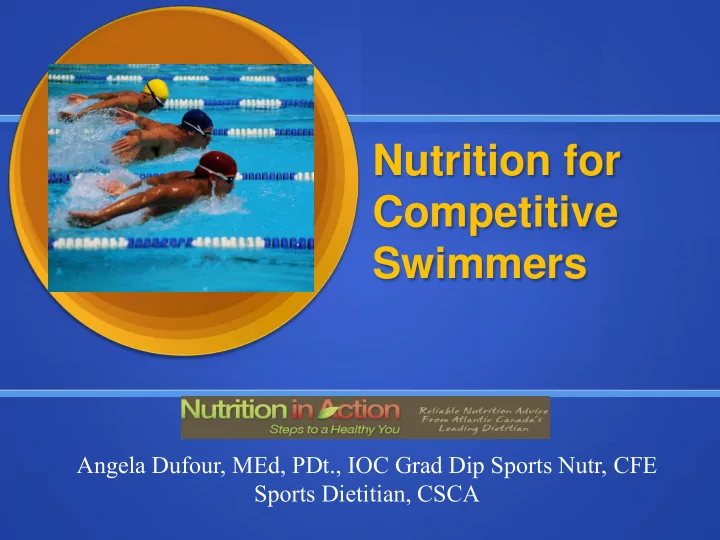
Nutrition for Competitive Swimmers
Angela Dufour, MEd, PDt., IOC Grad Dip Sports Nutr, CFE Sports Dietitian, CSCA
Nutrition for Competitive Swimmers Angela Dufour, MEd, PDt., IOC - - PowerPoint PPT Presentation
Nutrition for Competitive Swimmers Angela Dufour, MEd, PDt., IOC Grad Dip Sports Nutr, CFE Sports Dietitian, CSCA ABOUT ANGELA! Professional (Sports) Dietitian Bachelor of Science in Human Ecology (BScHE) Nutrition Masters
Angela Dufour, MEd, PDt., IOC Grad Dip Sports Nutr, CFE Sports Dietitian, CSCA
Professional (Sports) Dietitian
Bachelor of Science in Human Ecology (BScHE) Nutrition
Masters degree in Adult Education
International Olympic Committee’s (IOC) Graduate
Level 2 Anthropometrist
2
CHO/PRO/Fat requirements
competition
Competitive athletes may train 300-600 times each year, but most will eat 1200-1600 times in the same period. Therefore, well-chosen eating practices have much to offer the athlete:
Fuel to train and perform at a competitive level
Optimum gains from the training program
Enhanced recovery between workouts and between events
Achievement and maintenance of an ideal body weight and physique
Increase immunity
Reduced risk of injury, overtraining fatigue and illness
Sustain concentration and mental skills over the day
Confidence in being well-prepared to face competition
Achieve consistent high-level competition performances
Enjoyment of food and social eating occasions at home and during travel
Carbohydrates – fuel for your gas tank
► This nutrient is your main source of energy
Protein – the mechanic
► Used for recovery, building/rebuilding
muscles
Fluids – oil to keep your engine from
seizing
► Fluids keep nutrients moving through your
body
Nutrition in Action, Professional Education Services
period) 45-52kcal/Kg/day
DUFOUR, 2013
Taper/ Light training Moderate Training/ Comps Heavy aerobic training Grains/Starches
Vegetable Fruit
Meat and Alternatives
Fats/oils
Extras
A 120 lbs. swimmer = 55kg 55 x 6 g/kg = 330 g 55kg X 8 g/kg = 440g 120 lbs. swimmer’s CHO range : 330g- 440g
What end of the range would you choose during taper?
1.2-1.4 g/kg/BW/day–training 1.4-1.8 g/day- heavy strength training HOW TO FIGURE THIS OUT? A 120lbs. Swimmer = 55kg: 55kg swimmer X 1.2g= 66 55kg swimmer X 1.4g = 77g Recommended intake = 66-77g/kg
200-300 grams of Carbohydrate, some Protein
Moderate-High in Carbohydrates Familiar foods (PRACTICE!)
Time before event Food choices 3-4 hours 1.5 c pasta with 1 cup tomato sauce 2 pancakes with 2 tbsp syrup and 1 cup chocolate milk 2-3 hours 2 English muffin with 2 tbsp jam 1 cup oatmeal with 1 c fruit juice Cereal bar and a banana 1-2 hours 250 ml Smoothie or Boost 15 minutes Sport gel or sip on a sport drink
Focus on easily digested high carbohydrate /mod. protein foods (min 20-30 g Carbs/hour)
Sports drinks/diluted juices Sports gels (w caffeine?) High Carb /moderate protein
sports/cereal/granola bars
Cliff/Elevate Me/PowerBars/Chews
Fresh or dried fruit of choice Dried Fruit/ Leathers/Squishies
Did you know that in a typical hard two-hour workout, you can use up all your stored carbohydrate energy (muscle and liver glycogen), sweat away over two litres of water (along with approximately 1600 mg of sodium), and break down a variety of different body cells including muscle and red blood cells?
Phase 1: Immediately (within 20 min) Phase 2: Within 1-2 hours Refuel: ~1.2-1.5 g/kg carbohydrates (60-75g) Repair: 0.3-0.4g/kg g protein. (15-25g) TYPES? Whey/Leucine Rehydrate: 1.2-1.5L of fluid for every 1 kg lost 3/4:1 ratio Carbs to Protein!
FOOD CHOICES CHO PRO 1 Container GreekYogurt 1 Medium Banana ½ cup low fat granola ½ cup choc and ½ cup skim milk
75 22
1.25 cup vector + 1 cup fruit juice+ 1 cup skim milk
69 13
2 yogurt+1 pc fruit+ ½ bagel + 1 tsp jam
75 16
2 sl Banana Bread or 1 med low fat pumpkin muffin + 1 tbsp PB + ½ cup Kefir or ¾ cup greek yogurt
55 15
Elevate Bar + ½ cup juice
68 16
Calcium and Vit D Iron? B12? Probiotics Omega 3 Antioxidants!
Vit C, E
Sports Foods Vitamin/minerals Ergogenic Aids
94 of 634
11 of 57 (22%) contained
prohibited steroids
110 dietary supplements
purchased, 14 contained undeclared caffeine, 2 with undeclared ephedrine
Journal of Sports Sciences, 2011; 29(S1): S57–S66
Moderate - High carbohydrate diet depending on
Balanced meals Variety of foods Fueling pre-workout and during Refueling post-workout Hydrate!