Notes Putting it together E 11 = 11 22 33 Some example values - - PDF document

notes putting it together
SMART_READER_LITE
LIVE PREVIEW

Notes Putting it together E 11 = 11 22 33 Some example values - - PDF document

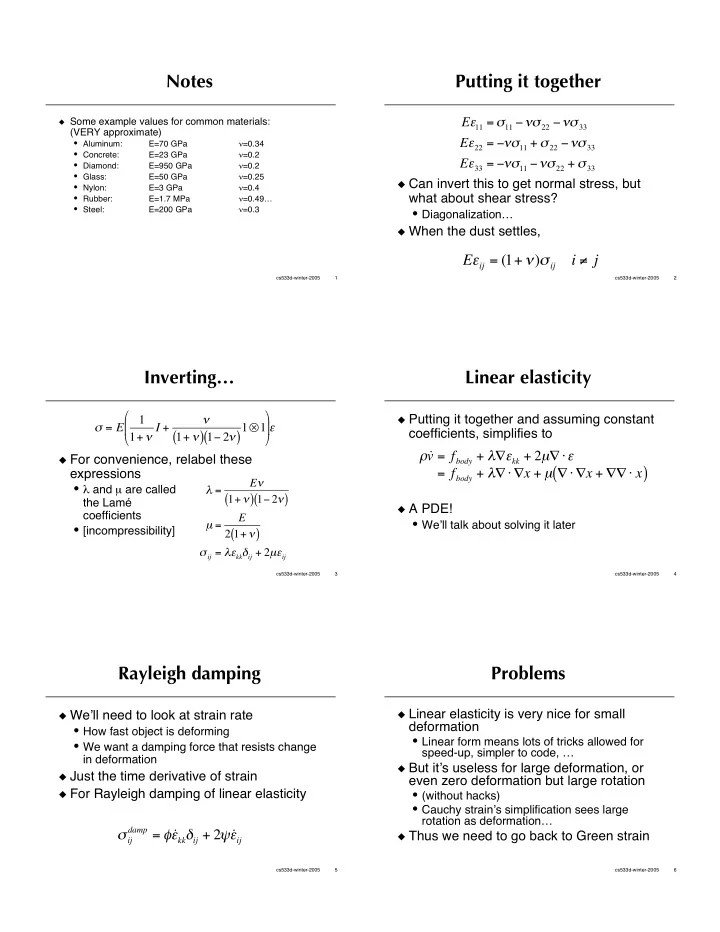
Notes Putting it together E 11 = 11 22 33 Some example values for common materials: (VERY approximate) E 22 = 11 + 22 33 Aluminum: E=70 GPa =0.34 Concrete: E=23 GPa


slide-1
SLIDE 1

1 cs533d-winter-2005

Notes

Some example values for common materials:

(VERY approximate)

  • Aluminum:

E=70 GPa =0.34

  • Concrete:

E=23 GPa =0.2

  • Diamond:

E=950 GPa =0.2

  • Glass:

E=50 GPa =0.25

  • Nylon:

E=3 GPa =0.4

  • Rubber:

E=1.7 MPa =0.49…

  • Steel:

E=200 GPa =0.3

2 cs533d-winter-2005

Putting it together

Can invert this to get normal stress, but

what about shear stress?

  • Diagonalization…

When the dust settles,

E11 = 11 22 33 E22 = 11 + 22 33 E33 = 11 22 + 33

Eij = (1+ ) ij i j

3 cs533d-winter-2005

Inverting…

For convenience, relabel these

expressions

  • and µ are called

the Lamé coefficients

  • [incompressibility]

= E 1 1+ I +

  • 1+

( ) 1 2 ( )

11

  • =

E 1+

( ) 1 2 ( )

µ = E 2 1+

( )

ij = kkij + 2µij

4 cs533d-winter-2005

Linear elasticity

Putting it together and assuming constant

coefficients, simplifies to

A PDE!

  • We’ll talk about solving it later

˙ v = fbody + kk + 2µ = fbody + x + µ x + x

( )

5 cs533d-winter-2005

Rayleigh damping

We’ll need to look at strain rate

  • How fast object is deforming
  • We want a damping force that resists change

in deformation

Just the time derivative of strain For Rayleigh damping of linear elasticity

ij

damp = ˙

  • kkij + 2˙
  • ij

6 cs533d-winter-2005

Problems

Linear elasticity is very nice for small

deformation

  • Linear form means lots of tricks allowed for

speed-up, simpler to code, …

But it’s useless for large deformation, or

even zero deformation but large rotation

  • (without hacks)
  • Cauchy strain’s simplification sees large

rotation as deformation…

Thus we need to go back to Green strain

slide-2
SLIDE 2

7 cs533d-winter-2005

(Almost) Linear Elasticity

Use the same constitutive model as before,

but with Green strain tensor

This is the simplest general-purpose

elasticity model

Animation probably doesn’t need anything

more complicated

  • Except perhaps for dealing with

incompressible materials

8 cs533d-winter-2005

2D Elasticity

Let’s simplify life before starting numerical

methods

The world isn’t 2D of course, but want to track

  • nly deformation in the plane

Have to model why

  • Plane strain: very thick material, 3•=0

[explain, derive 3•]

  • Plane stress: very thin material, 3•=0

[explain, derive 3• and new law, note change in incompressibility singularity]

9 cs533d-winter-2005

Finite Volume Method

Simplest approach: finite volumes

  • We picked arbitrary control volumes before
  • Now pick fractions of triangles from a triangle mesh

Split each triangle into 3 parts, one for each corner E.g. Voronoi regions Be consistent with mass!

  • Assume A is constant in each triangle (piecewise

linear deformation)

  • [work out]
  • Note that exact choice of control volumes not critical -

constant times normal integrates to zero

10 cs533d-winter-2005

Finite Element Method

#1 most popular method for elasticity problems (and

many others too)

FEM originally began with simple idea:

  • Can solve idealized problems (e.g. that strain is constant over a

triangle)

  • Call one of these problems an element
  • Can stick together elements to get better approximation

Since then has evolved into a rigourous mathematical

algorithm, a general purpose black-box method

  • Well, almost black-box…

11 cs533d-winter-2005

Modern Approach

Galerkin framework (the most common) Find vector space of functions that solution (e.g. X(p))

lives in

  • E.g. bounded weak 1st derivative: H1

Say the PDE is L[X]=0 everywhere (“strong”) The “weak” statement is Y(p)L[X(p)]dp=0

for every Y in vector space

Issue: L might involve second derivatives

  • E.g. one for strain, then one for div sigma
  • So L, and the strong form, difficult to define for H1

Integration by parts saves the day

12 cs533d-winter-2005

Weak Momentum Equation

Ignore time derivatives - treat acceleration

as an independent quantity

  • We discretize space first, then use “method of

lines”: plug in any time integrator

L X

[ ] = ˙

˙ X fbody

Y L X

[ ]

  • =

Y ˙ ˙ X fbody

( )

  • =

Y˙ ˙ X

  • Yfbody
  • Y
  • =

Y˙ ˙ X

  • Yfbody
  • +

Y

slide-3
SLIDE 3

13 cs533d-winter-2005

Making it finite

The Galerkin FEM just takes the weak equation, and

restricts the vector space to a finite-dimensional one

  • E.g. Continuous piecewise linear - constant gradient over each

triangle in mesh, just like we used for Finite Volume Method

This means instead of infinitely many test functions Y to

consider, we only need to check a finite basis

The method is defined by the basis

  • Very general: plug in whatever you want - polynomials, splines,

wavelets, RBF’s, …

14 cs533d-winter-2005

Linear Triangle Elements

Simplest choice Take basis {i} where

i(p)=1 at pi and 0 at all the other pj’s

  • It’s a “hat” function

Then X(p)=i xii(p) is the continuous piecewise

linear function that interpolates particle positions

Similarly interpolate velocity and acceleration Plug this choice of X and an arbitrary Y= j (for

any j) into the weak form of the equation

Get a system of equations (3 eq. for each j)

15 cs533d-winter-2005

The equations

j ˙ ˙ x

ii i

  • j fbody
  • +

j

  • = 0

ji˙ ˙ x

i

  • i
  • =

j fbody

  • j
  • Note that j is zero on all but the triangles

surrounding j, so integrals simplify

  • Also: naturally split integration into separate

triangles