
SLIDE 1
CITY OF SPOKANE
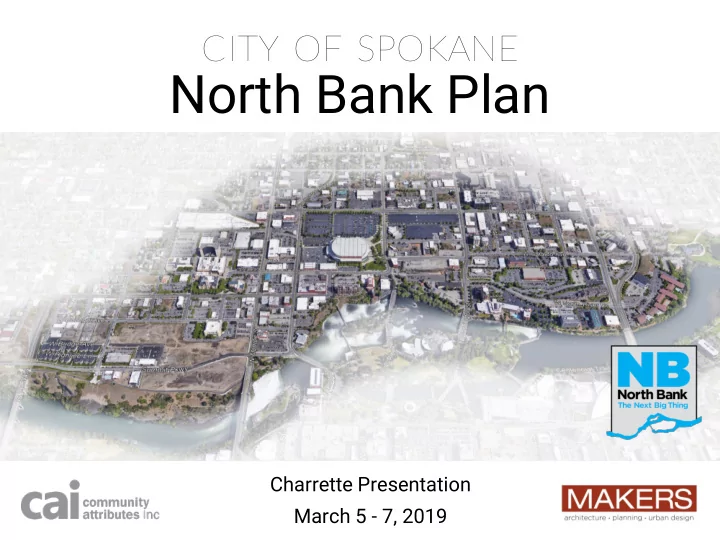
North Bank Plan
Charrette Presentation March 5 - 7, 2019
North Bank Plan Charrette Presentation March 5 - 7, 2019 Process - - PowerPoint PPT Presentation
CITY OF SPOKANE North Bank Plan Charrette Presentation March 5 - 7, 2019 Process Orientation, Context and Background Visioning Design and Assets, Opportunities, Development Synthesis and Themes and Development Problem Solving
Charrette Presentation March 5 - 7, 2019
1
Assets, Opportunities, Challenges Visioning Themes and Vision Statement Design and Development Considerations Development Concepts Synthesis and Refined Concept Problem Solving
What we heard before and during the charrette about assets,
ses through 2/26/19
ents are e gener eral ally y yo young ung – 44% of those completing the demographics section are 39 or younger; 20% are 60 or older
respondents have a household income of $100,000 or greater
th Bank and Downtown town are distin stinct, ct, but complementar plementary, and 31% believe that, while the North Bank and Downtown don’t currently have much in common, there are
Bank as part of (or the same as) Downtown.
proved ed or i is nicer now than it was previously; only 4% indicated that the area has gotten worse.
3
t important portant current nt assets ets in the North Bank (most votes) are:
st desir sired ed new assets ets (most votes) are:
st pressing sing issu sues es for the North Bank (most votes) are:
4
5
Assets, Opportunities, Challenges Vision Themes
North Bank Stakeholder Committee and Public Officials (28 responses) Current Assets MEAN RANK MEAN RANK MEAN RANK The Spokane River, Centennial Trail, Riverfront Park and
1.7 1 1.9 1 1.7 1 The Spokane Arena, future SportsPlex, Civic Theater, and
2.2 2 2.1 2 2.2 2 Existing restaurants and other retail 2.8 3 2.7 3 2.8 3 Existing offices and commercial centers 3.3 4 3.3 4 3.3 4 Potential Opportunities MEAN RANK MEAN RANK MEAN RANK Improving bike and pedestrian infrastructure and creating a walkable destination 2.3 1 2.4 2 2.3 1 Preserving and expanding public access to the Spokane River and creating new recreation amenities 2.6 3 3.1 4 2.7 4 Developing new housing 2.5 2 2.0 1 2.4 2 Improving facilities and programming to become a nationally-recognized destination for events 2.7 4 2.5 3 2.6 3 Total Stakeholder Committee Public Officials Total Stakeholder Committee Public Officials
6
Assets, Opportunities, Challenges Vision Themes
North Bank Stakeholder Committee and Public Officials (28 responses)
Challenges MEAN RANK MEAN RANK MEAN RANK Transportation: traffic, parking, east/west circulation and north/south connections to Downtown 1.7 1 2.7 4 1.9 1 Protecting and/or preserving existing historic buildings, valued businesses and residential neighborhoods 2.9 3 2.4 T-1 2.8 3 Maintaining Spokane River and Downtown views and preserving access to the River 2.4 2 2.4 T-1 2.4 2 Ensuring the safety of cyclists and pedestrians, or other public safety concerns 3.0 4 2.5 3 2.9 4 Vision Themes MEAN RANK MEAN RANK MEAN RANK River access and recreational amenities 3.8 6 3.8 7 3.8 6 Entertainment uses and 24-hour activity 3.6 10 3.5 11 3.6 10 Residential uses: mix of housing types affordable… 4.2 2 4.0 1 4.1 2 Residential uses: high-density urban housing 4.1 3 4.0 1 4.1 3 Walkable and bikeable streets 3.9 5 3.8 7 3.9 5 Arts and culture amenities 3.8 7 3.8 7 3.8 7 Open spaces and views 3.0 11 3.9 4 3.3 11 Employment opportunities and commercial spaces 3.7 9 3.8 7 3.7 9 Shopping and dining 4.1 4 3.9 4 4.0 4 Demographic and economic diversity 3.7 8 3.9 4 3.8 7 Connections to Downtown 4.6 1 4.0 1 4.4 1 Stakeholder Committee Public Officials Total Total Stakeholder Committee Public Officials
downtown
vibrant
neighborhood
river
entertainment
destination
walkable
area
housing
parking
sports
access
south
restaurants
commercial
activities
employment
affordable
connected
mixed-use
community
activity
tourism
spokane
diverse
space
safe
just
mix
7
A Visioning Vocabulary
The following are the most common words to appear in draft vision statements written by participants in the Stakeholder Committee Collective Visioning work session.
8
A Vision Statement A vibrant, walkable and truly authentic urban neighborhood that balances shopping, dining, entertainment and recreation on the Spokane River, with connections to Downtown and surrounding neighborhoods. (this is a starting point!)
Conceptual ideas around uses, intensity and amenities that leverage assets, seize opportunities and express the vision
10
Concept A: Event & Entertainment District
and entertainment facilities; intent to become a regional and national destination for events
residential and commercial, to create a 24/7 destination
levels and development patterns.
11
Concept A: Event & Entertainment District
Policy and Regulatory Considerations
programming, national attractions
building site coverage standards and retain strategic dimensional standards in view corridors
12
CONCEPT A: EVENTS AND ENTERTAINMENT DISTRICT
13
Evaluation: Concept A
14
Concept B: Walkable Urban Neighborhood
developed to meet the needs of a socioeconomically diverse pool of Spokane residents.
places for people of all ages. Walkability and bikeability are improved to prioritize neighborhood safety.
pursued.
as grocery or corner stores, are available in strategic locations.
residents.
development, potentially including MFTE and TIF
neighborhood scale and improve connectivity
projects
neighborhood residents
15
Concept B: Walkable Urban Neighborhood
Policy and Regulatory Considerations
16
CONCEPT B: WALKABLE URBAN NEIGHBORHOOD
17
Evaluation: Concept B
18
Concept C: Authentic Place on the Spokane River
expanded recreation amenities, green streets, pocket parks and connections to Riverfront Park are the most important features of this concept.
the Spokane River gorge.
North Bank is critical to maintain authenticity.
and bike-friendly amenities.
are expanded to create a place for people along the River.
development, potentially including MFTE and TIF
neighborhood scale and improve connectivity
projects
neighborhood residents
19
Concept C: Authentic Place on the Spokane River
Policy and Regulatory Considerations
20
CONCEPT C: AN AUTHENTIC PLACE ON THE SPOKANE RIVER
21
Evaluation: Concept C
22
Instant Reaction: why can’t we have all of them?
There are tradeoffs but we can have bits and pieces of each.
A single, flexible (and draft!) development concept that reflects initial feedback to guide efforts in policy and regulatory development
24
Synthesis
The Visioning Survey cast a wide net to determine what the common visioning themes were. Those visioning themes were ranked by the Stakeholder Committee and by public officials (City Council, Plan Commission, Design Review Board). Top-ranking visioning themes were used as criteria for the evaluation of three draft development concepts.
Concept B received the most support, with an average rating of 3.63 / 5.00 across all criteria. Concept A (3.10) and Concept C (3.09) received similar support.
Concessions to A:
remain as valued assets for Spokane residents and regional tourism draws.
limited area (in close proximity to event and entertainment assets).
stakeholders. Concession to C:
trail wayfinding, completing missing links, and ensuring connectivity throughout the Downtown and North Bank area (north/south and east/west) would capitalize on these assets.
ground-level public/private open space, etc.) would benefit a residential base as much or more than it would recreational users of the Trail corridor. Internal multimodal connectivity is key.
historic assets.
25
Synthesis
The North Bank can be both destinatio tination and neig ighborh hborhood
tive and authen thenti tic.
required to make this area a real neighborhood and valued place. Density, intensity and energy increase closer to the River and Downtown.
expand programming opportunistically and pursue synergies with other event and entertainment uses (e.g. Downtown Entertainment District, Convention Center)
and recreational assets and extending such assets north into the surrounding neighborhoods.
26
Synthesis
and meet the needs of North Bank residents
uses citywide
story attached and detached) north of Boone and west of Monroe
Spokane River (and the River to residents)
terminus; secondary retail locations are located at Boone and Lincoln, Boone and Howard, and Boone and Division; tertiary retail locations are located at Boone and Washington and River and
uses and intensities.
27
28
29
30
How well does this concept reflect your vision and the consensus vision expressed by stakeholders and the public?
32
Does the concept fit with a consensus vision for the North Bank? What specific changes would help move the concept into alignment with a consensus vision?
33
(Some) Remaining Challenges
How to integrate Gonzaga? What’s the identity of the east end of the North Bank area? What, if any, possibilities existing for the long-term conversion of publicly-owned surface lots? How to support events and a growing resident base with high-capacity transit? How to negotiate completion of the trail network? How to create more active access to/interaction with the River? How to make the trail and related assets an intuitive experience? What tools are available to implement the concepts above absent a downzoning or major land use changes? Peak vs. non-peak identity (seasonality, event utilization, etc.) Can the Overlay be tailored more narrowly than the Subarea? Overlay may be more appropriate for 24/7 Center, while Subarea may continue to guide development in a larger area?
Campus (has a masterplan!) in or out?
with Downtown Plan boundary? Design Review areas? TIF Boundary?
34
(Other) Remaining Challenges?
_____________________________________________________ _____________________________________________________ _____________________________________________________ _____________________________________________________ _____________________________________________________
35
Objectives and Next Steps