SLIDE 1 Non equilibrium co-existence
10 20 60 2,000 Species abundances 4,000 6,000 8,000 10,000 30 a 40 50
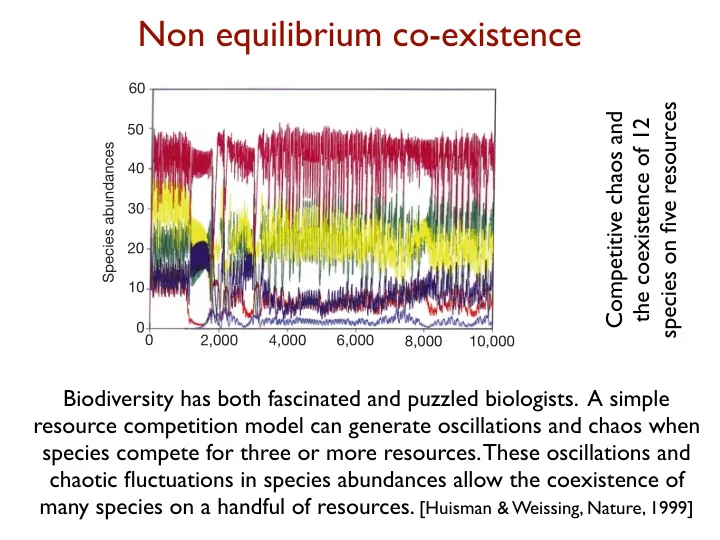
Competitive chaos and the coexistence of 12 species on five resources Biodiversity has both fascinated and puzzled biologists. A simple resource competition model can generate oscillations and chaos when species compete for three or more resources. These oscillations and chaotic fluctuations in species abundances allow the coexistence of many species on a handful of resources. [Huisman & Weissing, Nature, 1999]
SLIDE 2
Density dependent predation
SLIDE 3
CRISPR mediated immunity
Bacteria pick up DNA fragments from phages. They ‘store’ these fragments in their own genome to become immune to phages expressing these sequences [Levin et al. PLoS Genetics 2013]
SLIDE 4
Group formation and predator-prey dynamics
Lions living in groups have a lower food intake but have better stability. But is this an ESS? [Fryxell et al. Science, 2007]
SLIDE 5
We find that whereas the two separate, single host-single parasitoid interactions are persistent, the three-species system with the parasitoid attacking both hosts species (which are not allowed to compete directly) is unstable. One of the host species is eliminated owing to the effects of apparent competition.
Also study equal predation
Nature 1997
SLIDE 6
Competitive exclusion and parasitism
We studied the effect of a pathogen on winning species:
Sj
= bNj(1 − Nj/k) − djSj − βSjIj
Ij
= βSjIj − (dj + δ)Ij
Janzen-Connell hypothesis: parasites evolve towards most dominant species (negative density dependence) [Bagchi et al., Nature, 2014] What is the effect of pathogens on co-existence?
SLIDE 7 Ontogenetic development for dummies, try to repeat these results with:
Symmetry breaking in ecological systems through different energy efficiencies of juveniles and adults
Persson & De Roos Ecology 2013; De Roos & Persson, Princeton UP , 2013 R = K − c1J − c2A , dJ dt = eAR h2 + R − mJR h1 + R − µd1J and dA dt = mJR h1 + R − µd2A
SLIDE 8
Long term effects of vaccination
The effect of elephants is through regular browsing and coppicing of trees, fire through episodic burns linked to fuel load, wildebeest after being released from the suppressing effects of endemic rinderpest (a morbillivirus of artiodactyls), and rain through its connections to all system components. Holdo et al. [2009] demonstrate that eradication of rinderpest is responsible for the Serengeti switch from a net source to net accumulator of carbon. Getz, PLoS Biol 2009
SLIDE 9 Early-warning signals for critical transitions
Ecosystems can have tipping points at which a sudden shift to a contrasting dynamical regime may occur. Although predicting such critical points is extremely difficult, generic early-warning signals may indicate that a critical threshold is approaching [Scheffer Nature 2009]
Residual
a b c
2 4 6 Biomass (a.u.) F2 F1
Increasing the harvest rate over time
SLIDE 10 f(R) = 2R H + R +
McCauley et al Nature 1999
Large-amplitude cycles of Daphnia and its algal prey in enriched environments
SLIDE 11 Tilman’s competition model: famous 1982 Princeton book, and PNAS 1997
What is the relation between diversity and productivity? See also recent experimental tests:
Dybzinski & Tilman, American Naturalist 2007 & Adler et al. Science 2011
SLIDE 12 Tilman’s metapopulation model Nature 1994
m2 c2
P Patches occupied: ¯ pi
m1 c1 m2 c2
↑
m1(c1+c2)−m2 c1
SLIDE 13 Influenza strain replacement
Mapping the Antigenic and Genetic Evolution of Influenza Virus
Derek J. Smith,1,2*† Alan S. Lapedes,3* Jan C. de Jong,2 Theo M. Bestebroer,2 Guus F. Rimmelzwaan,2 Albert D. M. E. Osterhaus,2 Ron A. M. Fouchier2*
Study strain replacement within a season, and how this depends on the vaccine coverage at the start of the season.