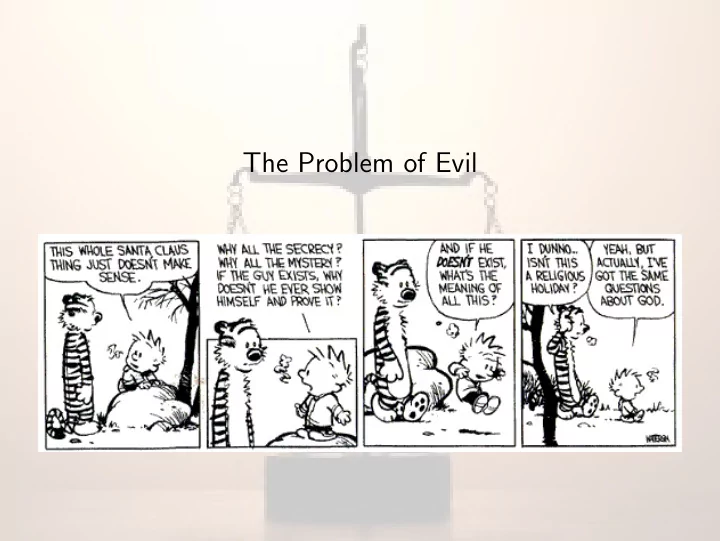
SLIDE 1
The Problem of Evil
SLIDE 2
Proofs of Non-existence
◮ Proofs of non-existence are strange; strange enough in fact
that some have claimed that they cannot be done.
◮ One problem is with even stating non-existence claims:
how can we name something and then say it doesn’t exist?
◮ While it is not possible to show the non-existence of a
particular thing we name, we can say that a name doesn’t refer to anyone (e.g. there is no Lennay Kekua)
◮ Also, we can say that there is nothing fitting a given
description (e.g. there are no leprechauns)
◮ There is a further worry about how we could ever show a
non-existence claim to be true
◮ It is easy to see how we prove the existence of something:
we show it or show things that imply it
◮ While non-existence proofs are different, there are at least
two ways to prove non-existence
SLIDE 3
Proofs of Non-existence
◮ First, one can show that something doesn’t exist by
showing that its properties are inconsistent.
◮ Since nothing can have impossible properties, if we can
show that it is impossible for something to have all the properties it would have to have to be a certain object, we can show it is impossible
◮ The easy examples of this are married-bachelors or square
circles
◮ There are, however, more complex and interesting
impossible combinations, such as the Barber of Saxony
SLIDE 4 Proofs of Non-existence
◮ Second, one can show that something doesn’t exist by
showing an absence of tell-tale signs
◮ This type of argument is inductive (as opposed to the
previous deductive argument), so it only yields probable conclusions, but it nonetheless is how we generally infer non-existence
◮ For instance, we can infer that there is no radiation in the
area by the fact that a Geiger counter is not going off
◮ If you look out the window, and you see that none of the
leaves are moving, you can infer that there is no wind
◮ These arguments are only good if we think we would see
the evidence if it was there, but there are often good inferences of this kind
SLIDE 5
The Problem of Evil
◮ The Problem of Evil is clearly the biggest problem for
those who believe there is an omni-God
◮ While we say “the problem of evil”, in reality, there are
thousands of different ways to argue from evil to the non-existence of God
◮ For instance, one can try to argue against a God because
there is evil, because there is horrendous evil, because we are able to do evil, because innocent people suffer, because of the distribution of suffering across people, etc.
◮ For present purposes, we will focus on two versions: one of
each type of non-existence proof.
◮ Let us call versions of the problem of evil which try to
show a contradiction in the concept of God the logical problem of evil
◮ This is contrasted with the evidential problem of evil which
says that we have good evidence for thinking there is no God because we don’t see the things we would expect to see if there was a God
SLIDE 6
The Logical Problem of Evil
(1) If God exists, then God is all good, all powerful, and all knowing and allows there to be evil in the world. (2) If God is all good, then he would want to eliminate evil. (3) If God is all powerful, then he can eliminate evil. (4) If God is all knowing, then he is aware of any evil that exists. (C) Therefore, God does not exist. Is this valid?
SLIDE 7
The Logical Problem of Evil
(1) If God exists, then God is all good, all powerful, and all knowing and allows evil. (2) If God is all good, then he would want to eliminate evil. (3) If God is all powerful, then he can eliminate evil. (4) If God is all knowing, then he is aware of any evil that exists. (5) If there is a being that knows about all evil, wants to eliminate evil, and is able to eliminate all evil, then that being would not allow there to be any evil in the world. (C) Therefore, God does not exist. Should we think that premise 5 is true?
SLIDE 8 The Logical Problem of Evil
The Missing Premise:
(5) If there is a being that knows about all evil, wants to eliminate evil, and is able to eliminate all evil, then that being would not allow there to be any evil in the world.
◮ Notice how strong a claim (5) is. It is a claim of
necessity−necessarily, if there is a being having all the properties of God, then that being would not allow any evil in the world.
◮ The idea of a God who allows evil is just as contradictory
- n this view as the idea of a round-square, a highest prime
number, a mountain without a valley, or a Barber of Saxony
◮ If we could provide some way of there being a square circle
- r Barber of Saxony, no matter how implausible, then it
would show that there was no contradiction in the concept.
◮ Likewise, if one could show some way of there being a God
who allows evil, no matter how implausible, then it would
SLIDE 9
The Logical Problem of Evil
The Missing Premise:
(5) If there is a being that knows about all evil, wants to eliminate evil, and is able to eliminate all evil, then that being would not allow there to be any evil in the world.
◮ Some philosophers find it helpful to distinguish between a “theodicy”
and a “defense”
◮ A theodicy explanation of why God allows evil in the world ◮ A defense is an explanation which for all we know is true, and if true
would explain why God allows suffering in the world
◮ All the theist needs in response to the logical problem of evil is a defense,
a possibility of God existing and permitting evil.
◮ Thus, the theist here need not say exactly why a given evil was
permitted, but instead can merely try to show it is possible there is a reason.
◮ By far the historically most important explanation of evil is free will. ◮ The free will defense will ultimately depend on 4 claims
SLIDE 10 Omnipotence
◮ A first step to any claims about possibilities for God is to
get clear on what is meant by “omnipotence”
◮ Can God make a rock so big even he can’t lift it?
4 possible responses:
- 1. Because answering “yes” or “no” would imply that there
was something God cannot do, this implies that it is impossible for there to be an omnipotent being.
- 2. Yes, God can, and he can then move the rock (Descartes’
answer).
- 3. No, but this doesn’t violate God’s omnipotence because
- mnipotence only applies to things consistent with God’s
nature (God also can’t sin, can’t tempt, etc.). Impossible things are not within God’s nature to do.
- 4. The question is meaningless.
◮ Only responses 3 and 4 will be open to a defense to the
problem of evil.
◮ Take any good thing, if 2 is true, then God could have
achieved that good without allowing any suffering or evil, so what could possibly justify God’s allowing such evil?
SLIDE 11
Value
◮ Whatever explains God’s allowing evil must be sufficiently
valuable so as to outweigh the evil it explains.
◮ One important divide is whether the explanation of evil
most be sufficiently good for me to outweigh the evil I suffer (and likewise for others) or if it is enough for the good to simply outweigh the bad in general
◮ Many have thought that free will is sufficiently good to
meet these requirements.
◮ Why think free will is so good? ◮ What is Ivan Karamazov’s response? Is it good?
SLIDE 12
Scope
◮ A third problem for explaining evil is explaining all the evil ◮ Free will, for instance, seems like a plausible explanation of
ISIS attacks or various other moral evils humans do to each other, but it is difficult to see how it could explain hurricanes, disease, starvation, and various other natural evils
◮ One may want to offer some other explanation for these
than free will
◮ However, if one is looking for a defense purely based on
free will, she can try to explain these in terms of the free will of non-human persons (demons) or by saying that they are a natural consequence of the abuse of human free will (the fall)
◮ Recall again that a defense need only show a logically
possible way for there to be a God that allows evil
SLIDE 13 The Free Will Defense
For all we know:
- 1. Free will is a great enough good as to outweigh than all
the negative value of evil in the world. (Value thesis)
- 2. Free will requires the ability to misuse free will.
(Libertarian thesis)
- 3. If free will requires the ability to misuse free will, then not
even God can create free creatures which are unable to misuse free will. (Omnipotence thesis)
- 4. All evil is the result of free will. (Scope thesis)
- 5. Therefore, all evil is justified because it comes from the
great good of free will.
- 6. Therefore, God is justified in creating a world with the
evils of our world.
◮ If this is possibly true, then there is no contradiction in
the description of a God that allows evil.
SLIDE 14 The Evidential Problem of Evil
◮ One may grant that the theist has provided a logically
possible way for there to be a God that allows evil, but it may still be the case that evil is powerful evidence against the existence of God.
◮ There are many different forms of the evidential problem
- f evil based on whether the evidence is the amount of
evil, the distribution of suffering, the amount of apparently excessive evil, etc.
◮ Here is one version:
(1) If there is an omniscient, omnipotent, omnibenevolent being (i.e. God), then there is no evil which is not necessary to obtain a greater good or to prevent at greater evil (i.e. superfluous evil). (2) There is superfluous evil. (C) Therefore, there is no God.
◮ Premise (2) is supposed to be the premise supported by
SLIDE 15
The Evidential Problem of Evil:
(1) If there is a God, then there is no superfluous evil. (2) There is superfluous evil. (C) Therefore, there is no God.
◮ Why think premise (2) is supported by our evidence? ◮ There are things (such as the Holocaust) for which we don’t see good
God-justifying reasons. Furthermore, these seem so bad that there couldn’t be any reasons justifying God’s allowing such an evil.
◮ Perhaps there are small things in our lives which seem bad at the
moment but turn out to be good, but surely there are massive evils in the world which nothing could justify.
◮ These are sometimes called “no-see-um” arguments because we don’t
see any reasons that God could have for allowing such prolonged and intense suffering in the world.
SLIDE 16 The Evidential Problem of Evil:
(1) If there is a God, then there is no superfluous evil. (2) There is superfluous evil. (C) Therefore, there is no God.
◮ Theists have responded to these arguments by challenging the inference
from “we don’t see any God-justifying reasons” to “there aren’t any God justifying reasons.”
◮ That type of inference is highly dependent on how likely we are to see
the thing we are looking for if we look for it (compare the inference for there not being an elephant in the room vs. the inference for there not being a mosquito in the room)
◮ There seem to be some reasons to think that we cannot see such reasons
(because of our limited knowledge of cause and effect across history and
- ur limited knowledge of good and evil) and that we could not
understand such reasons if we saw them (parent analogy)
◮ On the other hand, if one goes down this road, it seems to lead to moral
skepticism (at least if we are utilitarians) because we have no idea what
SLIDE 17
The Evidential Problem of Evil:
(1) If there is a God, then there is no superfluous evil. (2) There is superfluous evil. (C) Therefore, there is no God.
◮ Why think Premise (1) is true? ◮ It seems fairly obvious that given the properties of God,
God would not allow evil if there was not a very good reason for allowing it.
◮ This was our missing premise (5) above; thus, we seemed
to be assuming it all along
◮ However, there is an ambiguity between God allowing evil
in general and God allowing each particular instance of evil.
SLIDE 18 Consider the following scenario:
- Dr. Evil has just been found guilty of stealing one millions dollars, and you are
the judge solely responsible for his sentencing. In addition to him giving back the money (and then some) you believe he needs to serve some jail time both to serve the interests of justice and to deter future criminals. As judge, you have two desires. First, you want to make sure he serves a sufficient amount
- f jail time to be just, and 0 days in jail will not be just. Second, you don’t
want to make him serve any more days in jail than is necessary. Suppose you sentence him to 1,234 days in jail. Dr. Evil, being an evil mastermind, points
- ut to you that the interest of justice will still be served if he spends only 1,233
days in jail, so by your second desire, you should reduce his sentence by a day. However, when you do, he submits another appeal saying that the interests of justice will be equally served by his spending only 1,232 days in jail, so by your second desire, you should reduce his sentence by a day. In general, one less day in jail will never change whether or not the interests of justice are served, but if you continue along this path, he will end up with 0 days in jail, which is definitively unjust. So what do you do?
SLIDE 19
The Evidential Problem of Evil:
(1) If there is a God, then there is no superfluous evil. (2) There is superfluous evil. (C) Therefore, there is no God.
◮ A seemingly reasonable thing to do in response to the Dr. Evil problem is
to accept that there will be some superfluous days in jail and give up the desire t not make him serve a single day longer than necessary in jail
◮ Some have thought that God is in a similar scenario ◮ If God wanted to create a world with certain features such as containing
free creatures which can morally develop and participate in a plan of redemption, then there would be evil
◮ It is consistent with this that any (or many) individual evil(s) could be
eliminated without preventing a greater good or allowing a greater evil; nonetheless a world with approximately this much evil was necessary for God to accomplish God’s purposes, so the world as a whole is justified, even if it is not the case that each individual evil contributes to a particular good