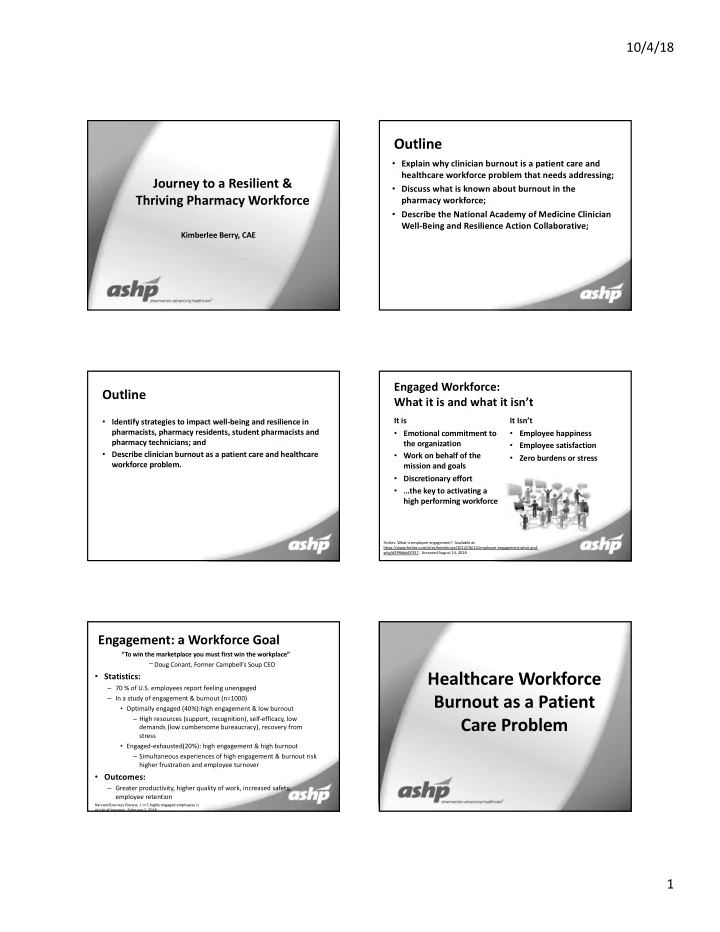
Healthcare Workforce Statistics: 70 % of U.S. employees report - - PDF document

healthcare workforce
SMART_READER_LITE
LIVE PREVIEW

Healthcare Workforce Statistics: 70 % of U.S. employees report - - PDF document

10/4/18 Outline Explain why clinician burnout is a patient care and healthcare workforce problem that needs addressing; Journey to a Resilient & Discuss what is known about burnout in the Thriving Pharmacy Workforce pharmacy


slide-1
SLIDE 1

10/4/18 1 Journey to a Resilient & Thriving Pharmacy Workforce

Kimberlee Berry, CAE

Outline

  • Explain why clinician burnout is a patient care and

healthcare workforce problem that needs addressing;

  • Discuss what is known about burnout in the

pharmacy workforce;

  • Describe the National Academy of Medicine Clinician

Well-Being and Resilience Action Collaborative;

Outline

  • Identify strategies to impact well-being and resilience in

pharmacists, pharmacy residents, student pharmacists and pharmacy technicians; and

  • Describe clinician burnout as a patient care and healthcare

workforce problem.

Engaged Workforce: What it is and what it isn’t

It is

  • Emotional commitment to

the organization

  • Work on behalf of the

mission and goals

  • Discretionary effort
  • …the key to activating a

high performing workforce It Isn’t

  • Employee happiness
  • Employee satisfaction
  • Zero burdens or stress
  • Forbes. What is employee engagement? Available at:

https://www.forbes.com/sites/kevinkruse/2012/06/22/employee-engagement-what-and- why/#2f96ddd37f37. Accessed August 14, 2018.

Engagement: a Workforce Goal

“To win the marketplace you must first win the workplace” ~ Doug Conant, Former Campbell’s Soup CEO

  • Statistics:

– 70 % of U.S. employees report feeling unengaged – In a study of engagement & burnout (n=1000)

  • Optimally engaged (40%):high engagement & low burnout

– High resources (support, recognition), self-efficacy, low demands (low cumbersome bureaucracy), recovery from stress

  • Engaged-exhausted(20%): high engagement & high burnout

– Simultaneous experiences of high engagement & burnout risk higher frustration and employee turnover

  • Outcomes:

– Greater productivity, higher quality of work, increased safety, employee retention

Harvard Business Review. 1 in 5 highly engaged employees is at risk of burnout. February 2, 2018.

Healthcare Workforce Burnout as a Patient Care Problem

slide-2
SLIDE 2

10/4/18 2 Burnout is a Patient Care Problem

Bodenheimer T, Sinsky C. From triple aim to quadruple aim: care of the patient requires care

  • f the provider. Ann Fam Med. 2014;12(6):573-6.

Swensen S, Shanafelt, Mohta NS. Leadership survey: Why physician burnout is endemic, and how health care must respond. NEJM Catalyst. December 8, 2016. Available at: https://catalyst.nejm.org/physician-burnout-endemic-healthcare-respond/

Burnout Medical Error

Bi-directional relationship

  • Higher levels of burnout associated with increased odds of reporting a

medical error in subsequent 3 months

  • Self-perceived medical error associated with worsening burnout &

depressive symptoms

Shanafelt Ann Surg 2009; Balch J Am Coll Surg 213; West JAMA 2006, 2009; Jones J Appl Psychol 1988; Cimiotti Am J Infect Control 2012; Welp Front Psychol 2015; Welp Crit Care 2016

Burnout and Patient Safety: Summary of the Evidence

  • Introduction: Evaluation of association between healthcare

staff wellbeing, burnout, and patient safety

  • Methods: Systematic Review
  • Results: 46 studies included

– Significant correlation between poor wellbeing in health care professionals and worse patient safety (n=16) – Significant association between burnout and patient safety (n=21)

  • Conclusion: Studies show correlation between burnout and

lower patient safety; more studies needed to determine causality

Hall LH, Johnson J, Watt I, et al. Healthcare staff wellbeing, burnout, and patient safety: A systematic review. PLoS ONE. 2016; 11(7): e0159015

Health Care Costs

↑Medical Errors ↑Malpractice claims ↑Turnover

– 1.2-1.3 x salary ($82-$88,000 per RN in 2007) – $500,000 to >$1 million

↑Absenteeism ↓Job productivity ↑Referrals ↑Ordering

Jones J Nurs Am 2008; Fibuch Physician Leadersh J 2015; Buchbinder Am J Manag Care 1999; Kushnir, Fam Pract 2014; Bachman Soc Sci Med 1999; Parker J Behav Med 1995, Toppinen-Tanner Behav Med 2005, Hilton J Occup Environ Med 2009

slide-3
SLIDE 3

10/4/18 3 Poll Everywhere Question

  • How have you seen burnout impact patient care?

Burnout in the Pharmacy Workforce

What is Stress?

  • Stress is a physical, mental, or

emotional factor that causes bodily

  • r mental tension.
  • Eustress is moderate or normal

psychological stress considered to be beneficial for the experiencer

Motivates, focuses energy, is short-term, perceived as within our coping abilities, feels exciting, & improves performance

  • Distress is extreme anxiety, sorrow,
  • r pain

Can be short-or long-term, feels unpleasant, considered outside of

  • ur coping ability, decreases

performance, may lead to mental & physical problems

https://www.medicinenet.com/script/main/art.asp?articlekey=20104

Caring for Patient Avoiding Harm Respecting Patient Autonomy Striving for Justice Growing Demands Burdensome Tasks Increased Stress

Maslach, C., S. E. Jackson, et al. (1996). Maslach Burnout Inventory Manual. Palo Alto, CA, Consulting Psychologists Press.

What is Burnout?

  • Syndrome of:
  • Emotional exhaustion
  • Depersonalization (e.g.,

cynicism)

  • Low personal

accomplishment

Identify Burnout

https://nam.edu/valid-reliable-survey-instruments- measure-burnout-well-work-related-dimensions/

slide-4
SLIDE 4

10/4/18 4

Maslach Burnout Inventory – Human Services Survey Tool

  • Medical Personnel

– Emotional exhaustion

  • Measures feelings of being emotionally overextended and exhausted by
  • ne’s work

– I feel emotionally drained from my work

– Depersonalization

  • Measures an unfeeling and impersonal response toward patients

– I don’t really care what happens to some patients

– Personal Accomplishment

  • Measures feelings of competence and successful achievement in one’s

work

– I have accomplished many worthwhile things in this job

– Response options (frequency): never, a few times a year or less, once a month or less, a few times a month, once a week, a few times a week, every day

High Prevalence of Burnout

Medicine

  • 2014, 6880 physicians, all

specialties, all practice types

  • 2012, 5521 medical students &

residents Nursing

  • 1999, >10,000 inpatient RN
  • 2007, 68,000 nurses

Aiken JAMA 2002;288; McHugh Health Aff 2011;30; Dyrbye Acad Med 89(3): 443-451; Shanafelt MCP 2015:90:1600

Burnout: Pharmacy Residents

Study Overview

  • Stress and negative affect

levels surveyed in PGY1 & PGY2s (n=524, 27.7% response)

  • Those working > 60

hours/week reported higher levels of perceived stress and elevated depression, hostility, and dysphoria

  • Perceived stress for pharmacy

residents was 19.06+5.9

– 14.2+6.2 in 18-29 year old health adults – 20.3+7.4 in cardiology medical residents

Takeaways

  • 10-item Perceived Stress

Scale is a free, validated tool to assess stress among pharmacy residents

  • Hostility was highest in

PGY2

  • When pressures of being
  • verworked > resident’s

ability to cope, well-being is in danger

Le HM, Young SD. Evaluation of stress experienced by pharmacy residents. AJHP.2017;74:599-604

Burnout: Clinical Pharmacists

  • Jones and colleagues measured clinical pharmacist

burnout (n=974)

– Nearly ¾ included respondents are certified by BPS – More than half completed residency training – 61.2% overall burnout rate; 52.9% high emotional exhaustion – Characteristics of burned out clinical pharmacists:

  • Less likely to have children (p=0.002)
  • More likely to work more median hours (p<0.001)
  • More likely to have attained BPS certification (p=0.005)

– No difference observed in practice area, hospital setting

Jones GM, Roe NM. Factors Associated With Burnout Among US Hospital Clinical Pharmacy Practitioners: Results of a Nationwide Pilot

  • Survey. Hosp Pharm.2017;52:11:742-51.

Drivers of Burnout in Healthcare Professionals

Risk Factors Associated With Burnout

Am J Health-Syst Pharm. 2017; 74:e576-81

Risk Factor Example Workload Job demands exceeding human limits; limited time to rest, recover, and restore. Control Role conflict; absence of direction in the workplace Reward Inadequate financial, institutional, or social reward in the workplace; lack of recognition Community Inadequate opportunity for quality social interaction at work; inadequate development of teams Fairness Perception of equity from an organization or leadership Values Organizational values are incongruous with an individual’s personal values or beliefs Job-person incongruity Personality does not fit or is misaligned with job expectations and coping abilities

National Academy of Medicine Action Collaborative Clinician Well-Being and Resilience

slide-5
SLIDE 5

10/4/18 5

National Academy of Sciences

§ Founded in March, 1863 § Private, nonprofit organization

  • f the country’s leading

researchers § National Academy of Medicine

§ Formed in 1970 to advise the nation on medical & health issues §

  • Dr. Victor Dzau is President

Dzau VJ, Kirch DG, Nasca TJ. To care is human – collectively confronting the clinician-burnout crisis. NEJM.2018;378(4):312-314.

“Through collective action and targeted investment, we can not only reduce burnout and promote well-being, but also help clinicians carry out the sacred mission that drew them to the healing professions – providing the very best care to patients”

Action Collaborative Goals

NAM

  • Improve baseline understanding

across organizations of challenges to clinician well-being

  • Raise visibility of clinician stress

and burnout

  • Advance evidence-based,

multidisciplinary solutions to reverse these trends, leading to improvements in patient care by caring for the caregiver

ASHP

  • Improve patient outcomes

through optimal medication use

  • Identify mechanisms to improve

and sustain pharmacy workforce well-being and resilience

  • Deploy pharmacy workforce to

support multidisciplinary solutions for improving healthcare workforce well-being and resilience

Action Collaborative Timeline

July 2016 July 2017 Jan 2017 Sept 2016 June 2017 May 2018 Sept 2017

American Society of Health-System Pharmacists

  • Vision
  • Medication use will be
  • ptimal, safe, and

effective for all people all of the time

  • Membership

Organization

  • Established 1942
  • 45,000 members
slide-6
SLIDE 6

10/4/18 6 ASHP Vision & Strategic Plan

  • Our Patients and Their

Care

– Goal 4: Improve Patient Care by Enhancing the Well-Being and Resilience

  • f Pharmacists, Student

Pharmacists, and Pharmacy Technicians

  • Our Members and

Partners

  • Our People and

Performance Goal 4: Objectives

  • Engage in major national

initiatives

  • Facilitate the

development of education

  • Improve the well-being

and resilience in postgraduate pharmacy residency training

  • Foster research

Strategic Plan

Collaborative Composition & Commitments

  • 36 sponsoring organizations, 100 network
  • rganizations:

– Professional organizations – Government – Technology and EHR vendors – Large health care centers – Payors

  • 130 commitment statements

– To provide an opportunity for organizations across the country discuss and share plans of action to reverse clinician burnout and promote clinician well-being. – https://nam.edu/initiatives/clinician-resilience-and-well- being/commitment-statements-clinician-well-being/

Creating An All-Encompassing Model

ü Broad enough to define the issue across all healthcare professions ü Satisfactorily encompasses multiple environments (education, practice) ü Satisfactorily encompasses multiple stages of development

  • f the health professional

ü Satisfactorily encompasses system and individual issues in ways that are helpful toward developing a solution (e.g. defining without stigmatizing) ü Lends itself to being a tool for diagnosis, explanation, treatment ü Serves as a taxonomy for organizing other elements/tools developed as part of this NAM Collaborative

Brigham T, Barden C, Legreid Dopp, A, Hengerer A. et al. A journey to Construct an all-encompassing conceptual model of factors affecting clinician well-being and resilience. National Academy of Medicine, 2018.

Strategies to Impact Well-Being and Resilience

slide-7
SLIDE 7

10/4/18 7 Clinician Well-being and Resilience

  • Well-being

– The presence of positive emotions and moods. – The absence of negative emotions. – Satisfaction with life, fulfillment and positive functioning. – Physical well-being is also viewed as critical to overall well-being.

  • Resilience

– Set of individual skills, behaviors, and attitudes that contribute to personal physical, emotional, and social well-being, including the prevention of burnout.

Resilience & Coping Skills

  • Bounce back from adversity,

uncertainty, risk or failure, and adapt to changing and stressful life demands

  • Hope, optimism, self-

efficacy

  • Perseverance and passion

for long term goals (Grit)

Ready

Good to go Adapting/flexible Excelling at job “I am at the top

  • f my game and

adapting well to all pressures”

Reacting

Mild distress Temporary symptoms Still getting work done “Stress is affecting me but I can still get the job done”

Injured

Noticeable symptoms Personality change Erratic functioning “I have changed to the point that I am not in total control of my behavior or reactions”

Ill

Severe impairment Extremely

  • verwhelmed

Possible danger to self/others “This worsening condition requires full attention before getting back to work”

Self Interventions Social Support Professional Care Rest Needed

*Adapted from US Navy’s COSC Doctrine

Mitigating Stress

Self-Care Techniques

  • Monitor personal stress

indicators (sleep, eating, agitation, etc)

  • Decompress with healthy

transitions (teatime, yoga, journal, breathwork, music)

  • Record three good

experiences from the day, savor those positive moments and plan for good experiences tomorrow

  • Speak with trusted people,

maintain social connections

Resiliency Competencies

  • Awareness

– Noticing the right information

  • Sensations, thoughts,

environments

  • Regulation

– Of self and others’ stress reactions and emotions

  • Leadership

– Toward meaningful personal and team actions

slide-8
SLIDE 8

10/4/18 8

Strategies to Alleviate Burnout in Healthcare Professionals

Risk Factors Associated With Burnout

Am J Health-Syst Pharm. 2017; 74:e576-81

Risk Factor Strategy to Alleviate Risk Workload Permitting time at the workplace to recover from a stressful event Control Clearly defined roles and expectations from organizational leadership Reward Identify suitable rewards to recognize achievements, provide

  • pportunities to teach or mentor trainees

Community Promote participation in professional organizations Fairness Transparency in decision-making Values Align personal expectations with organizational goals Job-person incongruity Evaluate and align job responsibilities with personal and professional expectations

Executive Leadership Strategies

  • Acknowledge & assess the issue
  • Identify impediments
  • Harness the power of leadership
  • Implement system approaches
  • Cultivate community
  • Use rewards & incentives wisely
  • Align values & strengthen culture
  • Promote flexibility and work-life integration
  • Provide resources to promote self-care
  • Use improvement science to test
  • 1. Shanafelt TD, Noseworthy JH. Executive leadership and physician well-being: Nine

Organizational Strategies to promote engagement and reduce burnout. Mayo Clin

  • Proc. 2017;92(1):129-146. 2. Perlo J, Balik B, Swensen S, Kabcenell A, Landsman J, Feeley D.

IHI Framework for Improving Joy in Work. IHI White Paper. Cambridge, Massachusetts: Institute for Healthcare Improvement; 2017.

Decrease Toxicity Decrease Stress Establish Meaning

LOOKING AHEAD Educate Yourself on Burnout

  • Webinars

– Extinguishing the Burnout: Yourself and Your Team – Tame the Flames of Burnout: Tools for Building Resilience in Your Workforce – Leadership Burnout and Strategies for Burnout Prevention

  • More Resilience sessions planned for:

– 2018 National Pharmacy Preceptors Conference

  • Creating a Culture of Resident Well-Being
  • Building Resilience in Residency Training It Takes a Village
  • Fueling Your Fire Identifying and Managing Preceptor Burnout

– 2018 Conference for Pharmacy Leaders

  • Workforce Resilience Developing an Open and Successful Environment

– 2018 Midyear Clinical Meeting

Educate Yourself & Join the Conversation Follow the conversation: nam.edu/ClinicianWellBeing #ClinicianWellBeing

slide-9
SLIDE 9

10/4/18 9 NAM Knowledge Hub

nam.edu/clinicianwellbeing

Questions? Ideas? Considerations?

Christina Martin Anna Legreid Dopp cmartin@ashp.org adopp@ashp.org