
SLIDE 1
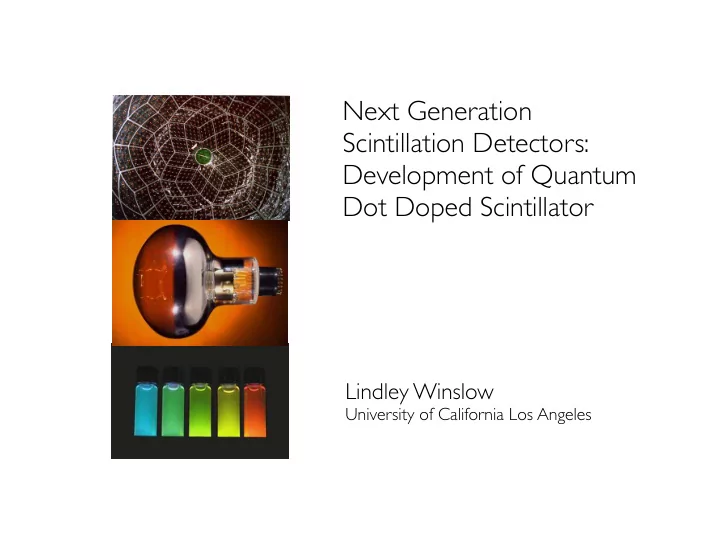
Next Generation Scintillation Detectors: Development of Quantum Dot Doped Scintillator
Lindley Winslow
University of California Los Angeles
Next Generation Scintillation Detectors: Development of Quantum - - PowerPoint PPT Presentation
Next Generation Scintillation Detectors: Development of Quantum Dot Doped Scintillator Lindley Winslow University of California Los Angeles I am particularly interested in applications to ... e - e - i i Nucleus Z+2 Nucleus Z
Lindley Winslow
University of California Los Angeles
➢ Nucleus Z+2
Nucleus Z ➢
e-
νi
e-
Nuclear Process
νi
Neutrinoless Double Beta Decay I am particularly interested in applications to ...
Neutrinoless Double Beta Decay
The sum of the electron energies gives a spike at the endpoint of the “neutrino-full” double beta decay.
How many sigma you would like to be able to measure.
Detector Efficiency Isotopic abundance Molecular Weight
Exposure time Background rate
Total Mass
Energy resolution
Phys.Rev.D76:093009,2007
Angular Correlation One electron energy
Kotila and Iachello Ali, Borisov, Zhuridov
νe e- νe e-
Z
Nuclear Instruments and Methods in Physics Research A 440 (2000) 360 } 371
Typically, 200 photons detected per MeV with ~3ns timing resolution.
Number of Cerenkov Photons for a 1MeV e- The Cerenkov light is still there... For KamLAND scintillator, this is 60 (10) photons per MeV above 400nm below 400nm the light is absorbed and reemitted as scintillation light.
Geant4 simulation
spherical geometry.
electrons.
scintillator and PMTs.
Cerenkov signal? From: Christoph Aberle
Results for 100 e- events: Cerenkov light more important at longer wavelengths.
As expected Cerenkov light is directed forward...
and the Cerenkov light arrives earlier... Note: 3ns transit time spread of KamLAND PMTs is not great.
Now with a 35ns cut we can pull out a directional signal... Event by event is going to be difficult, unless...
With perfect timing...
Much better directional distribution... and even event by event looks possible.
So the timing and photocathode coverage requirements point to something like the LAPPD (higher quantum efficiency would be nice too).
νe e- νe e-
Z
What are Quantum Dots?
Quantum Dots are semiconducting nanocrystals. A shell of organic molecules is used to suspend them in an
Common materials are CdS, CdSe, CdTe...
Isotope Endpoint Abundance
48Ca
4.271 MeV 0.0035%
150Nd
3.367 MeV 5.6%
96Zr
3.350 MeV 2.8%
100Mo
3.034 MeV 9.6%
82Se
2.995 MeV 9.2%
116Cd
2.802 MeV 7.5%
130Te
2.533 MeV 34.5%
136Xe
2.479 MeV 8.9%
76Ge
2.039 MeV 7.8%
128Te
0.868 MeV 31.7%
Quantum Dot Materials Overlap with Candidate Isotopes!
Making stable metal doped scintillator is tricky.
Instability affect quality of data and duration of data taking.
Why are they so popular?
Because of their small size, their electrical and optical properties are more similar to atoms than bulk semiconductors. In fact, the optical properties of quantum dots with diameter <10nm is completely determined by their size. smaller bigger Their size is easily regulated during their synthesis.
Example CdS Quantum Dot Spectra:
They absorb all light shorter than 400nm and re-emit it in a narrow resonance around this wavelength. Very Useful for Biology, Solar Cells, and LEDs! surface states which can be eliminated with a second shell.
Wavelength [nm]
300 350 400 450 500 550 600 650 700
Counts [Arbtrary Units]
500 1000 1500
Toluene + 5 g/L PPO
Because ν’s are worth it.
Available at: JINST 7 (2012) P07010 arXiv:1202.4733
Let’s start with some basic measurements!
First spectrometer data with excitation with 280nm LED. Samples are: 20mL toluene + 5 g/L PPO + 1.25 g/L quantum dots.
Wavelength [nm]
300 350 400 450 500 550 600 650 700
Counts [Arbtrary Units]
500 1000 1500
Toluene + 5 g/L PPO NN-Labs 360nm Dots NN-Labs 380nm Dots
How much light? Excite the scintillator with a 280nm LED.
These dot have a 20% quantum efficiency, state of the art is > 80%.
PMT Peak Sensitivity
PMT Peak Sensitivity How much light?
Wavelength [nm]
300 350 400 450 500 550 600 650 700
Counts [Arbtrary Units]
500 1000 1500
Toluene + 5 g/L PPO Sigma-Aldrich 380nm Dots Sigma-Aldrich 400nm Dots Sigma-Aldrich 420nm Dots
Excite the scintillator with a 280nm LED.
Do Quantum Dots Age?
One of the NSF reviewers asked if this was an issue.
Wavelength [nm]
300 350 400 450 500 550 600 650 700
Counts [Arbtrary Units]
500 1000 1500
NN-Labs 380 nm Dots December 2011 - Batch 1 December 2011 - Batch 2 June 2011 June 2010 Toluene + 5 g/L PPO
No evidence for aging. The bigger issue for us seems to be batch to batch variations.
Sample 20mL To 1GS/s waveform digitizer.
90Sr
β=1MeV
Dark Box
Does the scintillator still scintillate?
The light yield is reduced compared to the standard scintillator
Charge [ADC Units]
1000 2000 3000 4000 5000
Rate per 20.0 ADC Units [Hz]
1 2 3 4
Toluene + 5 g/L PPO Sigma-Aldrich 380nm Dots NN-Labs 360nm Dots NN-Labs 380nm Dots Sigma-Aldrich 400nm Dots
Study the scintillator with a 90Sr beta source.
Do quantum dots change the timing characteristics of the scintillator?
Photon Arrival Time [ns]
10
2
10
3
10
4
10
Toluene + 5 g/L PPO Sigma-Aldrich 380 nm Dots NN-Labs 360 nm Dots
The answer is no, though the quantum dot scintillator seems to have a slightly larger late light component.
Photon Arrival Time [ns]
10
2
10
3
10
4
10
Toluene + 5 g/L PPO Sigma-Aldrich 380 nm Dots NN-Labs 360 nm Dots
Next Steps: 1L Detector - Now
Last Spring
The 1 L detector can be a neutron detector! Cadmium is a good alternative to Gadolinium.
Next Steps:
1m3 Detector
Recall you can have Two Neutrino Double Beta Decay:
With 10g of 116Cd, I expect 1000 events in 6 months.
➢ Nucleus Z+2
Nucleus Z ➢
e-
νe e- νe
Nuclear Process
Next Steps:
We are here
Next Steps:
We are here