New Insights into health of dairy calves during the pre- weaning - - PDF document

new insights into health of dairy calves during the pre
SMART_READER_LITE
LIVE PREVIEW

New Insights into health of dairy calves during the pre- weaning - - PDF document

8/21/2019 New Insights into health of dairy calves during the pre- weaning period Vinicius Machado, DVM, Ph.D. Assistant Professor of Dairy Health and Management Department of Veterinary Sciences 1 OUTLINE Introduction Common health


slide-1
SLIDE 1

8/21/2019 1

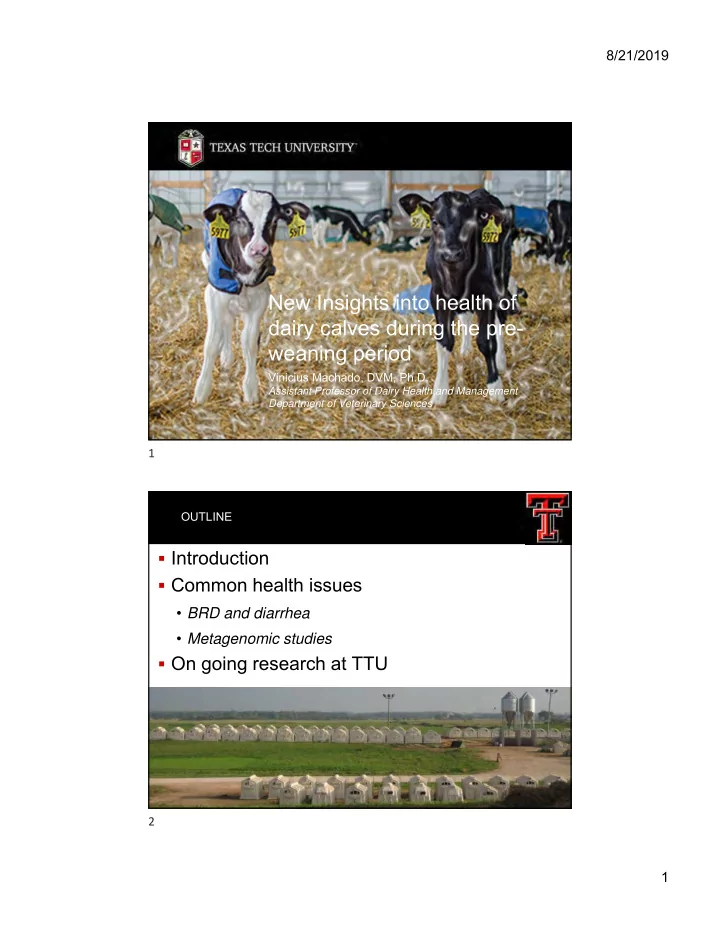
New Insights into health of dairy calves during the pre- weaning period

Vinicius Machado, DVM, Ph.D.

Assistant Professor of Dairy Health and Management Department of Veterinary Sciences

OUTLINE

  • Introduction
  • Common health issues
  • BRD and diarrhea
  • Metagenomic studies
  • On going research at TTU

1 2

slide-2
SLIDE 2

8/21/2019 2

INTRODUCTION

Hulbert and Moisa, J Dairy Sci, 2016

GROWTH DURING PRE-WEANING PERIOD HAS LONG TERM IMPACT ON PERFORMANCE

Soberon et al. (2012)

200 400 600 800 1000 3d 2nd 1st Difference in milk per kg of preweaned ADG Lactation

3 4

slide-3
SLIDE 3

8/21/2019 3

FEEDING CALVES

Curtis et al. Veterinary Record , 2018

Restricted Ad libitum

COMMON HOUSING SYSTEMS

  • Goals:
  • Deep, clean and dry bedding
  • Good ventilation / air quality

Individual pens Group pens

5 6

slide-4
SLIDE 4

8/21/2019 4

INDIVIDUAL HOUSING

  • Pros:
  • Isolated animals
  • Decreased disease / pathogens transmission
  • Easy to monitor milk consumption and health
  • Cons:
  • Feeding is labor intensive (ad

libitum systems often not practical)

  • Cleaning is hard and labor

intensive

  • Welfare / socialization / public

perception

GROUP HOUSING

  • Pros:
  • Easy to clean
  • Easy to adopt ad libitum feeding systems
  • Socialization and public perception
  • Cons:
  • Transmission of pathogens
  • Difficult to monitor intake
  • Difficult to detect sick

animals

7 8

slide-5
SLIDE 5

8/21/2019 5

DIFFERENT HOUSING SYSTEMS – DIFFERENT CHALLENGES

  • Lower incidences of disease
  • Difficult to feed
  • Higher incidences of disease
  • Higher feed intakes

Individual pens Group pens

COMMON HEALTH ISSUES

  • Diarrhea – Scours
  • Bovine respiratory disease
  • Pneumonia – Otitis

10 20 30 40 50 60 70

%

Calf mortality

NAHMS-USDA 2007

nasopharynx is connected to the middle ear via the Eustachian tube

9 10

slide-6
SLIDE 6

8/21/2019 6

MULTIFACTORIAL DISEASES METAGENOMICS – SCOURS

Oikonomou et. al, PLOS ONE, 2013

11 12

slide-7
SLIDE 7

8/21/2019 7

METAGENOMICS – SCOURS

Discriminant analysis of fecal microbiomes by week of life Discriminant analysis of fecal microbiomes for the first week of calf life and for calves that suffered or not from diarrhea

Oikonomou et. al, PLOS ONE, 2013

METAGENOMICS – SCOURS

Oikonomou et. al, PLOS ONE, 2013

Adjusted means of body weight by week of life as well as adjusted means of diarrhea incidence for different Faecalibacterium spp. terciles

13 14

slide-8
SLIDE 8

8/21/2019 8

Oral Administration of Faecalibacterium prausnitzii

Foditsch et. al, PLOS ONE, 2015

N = 296 N = 258

Oral Administration of Faecalibacterium prausnitzii

Foditsch et. al, PLOS ONE, 2015

Mortality due to severe diarrhea Overall mortality

15 16

slide-9
SLIDE 9

8/21/2019 9

Oral Administration of Faecalibacterium prausnitzii

Foditsch et. al, PLOS ONE, 2015

0.6 0.65 0.7 0.75 0.8 0.85 ADG (kg) Control FPTRT

P = 0.01

METAGENOMICS – BRD

Lima et. al, Scientific Reports, 2016

  • 174 calves
  • Nasal swabs

collected at 3, 14, 28, and 35 days of life

  • 16s rRNA

gene sequencing

17 18

slide-10
SLIDE 10

8/21/2019 10

METAGENOMICS – BRD

Lima et. al, Scientific Reports, 2016

METAPHYLAXIS – BRD

  • CTR = untreated
  • M1 = one tildipirosin injection administered at 10 days of life
  • M2 = two tildipirosin injections at 10 days and 35 days of life

Teixeira et. al, The Vet J, 2016

19 20

slide-11
SLIDE 11

8/21/2019 11

TRADITIONAL CALF RAISING MANAGEMENT TRANSPORTATION CHALLENGES – HIGH RISK FOR BRD

21 22

slide-12
SLIDE 12

8/21/2019 12

MANAGEMENT OF HIGH RISK CALVES Total n of animals enrolled = 1,360

Active ingredient is mycobacterium cell wall fraction (MCWF) of Mycobacterium phlei, a non-pathogenic, soil-borne bacterium

Item Enrolled (%) Treated (%) Dead (%)

Calves

1,360 155 (11.3) 16 (1.2)

CON

458 60 (13.1) 6 (1.3)

BTIS

449 44 (9.8) 5 (1.1)

ATIS

453 51 (11.4) 5 (1.1)

CON: control; BTIS: before transport; ATIS: after transport

Disease treatment events were lower than the national average

Courtesy of Luciano Caixeta

23 24

slide-13
SLIDE 13

8/21/2019 13

ATIS CON BTIS

Group Adjusted Hazard ratio 95% CI P - value CON Ref.

  • BTIS

0.74 0.50 – 1.09 0.14 ATIS 0.84 0.57 – 1.2 0.35

CON: control; BTIS: before transport; ATIS: after transport

No difference in hazard of treatment within first month of life

Courtesy of Luciano Caixeta

Group Pneumonia Scours HR 95% CI P- value HR 95% CI P- value

CON

Ref.

  • Ref.
  • BTIS

0.54 0.31 – 0.94 0.02 1.04 0.58 – 1.88 0.87

ATIS

0.88 0.55 – 1.42 0.60 0.75 0.40 – 1.42 0.38 CON: control; BTIS: before transport; ATIS: after transport Courtesy of Luciano Caixeta

BTIS reduced hazard of treatment for pneumonia but not for scours within first month of life

25 26

slide-14
SLIDE 14

8/21/2019 14

SERUM BIOMARKERS OF STRESS AND INFLAMMATION AFTER TRASNPORTATION OF NEWBORN CALVES

  • 168 calves
  • Control (untreated) group
  • Biomarkers measured
  • Haptoglobin
  • Cortisol
  • L- lactate

Correlation between biomarkers

  • Haptoglobin
  • 67.9 μg/ml
  • Cortisol
  • 17.36 ng/ml
  • L-lactate
  • 6.5 mM

27 28

slide-15
SLIDE 15

8/21/2019 15

Association between biomarkers and BRD

2 4 6 8 10 12 14 16 18 Hp Cortisol L-lactate BRD Incidence (%) low high P = 0.07 P = 0.22 P = 0.74

Association between Hp and BRD

P = 0.04

29 30

slide-16
SLIDE 16

8/21/2019 16

Association between biomarkers and weight gain

0.4 0.42 0.44 0.46 0.48 0.5 0.52 Hp Cortisol L-lactate Average Daily Gain (kg/d) low high P < 0.01 P = 0.14 P = 0.18

PHYSIOLOGIC VS PATHOLOGIC LEVELS OF HAPTOGLOBIN

31 32

slide-17
SLIDE 17

8/21/2019 17

LEVELS OF HAPTOGLOBIN IS ASSOCIATED WITH IMMUNE SYSTEM ACTIVATION

10000 20000 30000 40000 50000 60000 70000 80000 90000 Mean Fluorescence L-selectin low Hp high Hp 10 20 30 40 50 60 70 80 % Oxidative burst % Phagocytosis

P = 0.06 P = 0.04 P = 0.01

CONTINUING CALF RESEARCH

33 34

slide-18
SLIDE 18

8/21/2019 18

Vinicius Machado

vinicius.machado@ttu.edu

35