Goals T o Survey 300 dairy herds regarding biosecurity on their - - PDF document

goals
SMART_READER_LITE
LIVE PREVIEW

Goals T o Survey 300 dairy herds regarding biosecurity on their - - PDF document

06.06.2014 Ontario Dairy Hoof Health Project Goals T o Survey 300 dairy herds regarding biosecurity on their farm T o record hoof health on 315 Ontario dairy farms and up to 30,000 head of dairy cattle T o do a full risk


slide-1
SLIDE 1

06.06.2014 1

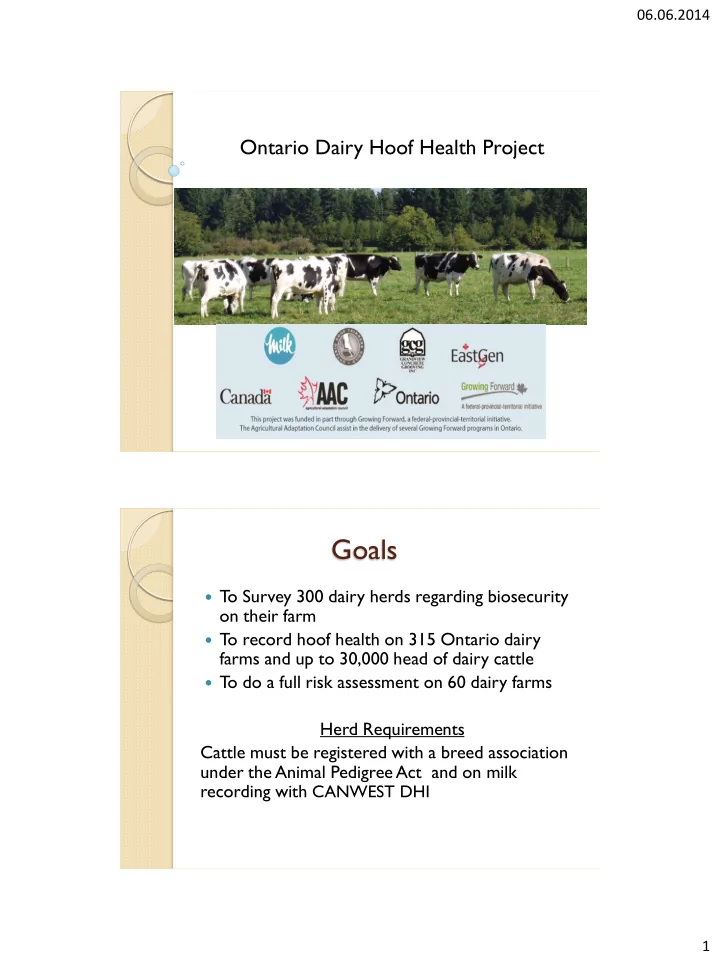
Ontario Dairy Hoof Health Project

Goals

 T

  • Survey 300 dairy herds regarding biosecurity
  • n their farm

 T

  • record hoof health on 315 Ontario dairy

farms and up to 30,000 head of dairy cattle

 T

  • do a full risk assessment on 60 dairy farms

Herd Requirements Cattle must be registered with a breed association under the Animal Pedigree Act and on milk recording with CANWEST DHI

slide-2
SLIDE 2

06.06.2014 2

335 Project Herd Locations

By using New Communication Technology for hoof trimmers

slide-3
SLIDE 3

06.06.2014 3

Incorporating the Foot Atlas

Established in 2008 by the International Lameness Committee, Zinpro Corp.

Which allows a standard evaluation

  • f location and severity of lesions
slide-4
SLIDE 4

06.06.2014 4

Project Trimmers received Training for Program Use and Lesion identification according to a standard Guide

Housing for Lactating Cows is:

81% 19%

Tie stall Free stall

slide-5
SLIDE 5

06.06.2014 5

Does This Herd Have Cows With BDD Today?

31 2 1 100 36 5 1 20 40 60 80 100 120 Yes No No Answer Yes No No Answer Yes No Free stall Tie stall Pack Herd & BDD Status Number of Responses

91% 71%

Ontario Preliminary Results June 6/12

Digital Dermatitis Sole Ulcer White Line Lesion Sole Hemorrhage Toe Ulcer Interdigital Hyperplasia Thin Sole Foot Rot Heel Erosion Corkscrew Claw Interdigital Dermatitis Axial Fissure Vertical Fissure Horizontal Fissure

Participating Farms T

  • tal Distinct Cows

with Lesions Lesions: Digital Dermatitis Sole Ulcer White Line Lesion Sole Hemorrhage T

  • e Ulcer

Interdigital Hyperplasia Thin Sole Foot Rot Heel Erosion Corkscrew Claw Interdigital Dermatitis Axial Fissure Vertical Fissure Horizontal Fissure T

  • tal Lesions

Ontario

283 19,169 7,225 3,570 35.7% 1,327 13.3% 832 8.3% 2,127 21.3% 162 1.6% 764 7.6% 108 1.1% 110 1.1% 232 2.3% 130 1.3% 574 5.7% 34 0.3% 23 0.2% 10 0.1% 10,003 100.0%

slide-6
SLIDE 6

06.06.2014 6

Provincial Comparisons

Alberta British Columbi a Ontario

# Participating farms

147 70 283

T

  • tal Distinct

cows

27,666 8,137 19,169

with lesions

13,481 48.6% 4,679 57.5% 7,225 37.7%

Lesions Digital Dermatitis

8,371 44.8 2,581 40.3% 3,570 35.7%

Sole Ulcer

3,065 16.4% 821 12.8% 1,327 13.3%

White Line

2,598 13.9% 846 13.2% 832 8.3%

Sole Hemorrhage

1,235 6.6% 490 7.6% 2,127 21.3%

T

  • e Ulcer

901 4.8% 335 5.2% 162 1.6%

Our Project allowed for new thought processes

 Creating a series of logic lines for farmers,

trimmers and veterinarians to explain

  • utbreaks of digital dermatitis
slide-7
SLIDE 7

06.06.2014 7

Level of Risk Foot Conformation (Interdigital Cleft Space) Stocking Density Environmental System Nutrition Protein Level Cattle Hygiene New cattle entry to the barn

Risk theory

Interdigital space narrowing increasing the risk of BDD Increasing cow density increases the risk of BDD Increased confinement & housing type increases the risk of BDD Increased protein in diet increases nitrogen in urine and the risk of BDD Increased body soiling increases the risk of BDD Increased addition of cattle from more sources increases the risk of BDD

Low

Rank 3 (open = 3.7 mm) 90% Yearly pasture 16% Clean body, legs, feet and udder Closed Herd – No live cattle introductions

Med

Rank 2 (partial openness) 100% Tiestall, 18% Moderate soiling of legs and feet. Selected cattle from limited number of farms

High

Rank 1 (cleft is closed) 130% Freestall, total confinement 20% Severe soiling of legs, udder, feet and body. Purchase of many cattle from many sources.

Risk Theory Low Medium High

narrowing

  • f the

Interdigital space Increasing cow density Increased confinement & housing type Increased dietary protein and increased ammonia Increased body soiling Addition of cattle from many sources Rank 3 –open is >3.7mm Rank 2 partial openess Rank 1 – cleft is closed 90% stocking rate 100% stocking rate 130% stocking rate Yearly pasture Tie stall seasonal pasture Free & tie stall, total confinement

16% 18% 20%

Clean body legs, feet and udder Moderate soiling of legs and feet Severe soiling of legs, feet and udder Closed herd no live cattle introductions Selected cattle from a limited number of farms Purchase of many cattle from many sources

Prioritizing on-farm Risk Factors for Bovine Digital Dermatitis (BDD)

Thank you for your attention