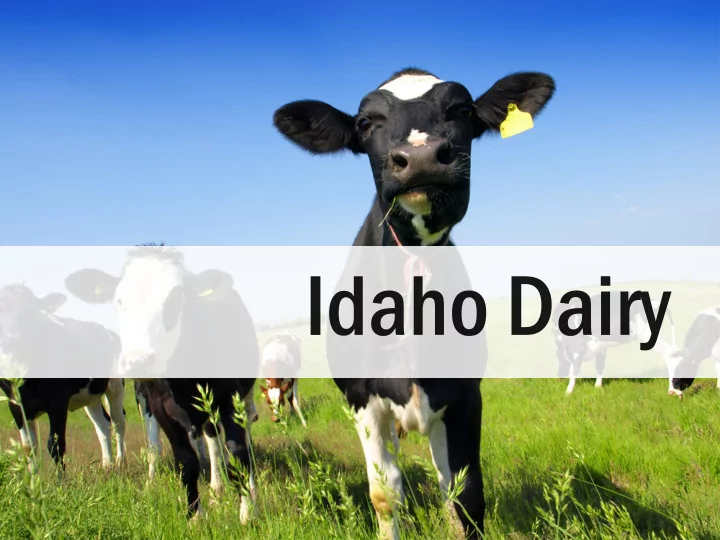
Cattle: A Description Bovine is a fancy word for any type of cattle. - - PowerPoint PPT Presentation

cattle a description
SMART_READER_LITE
LIVE PREVIEW

Cattle: A Description Bovine is a fancy word for any type of cattle. - - PowerPoint PPT Presentation

Cattle: A Description Bovine is a fancy word for any type of cattle. Cows are females, calves are babies, and bulls are males. All together, cows, calves, and bulls are called cattle. Cow and Calf Bull Dairy Cattle vs. Beef Cattle


slide-1
SLIDE 1
slide-2
SLIDE 2

Cattle: A Description

  • Bovine is a fancy word for any type of cattle. Cows

are females, calves are babies, and bulls are males.

  • All together, cows, calves, and bulls are called

cattle. Cow and Calf Bull

slide-3
SLIDE 3

Dairy Cattle vs. Beef Cattle

  • Dairy Cattle are raised to produce milk.
  • Beef Cattle are raised to produce meat and other

by-products. Holstein Dairy Cows Black Angus Beef Cows

slide-4
SLIDE 4

Origins of Cattle

  • Cattle have been one
  • f the main sources
  • f food for human

civilization.

  • Evidence is found in

cave paintings.

http://www.cardiffsciscreen.co.uk/sites/default/files/imce_uploads/Lascaux-aurochs.jpg

slide-5
SLIDE 5

Domestication of Cattle

  • Cattle were

domesticated approximately 10,000 years ago by early humans.

  • Since humans could

now raise their own cattle, more and more people had easy access to their products such as milk and meat (beef).

http://upload.wikimedia.org/wikipedia/commons/thumb/e/ed/Egyptian_Domesticated_Animals.jpg/ 800px-Egyptian_Domesticated_Animals.jpg

slide-6
SLIDE 6

Cattle in the United States

  • In the early 1600s,

immigrants brought cattle with them from Europe to provide dairy products and meat for their families.

  • It wasn’t until the 1800s

that breeds of cattle were specifically developed for dairy purposes.

Devon cows were some of the first breeds of cattle brought to the United States by early immigrants.

slide-7
SLIDE 7

Dairy Cattle in Idaho

  • Cassia
  • Jerome
  • Gooding
  • Twin Falls
  • Lincoln
  • Canyon
  • Ada
  • Owyhee

The top counties where milk is produced in Idaho today are:

slide-8
SLIDE 8

Idaho Dairy Facts

  • Dairy is Idaho’s #1 agriculture business.
  • Idaho ranks in the top four milk producing states.
  • Idaho ranks as the third largest producer of

natural cheese.

  • If Idahoans had to drink all the milk produced in

the state every man, woman, and child would have to drink 40 glasses of milk every day of the year!

slide-9
SLIDE 9

The Journey

  • f Milk Video
slide-10
SLIDE 10

Dairy Farms: The Original Recyclers

Recycling happens on a dairy farm in a few ways.

  • Water is recycled.
  • Manure is used to fertilize corn fields. The corn

will later be used to feed the cows.

  • Some dairies turn the manure into compost to be

sold.

slide-11
SLIDE 11

Milking the Cows

  • Cows are milked 2-3 times

every day for 4 minutes by an automated milking machine.

  • One cow can give up to 8

gallons of milk each day.

  • The milk is over

100°when it comes out

  • f the cow.
slide-12
SLIDE 12

Milk’s Journey from the Cow

  • The 100°milk is instantly chilled to 40°to keep it

fresh.

  • The milk is then transferred to a bulk tank.
  • From the bulk tank, milk is pumped into an

insulated milk tanker truck to be delivered to a processing plant.

  • At the processing plant:
  • Milk is pasteurized to kill microorganisms.
  • Milk is put into jugs or bottles or made into

yogurt or cheese.

  • Dairy products are shipped a short distance to

consumers.

slide-13
SLIDE 13

Nutrition Facts

  • Dairy foods provide a

powerful package of eight essential nutrients – including calcium, potassium, phosphorus, protein, vitamins D, A, B12, and riboflavin.

  • Calcium helps build strong

bones and teeth. It is also needed so muscles, like your heart, can contract.

slide-14
SLIDE 14

“3-Every-Day”

  • This is the easiest way to

remember that three daily servings of milk, cheese, or yogurt will help most children and adults meet calcium needs while supplying an abundance of other essential nutrients.

  • One milk group serving is equivalent to:
  • 1 cup (8 ounces) of milk or yogurt
  • 1 ½ ounces of natural cheese (mozzarella or cheddar)
slide-15
SLIDE 15

Activity

  • Now you are going to summarize the production journey
  • f dairy products by writing a paragraph describing the

step by step journey milk takes from producer to

  • consumer. Be sure to use proper grammar, mechanics,

spelling, and transition words.