
SLIDE 1
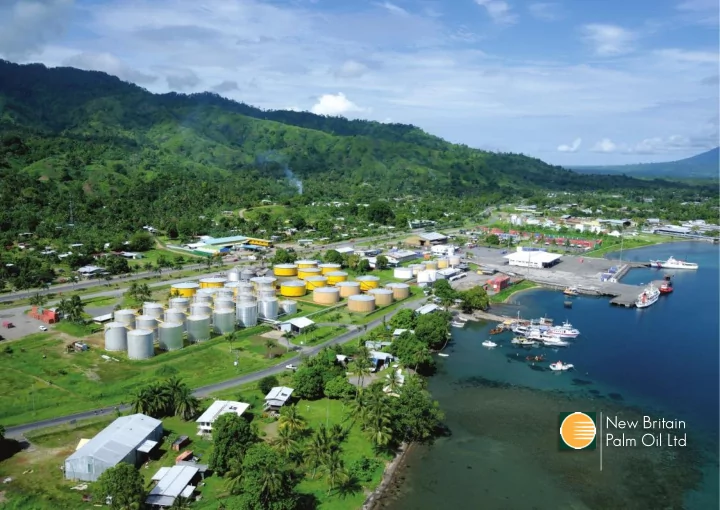
New Britain Palm Oil Ltd New Britain Palm Oil Ltd New Britain Palm - - PowerPoint PPT Presentation
New Britain Palm Oil Ltd New Britain Palm Oil Ltd New Britain Palm Oil Ltd February 2014 Preliminary Results FY2013 Facilities on New Britain Introduction New Britain NBPOL Today Palm Oil Ltd Seeds Plantations NBPOL is one of the worlds
February 2014
Facilities on New Britain
Plantations Land bank 134,600 ha c.80,000 hectares of NBPOL managed oil palm plantations More than 42,500 mature hectares cultivated by smallholders supplying NBPOL All plantations (including smallholders) covered by the same RSPO certificate Milling and Refining 12 oil mills in Group 2 refineries Special fractionation plant completed for Ferrero Bakery fats plant in the UK Infrastructure c.80,000 tonnes / oil storage capacity Trucking transport fleet Housing Two methane capture facilities Export terminals Seeds NBPOL is one of the world’s largest private seed producers Highly respected plant breeding research and development Important for success of wider business Cattle 9,282 hectares of cattle grazing land Integrated with the palm oil plantation >20,000 head of cattle RAIL 1 sugar mill 1 ethanol plant 7,718 hectares sugar cane
5
Revenue contribution Palm Oil Sales Seed Sales Cattle Production Sugar Sales
SOLOMON
Main area of NBPOL operation 37,000 hectares oil palm
PAPUANEWGUINEA
Lae • RAIL
11,500 hectares oil palm 7,700 hectares sugar cane 8,888 hectares pasture
10,700 hectares oil palm
8,800 hectares oil palm GPPOL
6,300 hectares oil palm
5,600 hectares oil palm
NEWBRITAIN
New Britain Oils Commissioned in March 2010, the first fully segregated and traceable sustainable palm oil refinery in the UK. Bakery fats plant now operational
cultivated by smallholders
Orangerie Bay Plantations
with oil palm
6
palms at Kula plantations during 2012 and 2013, and biological yield declines in the second half of the year
denominated loans
7
Year Ended 31 December
2013 2012
FFB processed (tonnes) 2,085,670 2,273,081 CPO / PKO produced (tonnes) 507,856 545,207 Average CPO price achieved ($ / tonne) 868 1,062 Revenue ($m) 558.7 677.0 EBITDA* ($m) 96.8 162.1 Profit Before Tax* ($m) 17.3 81.6 Profit Before Tax* ($m) (excl. non-cash FX losses on USD loans) 40.5 72.5 Earnings Per Share* (US¢) 7.4 36.0 *Excluding IAS 41 adjustments. Note: 2013 figures unaudited.
8
(2012: 30.2%)
increase
savings
9
300 400 500 600 700 800 900 1000 600 700 800 900 1000 1100 1200 1300 1400 1500 1600 NBPO.LN (p) CIF Prices (US$/MT) CPO CIF (US$/MT) CPKO CIF (US$/MT) NBPO.LN (GBP)
US$900/tonne for most of 2013, averaging $853 versus $1,001 for 2012
year as stock levels decreased, but the price retraced to a low of $785/tonne as Malaysia and Indonesia entered their peak production period
inventory levels and strong demand, driven partly by biodiesel usage
US$1,108/tonne in 2012)
driven primarily by the expected supply concerns following typhoon Haiyan in the Philippines (a major producer of coconut oil)
trading around US$1,300/tonne
NBPOL Share Price and Palm Product Prices Palm Oil vs. Soyoil; PKO vs. CNO Source: Bloomberg, Reuters
100 200 300 400 US$/MT SBO FOB Arg - RBD Olein spread CNO-PKO CIF RDM
10
85.6 61.6 120.0 120.0 49.1 41.9 47.0 35.9 25.0 13.2 50 100 150 200 250 300 350
2012 2013
Long Term Debt - amortising Long Term Debt - non-amortising Short Term Financing - Liverpool RAMU Short Term Trade Finance
Total Debt: US$272.6m Total Debt: US$326.7m (USDm)
Reduction in total borrowings during 2013 11
£(10.00) £- £10.00 £20.00 £30.00 £40.00 £50.00 0% 50% 100% 150% 200% 250% Q4'10 Q1'11 Q2'11 Q3'11 Q4'11 Q1'12 Q2'12 Q3'12 Q4'12 Q1'13 Q2'13 Q3'13 Q4'13
driven by gross margin expansion and sales volume increase
commissioned during the first half of the year, increasing nameplate capacity to 300,000 MT per annum
business
products meet exacting customer requirements
developed
Liverpool Refinery Quarterly % Volume Increase (versus Q3 2010)
KEY FACTS The first palm oil provider able to guarantee fully traceable, sustainable palm oil direct from the plantation to the EU consumer Key contracts with well known UK and EU brands Captures greater margin share for NBPOL World’s first dedicated sustainable bakery foodstuffs production facility operational since 2012
Liverpool Refinery Rolling 12 Month EBITDA/MT Source: Unaudited management figures
12
and Wilmar) to supply ADM and Wilmar with fully traceable, certified sustainable palm oil (refer to slide 23 for further details)
sets of chromosomes
historic yields achieved by other F1 hybrid crops such as corn (maize), and on oil palm's estimated physiological yield potential)
13
Background
for up to 20% of the issued shares of NBPOL at a price of GBP 5.50 per share (PGK 19.36)
Offer provided. Accordingly, the Independent Directors of NBPOL recommended to shareholders that the Offer be rejected
enabling the PNG Securities Commission to prevent the takeover of a Code company where it is deemed contrary to PNG’s national interests
Offer lapsed following the dismissal of a court application by Kulim to revoke the orders Update
by the changes to PNG Takeovers Code
understand that it is intending to release guidelines on the application of the new rules in the near future
14
any upward movement of palm oil prices in the near term
$922/tonne (as at 21 February 2014 forward sales were c. 121,000 tonnes at an average of $933/tonne)
should further contribute to improved operating margins this year
15
9.0% 10.0% 11.0% 12.0% 13.0% 14.0% 15.0%
2004/05 2005/06 2006/07 2007/08 2008/09 2009/10 2010/11 2011/12 2012/13 2013/14
Major Vegetable Oil Palm Oil
1,200,000 1,400,000 1,600,000 1,800,000 2,000,000 2,200,000 2,400,000 2,600,000 Jan Feb Mar Apr May Jun Jul Aug Sep Oct Nov Dec
the 2012/13 marketing year
(versus 17.49 million tonnes in 2011/12)
11.44% to 11.35%
tightened significantly during 2013
million tonnes (versus a record 2.63 million tonnes in 2012)
(+3.1%) and low imports (-60.1%)
(+5.6%) and the EU (+5.2%)
tonnes (-24.5% Y-o-Y)
Indonesian palm oil industry, it is estimated that closing stocks in Indonesia decreased during 2013, ending the year at c. 2 million tonnes (Source: Bloomberg survey)
million tonnes
Global Vegetable Oil and Palm Oil Stocks-to-Use Ratio Malaysian Palm Oil Ending Stocks Source: USDA, MPOB
2012 2009 2011 2013 2010 USDA Forecast
(updated Feb 2014)
17
0.0% 1.0% 2.0% 3.0% 4.0% 5.0% 6.0%
1,000 1,500 2,000 2,500 3,000 3,500 4,000 4,500 5,000
2006 2007 2008 2009 2010 2011 2012 2013
Mature Ha ('000) (LHS) Y-o-Y Growth % (RHS)
countries was lower than market expectations
19.1 million tonnes in 2013, representing a modest +2.3% growth Y-o-Y, driven primarily by new areas coming into production in Sarawak
yearly decrease in production since 1998 (Source: GAPKI, Bloomberg)
SEA region due to yield cycle factors – may continue into 2014
2013
soyoil (-20.0%), rapeoil (-19.4%) and sunoil (-24.1%)
approximately US$300/tonne to US$60/tonne during 2013
producing countries
CPO, SBO and Rapeseed Prices (US$/MT) Growth in Mature Hectarage – Malaysia and Indonesia Source: MPOB, GAPKI, broker research
Malaysia
0.0% 2.0% 4.0% 6.0% 8.0% 10.0% 12.0% 14.0% 16.0% 18.0% 20.0%
2,000 3,000 4,000 5,000 6,000 7,000 8,000
2006 2007 2008 2009 2010 2011 2012 2013
Mature Ha ('000) (LHS) Y-o-Y Growth % (RHS)
Indonesia 700 800 900 1000 1100 1200 1300 CPO CIF RDM SBO DEGUM FOB EX-MILL EU RAPEOIL FOB EX-MILL DUTCH/EU
18
20 40 60 80 100 120 140 160 180 1 2 3 4 5 6 7 8 9
00/01 01/02 02/03 03/04 04/05 05/06 06/07 07/08 08/09 09/10 10/11 11/12 12/13
Total veg oil consumption (MT, m) Y-on-Y change in consumption (MT, m)
Y-on-Y change F&F use Y-on-Y change in Industrial use Total Consumption (MT, m)
200 300 400 500 600 700 800 900 1,000 2006 2007 2008 2009 2010 2011 2012 2013 Malaysia Indonesia
figures (2012/13 marketing year)
driven by growth in both Food & Feed and Industrial use
increasingly important
and US (+24.5%) remains healthy, though some data suggests China demand has stagnated
5-7% of global CPO production
determination that partially hydrogenated oils (e.g. PH soyoil) – a major source of trans fat in American diets – is no longer "generally recognized as safe“
strengthening global economy and mandatory biodiesel implementation by the world’s two biggest PO producers
Indonesia and Malaysia’s Biodiesel Consumption (‘000 MT) Vegetable Oil Consumption Source: USDA, broker research
19
20,000 30,000 40,000 50,000 60,000 70,000 80,000 90,000 2004 2005 2006 2007 2008 2009 2010 2011 2012 2013
substantially completed resulting in a higher than usual level of immature oil palm hectarage across the Group
hectarage (circa 6,500 hectares) has been replanted since 2011
land under lease which will be developed over the next few years
been completed at Orangerie Bay (including the Social Impact Assessment, Environmental Impact Assessment and the High Conservation Value assessment)
a nursery in 2014
approximately 86,000 Ha of mature oil palm in production, an increase of c. 25% from today’s level
region to significantly expand the Group’s land bank
Group Estates – Total Planted Oil Palm (Ha) Group Estates – Utilisation of Plantable Area Palm Oil (Ha)
66,746 69,067 73,000 77,000 11,597 10,817 9,000 7,000 12,000 11,000 9,000 7,000
20,000 30,000 40,000 50,000 60,000 70,000 80,000 2012 2013 2014 2015
Mature Immature Cultivatable Land
20
1,000,000 1,500,000 2,000,000 2,500,000 2004 2005 2006 2007 2008 2009 2010 2011 2012 2013
exceptionally heavy rainfall, lower mature hectarage and biological yield declines in the second half of 2013
2013, down c.14% year-on-year
harvesting fruit
yield cycles due to lower fertiliser application
extraction in 2014
targeting:
range of 2.25 million – 2.40 million MT
midpoints), the Group expects CPO and PKO production of approximately 565,000 MT in 2014
FFB Production (MT) CPO and PKO Production
200,000 300,000 400,000 500,000 600,000 2004 2005 2006 2007 2008 2009 2010 2011 2012 2013
21
$35m year-on-year saving
2013
quarters of 2013, with some recovery seen late in the year
lower year-on-year
Group’s cash cost of production (excluding the cost of purchasing smallholder FFB)
the Kina depreciation will be seen in 2014 due the lag effect
approximately 40% of the Group’s cost base
and debtors was US$23.2m in 2013
base) are expected to remain relatively flat in 2014
250 300 350 400 450 500 550 Jan-13 Feb-13 Mar-13 Apr-13 May-13 Jun-13 Jul-13 Aug-13 Sep-13 Oct-13 Nov-13 Dec-13
MOP DAP Urea
Fertiliser Prices (USD/MT) Source: World Bank / Indexmundi PGK denominated costs (e.g. labour) 40% Fertiliser 20% Freight & Fuel 30% Other 10% Cost Analysis (approximate cash cost excluding FFB purchases)
22
Hamburg Brake Rotterdam Liverpool London Papua New Guinea
Olenex: Access to a Powerful Marketing Platform in Europe
and marketing of refined vegetable oils and fats in the EEA and Switzerland
co-operation and offer the widest range of palm oil fractions and locations in Europe to date
Germany, as well as the supply of oil from NBPOL’s Liverpool refinery to ADM's Pura Food operations in London
ADM's operations in Hamburg, will be marketed and sold by Olenex throughout Europe
utilisation and continued volume growth at the Liverpool refinery
and Wilmar with fully traceable, certified sustainable palm oil
23
Corporate and Product Integrity
RSPO certification and responsible supply chains Traceability Transparency and anti-corruption Report on Social, Labour and Environmental Performance
and satisfy customer requirements
customers/consumer groups, investors, Governments, NGOs
Partnerships with Communities
Free, Prior and Informed Consent (FPIC) of indigenous peoples and local communities Food security Effective conflict resolution Social conditions Workers’ rights Support of palm oil smallholders
Environmental Responsibility
Breaking the link between palm oil expansion and deforestation Greenhouse gas (GHG) accountability Protect and conserve wildlife Pesticides use minimisation and chemical fertiliser Water accountability GMOs prohibition Peat land planting prohibition
NBPOL APPROACH TO SUSTAINABLE AGRICULTURE 24
A unique supply chain – fully integrated and low cost… …delivering 100% segregated, traceable and certified sustainable food ingredients 25
Innovation Group (POIG) , an initiative supported by organisations such as Greenpeace, WWF and Rainforest Action Network
RSPO certification scheme
palm oil and deforestation
sustainability and carbon reports
Charter on all sites by year end 2014 PALM OIL INNOVATION GROUP (POIG)
If there is one lesson we have learned in our journey to RSPO certification, it is the value of stakeholder engagement at all levels of operations 26
social development through NBPOL’s ‘One Hour Principle’
areas within Group plantations
agricultural products in the CDP’s 2013 annual forest footprint benchmark
companies’ exposure to and policies on deforestation. 2012 2013 THE ONE HOUR PRINCIPLE
A Community Needs Assessment that uses three pillars
socially responsible development based on NBPOL’s own research as to what can be achieved with investment in rural development The three pillars are based on The One Hour Principle: 1. Access to 20 litres of tap fed potable water within one hour’s walk 2. Access to a medical health post within one hour’s walk 3. Access to a primary school within one hour’s walk The three social pillars will be considered in the HCS land use decision making process for new developments, to ensure NBPOL is meeting community needs while not causing deforestation
27
achieve the ‘Zero Net GHG Emissions’ commitment
and locks it up in the biomass of trunk, fruit bunches and fronds
West New Britain is calculated to be 80.31 tonnes of carbon per hectare at 21 years
tonnes of carbon per hectare per year producing a time averaged sequestration rate of 14.89 t CO2eq /ha/year
and further internal power generation capacity is in preliminary development stages
Kumbango reducing diesel requirements at this site by ~1 million litres p.a.
Methane Capture Carbon Analysis: Sources of emissions at NBPOL
Land clearing 66% Planting on peat 0.4% Palm Oil Mill Effluent 26% Nitrogenous fertiliser 3% Mature fertiliser transport 3% Fuel in transport 1% Mill diesel use 0.6%
28
communities
arrangements
and family members)
29
50,000 150,000 250,000 350,000 450,000
2010 2011 2012 2013
CPO PKO Refined
the company as a responsible producer of sustainable palm oil
integrated supply chain delivering 100% segregated, traceable and certified sustainable palm oil products and food ingredients
generated significant momentum in recent times
2015 deadlines are looming)
make “deforestation-free” claims
manufacturers and other customers to achieve their stated sustainability goals/commitments
from GreenPalm certificates to physical oil supply
(though at this stage Mass Balance rather than Segregated)
customers is worth a significant amount per year in incremental revenue
2,000,000 3,000,000 4,000,000
2009 2010 2011 2012 2013
Segregation and Mass Balance Book & Claim (GreenPalm Certificates)
100,000 150,000 200,000
2009 2010 2011 2012
Segregation and Mass Balance Book & Claim (GreenPalm Certificates)
GLOBAL CSPO Sales (MT) Source: RSPO Source: CPET UK CSPO Imports (MT) NBPOL CSPO Sales Exports (MT)
+19% Y-o-Y +58% Y-o-Y +50% Y-o-Y +18% Y-o-Y +104% Y-o-Y +3% Y-o-Y +21% Y-o-Y
+28.7% Y-o-Y +70.6% Y-o-Y +45.4% Y-o-Y
30
certification process
Oil and continues to play a pivotal role as an executive board member
agricultural products in the CDP’s 2013 annual forest footprint benchmark
sustainability champions of 2011 and in 2012 invited NBPOL to join the Global Agenda Council on Biodiversity and Natural Capital
“zero net carbon emissions” commitment (the first ever LCA Carbon report in the industry)
Agricultural Products New Britain Palm Oil Ltd Food and Staples Retailing Sainsbury’s Supermarkets Ltd General Retailers Marks and Spencer plc Media British Sky Broadcasting Oil & Gas Greenergy International Ltd. Packaged Foods & Meats Marfrig Group and Unilever Paper & Forest Products Mondi PLC Personal & Household Products L’Oréal Textiles, Apparel & Luxury Goods PrimeAsia Leather Corporation Travel & Leisure British Airways Utilities Drax Group
Forest Footprint Disclosure – Leaders by Sector
2012 2013
“[NBPO] has developed new ways to engage small farmers, who provide one- third of the company’s supply. These close ties have not only helped to reduce poverty, but also enabled the company to develop one of the world’s first fully
traceable palm oil supply chains.”
World Economic Forum, September 2011 “NBPOL is unquestionably one of the forerunners in the RSPO and can serve as a positive example for other plantation companies.” World Wide Fund for Nature (WWF), 2009
32
meals, fish & chip trade, industrial bakery sectors
fraction / PKO
(with or without liquid oils) / boxed products for manufacturers / boxed and extruded industrial margarines
packed products from Liverpool
33
palm production is impacted by a pronounced dry season from May to October and areas of low water holding capability
assess the feasibility of oil palm irrigation in the area
PNG and possibly the largest irrigation system in the Asia Pacific region
pumps and 38,000 sprinklers installed
24 hours per day, 7 days per week, pumping c.400 million litres of water per week
a further 500 Ha (subject to results)
grassland areas in Ramu Valley Grassland and pasture available for planting in the Ramu Valley, significant expansion potential
Irrigation pump station Specialised automatic cleaning filters 38,000 sprinklers installed
34
February 2014
This document, which is personal to the recipient (“Recipient”), has been prepared by New Britain Palm Oil Limited (the “Company”). This document does not constitute
distribution form part of or be relied on in connection with any contract or investment decision relating thereto, nor does it constitute a recommendation regarding the securities of the Company or any other entity. Prospective investors are required to make their own independent investigations and appraisals before taking any investment decision. In making this document available to the Recipient the Company is not agreeing to take or refrain from taking any action in future or to undertake, or cease to undertake, any activity. Any recipient who is in any doubt about the matters referred to herein should take advice from an authorised person specialising in advising on matters of this kind. No representation or warranty, express or implied, is given by or on behalf of the Company or any of such persons’ directors, officers or employees or any other person as to the accuracy, fairness of the presentation, completeness of the information or opinions contained in this document. No liability whatsoever is accepted by the Company
information or opinions or otherwise arising in connection therewith. This document may not be reproduced, copied, redistributed or passed on, directly or indirectly, whether in hard copy or by email, to any other person or published, in whole or in part, for any purpose. This presentation is not directed to, or intended for distribution to or use by, any person or entity that is a citizen or resident of, or located in, any locality, state, country or any jurisdiction where such distribution or use would be contrary to law or regulation or which would require any registration or licensing within such jurisdiction. Neither this document nor any copy of it may be taken or transmitted into the United States of America, its territories or possessions or distributed, directly or indirectly, in the United States of America, its territories or possessions where to do so would contravene any law or regulation which would require any registration or licensing within such jurisdiction. Neither this document nor any copy of it may be taken or transmitted into Canada, Australia or Japan or to Canadian, Australian or Japanese persons or to any securities analyst or other person in any of those jurisdictions. Any failure to comply with this restriction may constitute a violation of United States, Canadian, Australian or Japanese securities law. The distribution of this document in other jurisdictions may be restricted by law and persons into whose possession this document comes should inform themselves about, and observe, any such restrictions. Certain statements, beliefs and opinions in this document are forward-looking, which include all statements other than statements of historical facts, including, without limitation, any statements preceded by, followed by or including the words “targets,” “believes,” “expects,” “aims,” “intends,” “may,” “anticipates,” “would,” “could” or similar expressions or the negative thereof. These statements reflect the Company’s or, as appropriate, the Company’s directors’ current expectations and projections about future events. By their nature, forward-looking statements involve a number of risks, uncertainties and assumptions that could cause actual results or events to differ materially from those expressed or implied by the forward-looking statements. These risks, uncertainties and assumptions could adversely affect the outcome and financial effects of the plans and events described herein. Such forward-looking statements are based on numerous assumptions regarding present and future business
will continue in the future. The Company does not undertake any obligation to update or revise any forward-looking statements, whether as a result of new information, future events or otherwise. You should not place undue reliance on forward looking statements, which speak only as of the date of this document.
35
Phone: +44 (0)20 7 472 5936
www.nbpol.com.pg