
SLIDE 1
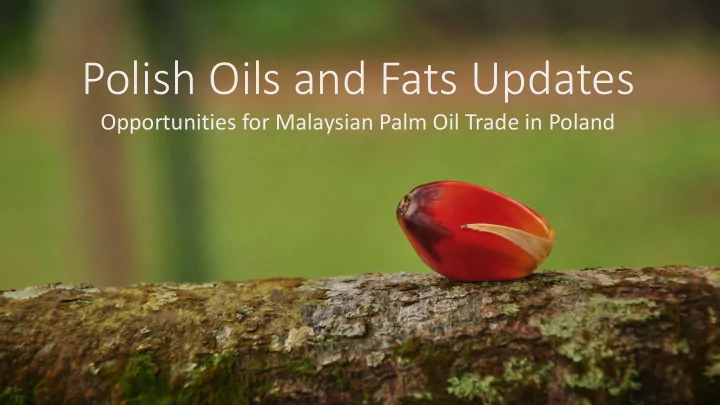
Polish Oils and Fats Updates
Opportunities for Malaysian Palm Oil Trade in Poland
Polish Oils and Fats Updates Opportunities for Malaysian Palm Oil - - PowerPoint PPT Presentation
Polish Oils and Fats Updates Opportunities for Malaysian Palm Oil Trade in Poland Outline of this Presentation Introduction Overview on Polish Oils and Fats Palm Oil in Poland Trends and Prospects for Polish Market How Palm Oil
Opportunities for Malaysian Palm Oil Trade in Poland
important palm oil importers in the Central and Eastern Europe (CEE) region.
Poland in 2014 was at 35,200 MT (Oil World). This makes Poland an emerging market for MPO in the region that includes Romania, Bulgaria and new EU member state, Croatia.
Country 2014 2013 Change (Volume) Change (%) Bulgaria 15,700 9,000 6,700 74.44 Croatia 4,700 4,500 200 4.44 Poland 35,200 35,900 (700) (1.95) Romania 10,300 13,000 (2,700) (20.77) Total 65,900 62,400 3,500 5.61
Source: Oil World
Poland is the biggest producer of rapeseed oil among the countries in the CEE region. Crushings were at the highest level in 5 years when a total of 2,460,300 MT of oilseeds were crushed in 2014. 2,400,000 MT or 97.5% of the crushings was for rapeseed.
2014 2013 2012 2011 2010 Crushings Soybeans 34.7 50.0 15.6 24.8 9.2 Rapeseed 2400.0 2290.0 2080.0 1990.0 2340.0 Sesameseed 5.0 5.0 5.0 5.5 5.8 Linseed 20.6 15.0 14.5 11.6 10.0 Total 2460.3 2360.0 2115.0 2031.8 2364.9
Crushings and Trade (with 3rd countries) of Oilseeds (1000 T)
Source: Oil World
2014 2013 2012 2011 2010 Imports Soybeans 24.6 45.0 10.6 19.6 3.6 Groundnuts 26.7 25.2 21.9 24.5 26.7 Sunflowerseed 12.9 13.3 13.2 11.7 8.4 Rapeseed 137.8 231.6 343.0 242.7 144.4 Sesameseed 8.9 9.2 8.6 9.0 8.8 Linseed 27.0 21.0 14.6 7.0 5.2 Total 238.0 345.3 411.8 314.4 197.1 Exports Sunflowerseed 0.2 0.3 0.1 0.1 0.2 Rapeseed 0.1 57.8 0.1 0.1 0.1 Linseed 0.1 0.2 0.1 0.1 Total 0.4 58.2 0.3 0.2 0.3
Source: Oil World
exported most of its rapeseed to Germany, Belgium-Lux and the Netherlands.
Lithuania.
partners in the EU include Bulgaria and Hungary as well as from Moldova.
Ukraine, as recorded in 2014.
2014, 998,000 MT of rapeseed oil was produced, registering a growth of 36% from 733,200 MT recorded back in 2008.
contributed to the greater rapeseed outputs over the years.
fat as well as tallow and grease sum up the country’s total production.
total domestic exports of oils and fats, a growth of 40% from a year ago.
Republic, Germany and Slovakia.
200 400 600 800 1000 1200 1400 1600 2010 2011 2012 2013 2014
(1000 T)
Rapeseed oil Butter as fat Lard Tallow & Grease Others
Source: Oil World
200 400 600 800 1000 1200 1400 1600
2007 2008 2009 2010 2011 2012 2013 2014 (1000 T)
for Biodiesel for Other Uses
Source: Oil World
imported a total of 660,700 MT of oils and fats in 2014, higher than 619,100 MT imported a year earlier.
year to year leading to the boost in the import figures. In 2014, palm oil import into Poland was at 214,500 MT, accounting for 32% of total imports. This was an increase of 26.4% from 169,700 MT of palm oil that was imported in 2010.
100 200 300 400 500 600 700 2010 2011 2012 2013 2014
(1000 T)
Palm oil Rapeseed oil Soybean oil Sunflower oil Palm kernel oil Others
Source: Oil World
200 400 600 800 1000 1200 1400 1600 1800 2010 2011 2012 2013 2014
(1000 T)
RSO Lard PO Butter as fat SBO SFO T&G Others
Source: Oil World
imported from the EU. Last year, palm oil import from the EU was at 175,600 MT, followed by Malaysia with 35,200 MT.
palm stearin and cooking oil. (MPOB)
(palm kernel fatty acid distillates), oleochemicals (soap noodles) and finished products (shortening and cocoa butter substitute). A significant amount of palm kernel shell was also exported to Poland in 2014 – 77,040 MT vs 24,621 MT (2013).
energetic purposes.
removed in the palm oil mill. Its high calorific values (on the average 4000 Kcal/kg) and low content of ash and sulphur recently have made it an attractive renewable energy fuel.
quality pellet, burn in cogeneration kettle as an addition to coal (in this form it significantly reduces the CO2 emission).
strongest increase of 2%.
ingredients and traditional Polish cuisine, but prepared in a healthier way than ever before.
fortified spreadable oils and fats will see faster development than regular spreadable oils and fats.
spreadable oils and fats with plant sterols and stanols, reducing cardiovascular risk.
83% value share in 2014. The reasonable prices and width of applications, such as frying, baking or addition to salads, cause local consumers to generally use rapeseed oil on a daily basis. It is the main oil plant cultivated in Poland and the high supply of raw materials promotes its use in production of vegetable and seed oils.
Published articles and information on the content of trans-fats not only in margarine, but also in spreadable oils and fats.
forecast period as the category already has reached a level of saturation with limited potential for further significant growth.
products with health and wellness-related properties such as functional spreadable oils and fats, butter and olive oil are expected to have strong growth potential.
healthy cooking.
‘000 tonnes 2011 2012 2013 2014 2015 2016 2017 2018 2019 Butter 79.30 81.77 85.16 88.21 91.12 93.89 96.43 98.80 101.06 Cooking Fats 7.72 7.55 7.41 7.29 7.12 6.95 6.85 6.81 6.80 Margarine 46.92 46.61 44.38 42.60 41.13 39.92 39.04 38.44 38.07 Olive Oil 3.82 3.95 3.75 3.67 3.61 3.62 3.67 3.72 3.80 Spreadable Oils and Fats 153.72 155.97 156.26 156.71 158.04 159.50 161.05 162.70 164.48 Vegetable and Seed Oil 156.50 153.14 154.90 155.91 156.24 155.30 154.76 154.57 154.74 Oils and Fats 447.97 448.98 451.86 454.39 457.25 459.19 461.79 465.05 468.93
Source: Euromonitor
Oil Palm Is A Non-GMO Crop
Oil palm is a non-genetically modified crop. Oil palm is bred through a natural process of breeding and is not genetically modified.
Palm Oil Is A Reliable Food Ingredient
Palm oil is one of the 17 edible
Agricultural Organisation (FAO) and the World Health Organisation (WHO)
(Codex Alimentarius Commission, 1983).
Palm Oil Is Free From Cholesterol
Like all other vegetable oils, palm
is cholesterol-free
(United States Department
Agriculture, 1979).
Palm Oil Is A Stable Oil
Palm oil has better oxidative stability and is resistant to the formation of oxidized polymers which form the sticky substance around the kitchen stove. Therefore, palm oil should always be the preferred choice for cooking
Palm Oil Has Many Functional Properties
Palm oil functions as a good cooking oil due to its stability. Palm oil is also well balanced which makes it suitable to be made into margarines and shortenings for use in bakery products (MPOB, 2009).
Palm Oil Is Free From Trans- Fatty Acids
Having a unique and balanced composition
saturation and unsaturation, palm oil does not require hydrogenation for use as a fat component in foods, thus avoiding the formation of trans-fatty acids. Therefore, palm oil and palm stearin are good alternatives to replace trans-fat and formulate trans-free food products.
the coming years for Polish market. At the same time, local food manufacturers are competing with each other to offer attractively-priced products to the public as price remains the key purchasing decision factor.
Central and Eastern Europe market and have continued to increase impressively. This translates into a competitive advantage in terms of its cost and price, which is persistently below that of the other vegetable oils.
region including Poland, price volatility remains the main factor towards the demand for oils and fats in this region.
must have palm oil stock locally available to capture the market. This can be done by having a joint venture and cooperation with local bulking facilities, which are appropriate for palm oil handling - storage and transhipment. Local production facilities allow manufacturers to maintain unit prices at a very competitive level.
possibility in engaging financial institutions in Malaysia to support Polish oils and fats players who intend to buy more palm oil for local use.
strategically located in the centre of Europe. Being the largest seaport in Poland, it serves as a major international transportation hub situated in the central part
Port of Gdansk plays a significant role as a key link in the Trans-European Transport Corridor No. 6 connecting the Nordic countries with Southern and Eastern Europe.
Exports)
Group of overseas buyers coming to Malaysia, meetings with Malaysian counterparts or vice versa
New and potential users of palm oil To introduce various applications of palm oil Avenue to develop business contacts
Biz-match sessions and participation in local conferences
abovementioned programmes.
may kindly contact MPOC HQ (Kuala Lumpur) or MPOC Regional Office in Brussels.
For feedback or suggestions, drop me an email at azriyah@mpoc.org.my Prepared by; Azriyah Azian Market Analyst, Europe Desk MPOC Kuala Lumpur