[Networking Hardwares] peripherals, interface cards and other - - PDF document

networking hardwares
SMART_READER_LITE
LIVE PREVIEW

[Networking Hardwares] peripherals, interface cards and other - - PDF document

10/18/2010 What is Networking Hardware? Networking hardware includes all computers, [Networking Hardwares] peripherals, interface cards and other equipment needed to perform data-processing and communications within the network. [Maninder


slide-1
SLIDE 1

10/18/2010 1

[Networking Hardwares]

[Maninder Kaur]

professormaninder@gmail.com

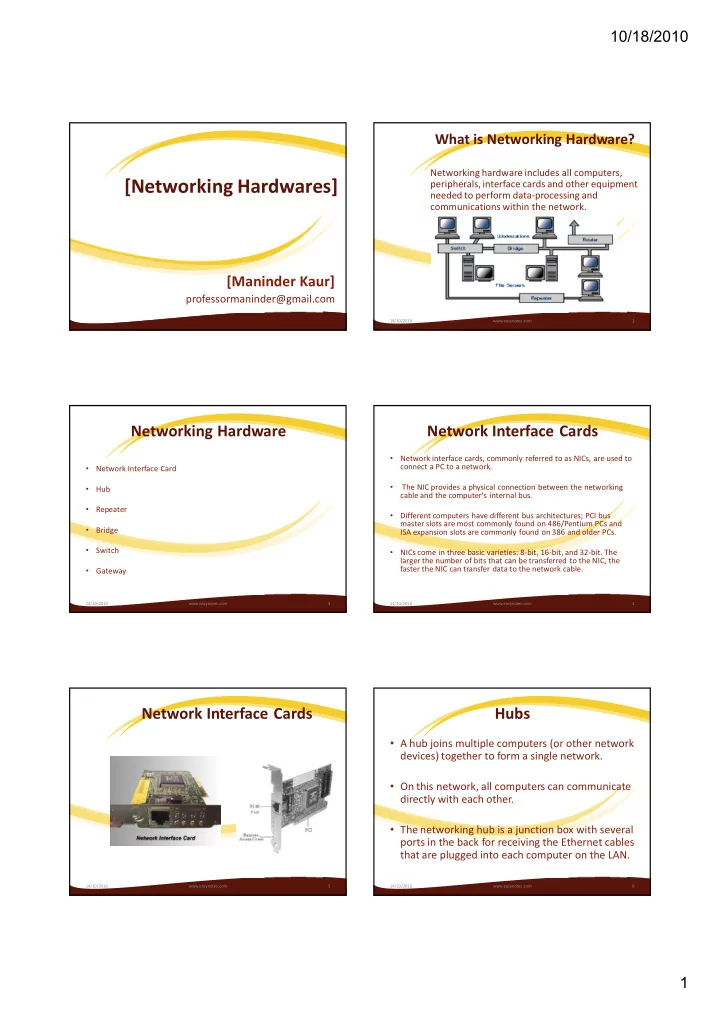
What is Networking Hardware?

Networking hardware includes all computers, peripherals, interface cards and other equipment needed to perform data-processing and communications within the network.

14/10/2010 2 www.eazynotes.com

Networking Hardware

  • Network Interface Card
  • Hub
  • Repeater
  • Bridge
  • Switch
  • Gateway

14/10/2010 3 www.eazynotes.com

Network Interface Cards

  • Network interface cards, commonly referred to as NICs, are used to

connect a PC to a network.

  • The NIC provides a physical connection between the networking

cable and the computer's internal bus.

  • Different computers have different bus architectures; PCI bus

master slots are most commonly found on 486/Pentium PCs and ISA expansion slots are commonly found on 386 and older PCs.

  • NICs come in three basic varieties: 8-bit, 16-bit, and 32-bit. The

larger the number of bits that can be transferred to the NIC, the faster the NIC can transfer data to the network cable.

14/10/2010 4 www.eazynotes.com

Network Interface Cards

14/10/2010 5 www.eazynotes.com

  • A hub joins multiple computers (or other network

devices) together to form a single network.

  • On this network, all computers can communicate

directly with each other.

  • The networking hub is a junction box with several

ports in the back for receiving the Ethernet cables that are plugged into each computer on the LAN.

14/10/2010 6 www.eazynotes.com

Hubs

slide-2
SLIDE 2

10/18/2010 2

Types of Hubs

  • A passive hub serves simply as a passage for the data,

enabling it to go from one device to another.

  • Intelligent hub include additional features that enables

an administrator to monitor the traffic passing through the hub and to configure each port in the hub.

  • Switching hub, actually reads the destination address
  • f each packet and then forwards the packet to the

correct port.

14/10/2010 7 www.eazynotes.com 14/10/2010 8 www.eazynotes.com

Hubs

  • Since a signal loses strength as it passes along a cable,

it is often necessary to boost the signal with a device called a repeater.

  • A repeater is an electronic device that receives a signal,

cleans it of unnecessary noise, regenerates it, and retransmits it at a higher power level so that the signal can cover longer distances without degradation.

  • A good example of the use of repeaters would be in a

local area network using a star topology with unshielded twisted-pair cabling.

14/10/2010 9 www.eazynotes.com

Repeater

14/10/2010 10 www.eazynotes.com

Repeaters Switch

  • A network switch is a small hardware device that joins multiple

computers together within one local area network (LAN).

  • Network switches appear nearly identical to network hubs, but a

switch generally contains more intelligence than a hub.

  • Unlike hubs, network switches are capable of inspecting data

packets as they are received, determining the source and destination device of each packet, and forwarding them appropriately.

  • Allow several users to send information over a network at the same

time without slowing each other down.

14/10/2010 11 www.eazynotes.com

Switch

14/10/2010 12 www.eazynotes.com

slide-3
SLIDE 3

10/18/2010 3

Router

  • A device to interconnect SIMILAR networks, e.g. similar

protocols and workstations and servers.

  • A router is an electronic device that interconnects two
  • r more computer networks, and selectively

interchanges packets of data between them.

  • Each data packet contains address information that a

router can use to determine if the source and destination are on the same network, or if the data packet must be transferred from one network to another.

14/10/2010 13 www.eazynotes.com

Router

14/10/2010 14 www.eazynotes.com

Bridge

  • A bridge is a device that connects a local area network (LAN) to

another local area network that uses the same protocol (for example, Ethernet or token ring).

  • The function of a bridge is to connect separate networks together.

Bridges connect different networks types (such as Ethernet and Fast Ethernet) or networks of the same type.

  • Bridges map the Ethernet addresses of the nodes residing on each

network segment and allow only necessary traffic to pass through the bridge. When a packet is received by the bridge, the bridge determines the destination and source segments.

14/10/2010 15 www.eazynotes.com

Types of Bridges

  • Bridges come in three basic types:
  • Local bridges: Directly connect local area networks

(LANs)

  • Remote bridges: Can be used to create a wide area

network (WAN) link between LANs. Remote bridges have been replaced with routers.

  • Wireless bridges: Can be used to join LANs or connect

remote stations to LANs.

14/10/2010 16 www.eazynotes.com

Bridges

14/10/2010 17 www.eazynotes.com

Gateway

  • Gateways are used to interconnect two different

networks having different protocols.

  • Networks using different protocols use different

addressing formats.

  • A gateway is a network point that acts as an

entrance to another network.

  • Gateways are also called protocol converters.

14/10/2010 18 www.eazynotes.com

slide-4
SLIDE 4

10/18/2010 4

Gateway

14/10/2010 19 www.eazynotes.com

What is the difference?

  • Bridge: device to interconnect two LANs that use the

SAME logical link control protocol but may use different medium access control protocols.

  • Router: device to interconnect SIMILAR networks, e.g.

similar protocols and workstations and servers.

  • Gateway: device to interconnect DISSIMILAR protocols

and servers, and Macintosh and IBM LANs and equipment

14/10/2010 20 www.eazynotes.com