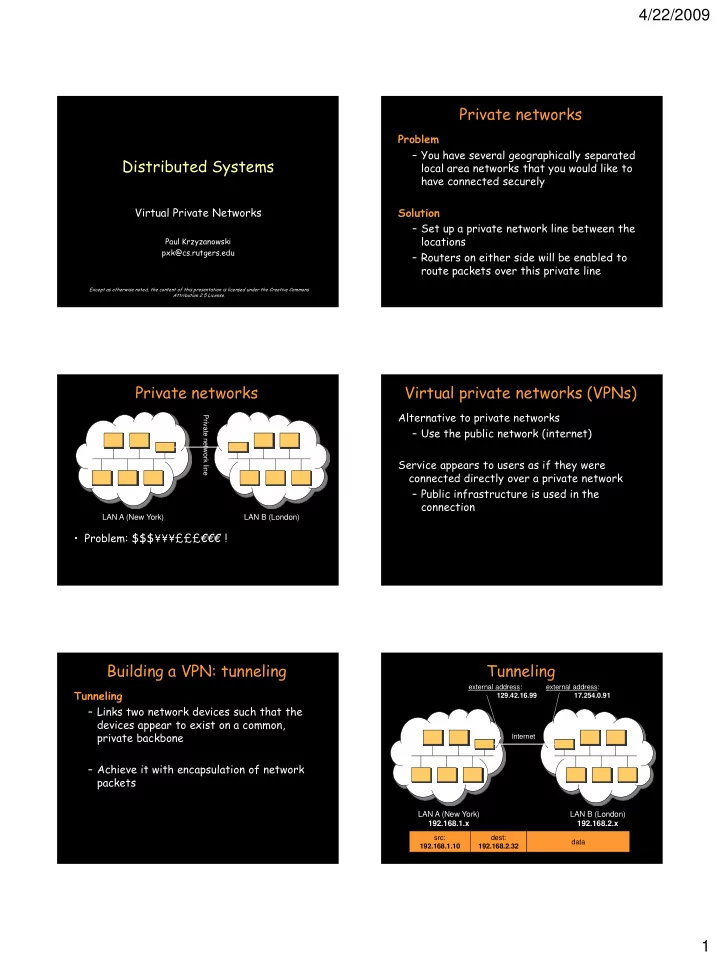
SLIDE 2 4/22/2009 2 Tunneling
Internet
LAN A (New York) 192.168.1.x LAN B (London) 192.168.2.x external address: 129.42.16.99 external address: 17.254.0.91
src:
192.168.1.10
dest:
192.168.2.32
data
- route packets for 192.168.2.x to VPN router
- envelope packet
- send it to remote router
src:
129.42.16.99
dest:
17.254.0.91
Tunneling
Internet
LAN A (New York) 192.168.1.x LAN B (London) 192.168.2.x external address: 129.42.16.99 external address: 17.254.0.91
src:
192.168.1.10
dest:
192.168.2.32
data src:
129.42.16.99
dest:
17.254.0.91
- accept packets from 129.42.16.99
- extract data (original IP packet)
- send on local network
Building a VPN: tunneling
Operation
– LAN-1 and LAN-2 each expose a single outside address and port. – A machine in the DMZ (typically running firewall software) listens on this address and port – On LAN-1, any packets addressed to LAN-2 are routed to this system.
- VPN software takes the entire packet that is
destined for LAN-2 and, treating it as data, sends it over an established TCP/IP connection to the listener on LAN-2
– On LAN-2, the software extracts the data (the entire packet) and sends it out on its local area network
Building a VPN: security
No need to make all machines in the local area networks accessible to the public network … just the router
BUT… an intruder can: – examine the encapsulated packets – forge new encapsulated packet Solution: – encrypt the encapsulated packets
- Symmetric algorithm for encryption using
session key
– need mechanism for key exchange
IPSEC: RFC 1825, 1827
- IP-layer security mechanism
- Covers authentication and encryption
- Application gets benefits of network encryption without
modification
- Additional header added to packet:
– IP Authentication header
- Identifies proper source and destination – basis of point-to-
point authentication
- Signature for IP header
- Encapsulating Security Protocol (ESP)
- Tunnel mode: encrypt entire IP packet (data and IP/TCP/UDP
headers)
- or Transport mode: encrypt only IP/TCP/UDP headers (faster)
- Encryption via RC4. DES. DES3, or IDEA
- Key management: manual, Diffie-Hellman, or RSA
IPSEC
src:
192.168.1.10
dest:
192.168.2.32
data src:
129.42.16.99
dest:
17.254.0.91
src:
192.168.1.10
dest:
192.168.2.32
data src:
129.42.16.99
dest:
17.254.0.91 Authentication header. Validate:
- Packet not modified
- Packet originated from peer
src:
192.168.1.10
dest:
192.168.2.32
data src:
129.42.16.99
dest:
17.254.0.91
with AH+ESP with AH simple tunnel
signature signature