Near-IR Spectral Mapping on the Multiple Outflows around LkH 234 - - PowerPoint PPT Presentation

near ir spectral mapping on the multiple outflows around
SMART_READER_LITE
LIVE PREVIEW

Near-IR Spectral Mapping on the Multiple Outflows around LkH 234 - - PowerPoint PPT Presentation

Near-IR Spectral Mapping on the Multiple Outflows around LkH 234 Heeyoung Oh (SNU) Co-workers: Tae-Soo Pyo (Subaru Telescope) Bon-Chul Koo (SNU) In-Soo Yuk (KASI) Byeong-Gon Park (UST, KASI) and IGRINS TEAM 2017 IGRINS Workshop July


slide-1
SLIDE 1

Near-IR Spectral Mapping on the Multiple Outflows around LkH⍺ 234

2017 IGRINS Workshop July 27-28, @KHU

NGC 7129, Subaru/HSC
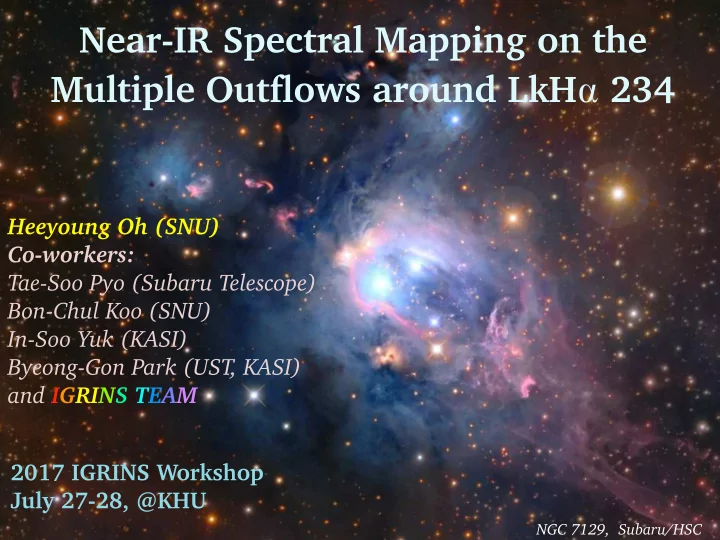
Heeyoung Oh (SNU) Co-workers: Tae-Soo Pyo (Subaru Telescope) Bon-Chul Koo (SNU) In-Soo Yuk (KASI) Byeong-Gon Park (UST, KASI) and IGRINS TEAM

slide-2
SLIDE 2

July 28, 2017

Andre (2000) accretion/

  • utflow

Why Study YSO Outflow?

Class 0 Class I Class II

  • Accretion/outflow is essential

in star/planet formation

  • Outflow removes angular

momentum of infalling material for growth of stellar seed

  • Outflow is fossil records of star

formation history

  • YSO outflow is close to us:

many samples, can be adopted to other astrophysical jets

2

slide-3
SLIDE 3

3

July 28, 2017

YSO outflow with IGRINS

HH 212, NIR H2

ESO/M. McCaughrean

NIR H-band, [FeII], H2. Hayashi & Pyo (2009) L1551-IRS5

Shock tracer:

  • Optical Herbig-Haro Objects (Hα,

[S II], [O I], etc.)

  • NIR H2 and [Fe II] emission

lines 2.7-m HJST/McDonald 4.3-m DCT

Advantages of NIR, High-resolution 2D spectra:

  • Complex multiple outflows spatially overlapped
  • Dense molecular cloud
  • Spectral mapping (3D datacube)
slide-4
SLIDE 4

July 28, 2017

  • NGC 7129 star formation region at 1.25 kpc
  • Intermediate-mass star LkHα 234: Herbig Be, ~8.5 M☉, age ~105 yr
  • VLA continuum, millimeter, mid-IR sources (VLA 1,2,3 & MM1) :

Sequential star formation in filament (Girart+ 2016)

  • Outflow: CO, [S II], H2, water masers in similar PA, Cavity & “PDR ridge”
  • Oh et al. (2016): Identification of new [Fe II] jet from VLA 3B, High-

velocity H2 gas (>100 km/s)

4

Background

  • Massive star formation? — not understood well, form in multiple,

filamentary structure

  • Alignment & orientation of disk/outflow in multiple protostars?
  • Multiple outflows having similar PA: ex) IC 1396-N, Oph A, IC 1396-W

(Nisini et al. 2001; Kamazaki et al. 2003; Froebrich & Scholz 2003) Motivation LkHα 234 region is good sample

slide-5
SLIDE 5

July 28, 2017 5

CO / [S II] Outflow

CO red lobe

LkHα 234

Blueshifted [S II] jet

NGC 7129, Subaru/HSC

slide-6
SLIDE 6

July 28, 2017

CO / [S II] Outflow

6

CO red lobe

LkHα 234

Blueshifted [S II] jet

slide-7
SLIDE 7

July 28, 2017

H2 Outflow

7

H2 2.12 μm

slide-8
SLIDE 8

July 28, 2017

CO / [S II] Outflow

3.6, 4.5, 5.8, 8.0 μm

8

VLA1 VLA2 VLA3 MM1 LkHα 234

[Fe II] jet

slide-9
SLIDE 9

July 28, 2017

9

IGRINS spectral mapping & slit position

Redshifted knots “PDR ridge”

LkHα 234

NGC 7129 center, CFHT H2 narrow-band

Spectral mapping

  • n blueshifted lobe

15ʺ x 4.3ʺ mapping

Purpose

  • Kinematics and shock properties in 3D
  • Orientation & driving source of multiple outflows

Mapping: IGRINS/McD (August 2015) Single slits: IGRINS/DCT (November 2016)

SP1 SP2 SP3 SP4

Previous study: Oh+2016

slide-10
SLIDE 10

July 28, 2017

H K

Data Reduction

[FeII]1.644 H2 2.122 [Fe II] and H2: NIR outflow tracers

  • IGRINS Pipeline Package: Sky subtraction, flat fielding, bad pixel correction, aperture

extraction, wavelength calibration.

  • Plotspec by Kyle Kaplan (IGRINS 2D spectra tool): Continuous 2D spectra of all the IGRINS

H- and K-band orders, removal of stellar photospheric absorption lines from the standard star, telluric correction, and relative flux calibration, continuum subtraction. (https:// github.com/kfkaplan/plotspec)

10

slide-11
SLIDE 11

July 28, 2017

11 VLA2 (SiO & H2O jet) MM1 (H2 jet) VLA1 (radio jet) VLA3 A,B (radio & NIR jet) LkHɑ 234

a b c

CFHT H2 IGRINS H2 IGRINS [Fe II]

Spectral Mapping: Monochromatic Image

  • H2: multiple peaks in knot A (note effect from cont. subtraction). PA 225 from MM1.
  • [Fe II]: different axis from H2, PA 240 from VLA 3 (As suggested by Oh+2016)

Velocity integrated over -180 ~ +60 km/s

P A 2 2 5 P A 2 4

slide-12
SLIDE 12

July 28, 2017

12

H2 1-0 S(1)

Spectral Mapping: Channel Map

(Vwidth = Vcenter ±10 km/s, Vsys= -11.5 km/s)

[Fe II] 1.644µm

  • H2 & [Fe II] are different in both position & velocity
  • H2: Dominant in low velocity & weak high-velocity. Complex multiple components.
  • [Fe II]: Strong high-velocity. Traced by one axis with PA 240.
  • Four different outflow features: PA 240, PA 225, A1ʹ, A2ʹ.
slide-13
SLIDE 13

July 28, 2017

13

Red lobe & PDR ridge: H2 1-0 S(1) PVDs

SP1 SP2 SP3

Similar distance from sources but different position & velocity: Different origin? ~65ʺ from YSOs Few km/s redshifted from Vsys VFWHM <7 km/s @ Vsys. Redshifted knots Spectral mapping @McD “PDR ridge”

SP1 LkHα 234

NGC 7129 center, CFHT H2 narrow-band

SP4

SP2 SP3 SP4

slide-14
SLIDE 14

July 28, 2017

14

Multiple Outflows

Origins & Axis

  • PA 240: Strong [Fe II] & weak
  • H2. Aligned well with VLA 3B

(Oh+2016).

  • PA 225: H2 jet from MM1 (Cabrit

+1997).

  • Peak A2ʹ: on the axis of PA 225,

but redshifted. — 1) wide angle

  • utflow from MM1, 2) NIR

counterpart of H2O jet of VLA 2, 3) interaction between two

  • utflows?
  • Peak A1ʹ: origin not clear. VLA3
  • r VLA 2?

Multiple Counter Jet

  • SP2 knot: ~100 km/s, traced by PA 240 (VLA 3B jet), high-velocity [Fe II] & H2.
  • SP 3 knot: low velocity, on PA 225: H2 jet from MM1, but also aligned with VLA 1

radio jet.

  • SP1: not clear. — far (65ʺ) from the sources. Similar velocity to SP3.
slide-15
SLIDE 15

Summary

  • 1. High-R, NIR spectral mapping allowed us to distinguish

multiple outflows using channel map.

  • 2. H2 emission: complex multiple outflow, with/without

counterparts in [Fe II] and/or [S II].

  • 3. Around LkHα 234, there are at least three different NIR
  • utflows from MM1, VLA 2, & VLA 3 showing similar PA.
  • 4. We reconfirmed that the source of [Fe II] jet n Oh et al. (2016)

is VLA 3B.

  • 5. We revealed redshifted counterparts of multiple outflows.
  • 6. H2 line ratios from fast & slow gases are similar, indicating C-

shock (or +J-shock).