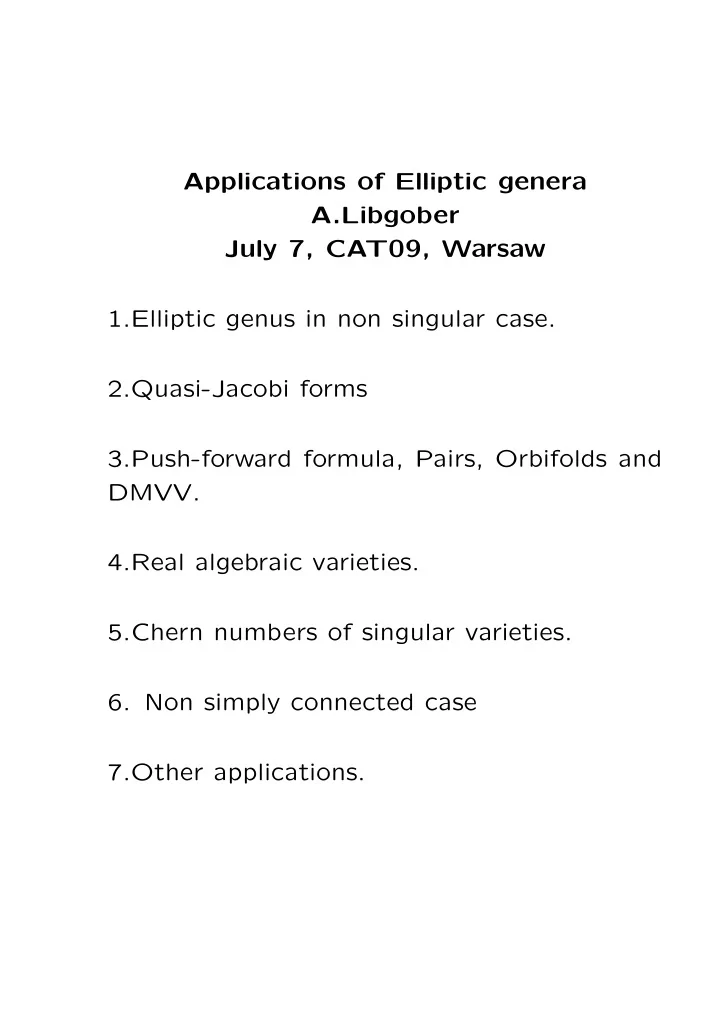
SLIDE 1 Applications of Elliptic genera A.Libgober July 7, CAT09, Warsaw 1.Elliptic genus in non singular case. 2.Quasi-Jacobi forms 3.Push-forward formula, Pairs, Orbifolds and DMVV. 4.Real algebraic varieties. 5.Chern numbers of singular varieties.
- 6. Non simply connected case
7.Other applications.
SLIDE 2 Elliptic genus: {Class of complex spaces} → {functions on H×C} Non Singular Case: (X almost complex:) Let xi be the Chern roots of X, i.e. for the total Chern class we have c(X) =
i(1 + xi), then
Ell(X; y, q) =
xi θ( xi
2πi − z, τ)
θ( xi
2πi, τ)
where q = e2πiτ and y = e2πiz and θ(z, τ) = q
1 8(2sinπz)
l=∞
(1−ql)
l=∞
(1−qle2πiz)(1−qle−2πiz) For z = 0 (y = 1), q = 0 ⇒
q = 0 : xeπi( x
2πi−z)−e−πi( x 2πi−z)
eπi( x
2πi)−e−πi( x 2πi)
= y−1
2 x(1−e−xy)
1−e−x
⇒ χy ydim/2Ell(X) ⇒ (y = 0)
x 1−e−x Todd
genus
SLIDE 3 Ell(X, q, y) is Poincare series of holomorphic euler charactersitic of bigraded bundle: E =
i 2qj
Typical graded bundles: E ⇒ Λt(E) =
- Λi(E)ti St(E) =
- Symi(E)ti
Let ELL = y−d
2⊗n≥1(Λ−yqn−1Ω1
X⊗Λ−y−1qnTX⊗SqnΩ1 X⊗SqnTX)
By Riemann Roch: Ell(X, y, q) = χ(ELL) =
xi θ( xi
2πi − z, τ)
θ( xi
2πi, τ)
Element of Chow ring under integral is call elliptic class. Elliptic genus is the top degree component of elliptic class in Chow ring A(X)
SLIDE 4 Specializes (q = 0) into χy and hence into topological euler characteristic, signature,... (χy is specialization of Batyrev’s E(u, v)-function). If z = 1
2 (y = −1) it becomes one variable el-
liptic genus (Ochanine genus) depending only
- f Pontryagin classes. Generating series:
Q(x) = x/2 sinh(x/2)
∞
[ (1 − qn)2 (1 − qnex)(1 − qne−x)](−1)n Alternatively: Q(x) = x g−1(x) g(x) =
x
dt
δ, ǫ are combinations of Eisenstein series. δ = −1 8 − 3
(
d)qn ǫ =
(
d odd
d3)qn g(x)-is logarithm of formal group associated with elliptic genus.
SLIDE 5 Totaro’s theorem: The kernel of complex elliptic genus on MSU ⊗ Z[1
2] is the ideal gen-
erated by X1−X2 where X1 and X2 are related by classical SU-flop. ˆ X ւ ց X1 X2 ց ւ X0 Hodge and Chern numbers If dimension of a Calabi-Yau manifold is less than 12 or is equal to 13, then the numbers χp determine its elliptic genus uniquely. In all
- ther dimensions there exist Calabi-Yau man-
ifolds with the same {χp} but distinct elliptic genera. Non trivial relation between Hodge and Chern numbers (L. -Wood):
d
(−1)pp 2
12{1 2d(3d−5)cd+cd−1c1}[X]
SLIDE 6
Modular properties: Ochanine genus of a manifold is a modular form for Γ0(2) and for Spin manifolds for Γθ (subgroup of SL2(Z) of index 3). Non modularity is similar to non integrality of ˆ A-genus in non Spin case. A Jacobi form of index t ∈ 1
2Z and weight k is
a holomorphic function χ on H × C satisfying the following functional equations: χ(aτ + b cτ + d, z cτ + d) = (cτ + d)ke
2πitcz2 cτ+d χ(τ, z)
χ(τ, z+λτ+µ) = (−1)2t(λ+µ)e−2πit(λ2τ+2λz)χ(τ, z) Ellitpic genus of a Calabi Yau manifold is Ja- cobi form of weigth 0 and index dimX
2
. Ring of Jacobi forms is a finitely generated bigraded algebra.
SLIDE 7 Quasi-jacobi forms In non CY case one has a “quasi-modular” Jacobi form. Problem: Find a finite dimensional algebra generated of functions on H × C which are elliptic genera of complex manifolds. Here is example of “not quite” Jacobi forms. En(z, τ) =
1 (z + aτ + b)n For n ≥ 3 one has absolute convergence and hence Jacobi property (index zero, weight n)
SLIDE 8 One has: E1(aτ + b cτ + d, z cτ + d) = (cτ + d)E1(τ, z) + πic 2 z E1(τ, z + mτ + n) = E1(τ, z) − 2πim and E2(aτ + b cτ + d, z cτ + d) = (cτ+d)2E2(τ, z)−1 2πic(cτ+d) E2(τ, z + aτ + b) = E2(τ, z) Elliptic genera of complex manifolds (after multiplying by (θ′(0)
θ(z) )d) are combination of Ei(z, τ)
and ordinary Eisenstein series: ei =
1 (aτ + b)n
SLIDE 9
Characterization of elliptic genera: Recall quasi-modular forms (for SL2(Z)): Algebra of quasi-modular forms is algebra C[e2, e4, .. generated by Eisenstein series. One has e2(aτ + b cτ + d) = (cτ + d)2e2(τ) − 1 2πic(cτ + d) but e2(τ) − 1 4πImτ transforms as modular form of weight 2. Definition Quasi-modular form of weight k and depth p is constant term of polynomial in
1 4πImτ of degree at most p which transforms
as modular form of weigth k. Ring of Quasimodular forms is closed under differentiation. Solutions to enumeration problems (branched covering of torus) etc.
SLIDE 10 We let: λ(z, τ) = z − ¯ z τ − ¯ τ , µ(τ) = 1 τ − ¯ τ These real analytic functions have the follow- ing transformation properties: λ( z cτ + d, aτ + b cτ + d) = (cτ + d)λ(z, τ) − 2icz λ(z + mτ + n, τ) = λ(z, τ) + m µ(aτ + b cτ + d) = (cτ + d)2µ(τ) − 2ic(cτ + d) Definition Almost meromorphic Jacobi form
- f weight k, index zero and depth (s, t) is a
(real) meromorphic function in C{q
1 l , z}[z−1, λ, µ],
with λ, µ given above and which a) satisfies the functional equations of Jacobi forms of weight k and index zero and
SLIDE 11 b) has degree at most s in λ and at most t in µ. Definition A quasi-Jacobi form is a constant term of an almost meromorphic Jacobi form
- f index zero considered as a polynomial in the
functions λ, µ i.e. a meromorphic function f0
- n H × C such that exist meromorphic func-
tions fi,j such that f0 + fi,jλiµj is almost meromorphic Jacobi form. Theorem The algebra of quasi-Jacobi forms
- f depth (k, 0), k ≥ 0 is isomorphic to the al-
gebra of complex unitary cobordisms modulo flops with isomorphism given by X → Ell(X)(θ′(0) θ(z) )d Elliptic genera of manifolds of dimension at most d span the subspace of forms of depth (d, 0) in the algebra of quasi-Jacobi forms.
SLIDE 12 If a complex manifold satisfies ck
1 = 0, ck−1 1
= 0 then its elliptic genus has depth at most k − 1. In particular if X is CY elliptic genus is Jacobi form: depth is measure of deviation from being CY. One can get formulas for the elliptic genus of specific examples in terms of Eisenstein series En. For example for a surface in P3 having degree d one has (E2
1(1
2d2−4d+8)d+(E2−e2)(d2 2 −2)d)( θ(z) θ′(0)
2
) In particular for d = 1 one obtains: (9 2E2
1 − 3
2(E2 − e2))( θ(z) θ′(0))2 For toric varieties one has formula in terms of fan ⇒ non trivial identity: for P2:
qm+n (1 + qm)(1 + qn)(1 + qm+n) =
q2r
k|r
k =
σ1(r)q2r
SLIDE 13 Singular elliptic genus. X be a Q-Gorenstein variety with log-terminal singularities, π : Y → X a desingularization of X whose ex- ceptional divisor E =
k Ek has simple normal
crossings. The discrepancies αk of the components Ek are determined by the formula KY = π∗KX +
αkEk. Chern roots yl of Y are given by c(TY ) =
- l(1+yl) and define cohomology classes ek :=
c1(ν(Ek)).
SLIDE 14 Singular elliptic genus of X is given by Ellsing(X; z, τ) :=
( yl
2πi)θ( yl 2πi − z)θ′(0)
θ(−z)θ( yl
2πi)
)× (
θ( ek
2πi − (αk + 1)z)θ(−z)
θ( ek
2πi − z)θ(−(αk + 1)z))
If resolution is crepant then elliptic genus of singular space is elliptic genus of resolution. Need to prove independence of resolution!! The same defintion for Ellsing(X, D) provided that meaning of αk is KY = π∗(KX + D) +
αkEk. Specializes into Batyrev’s χy(X, D):
- Ell(X, D; u, q = 0) = (u−1
2−u 1 2)dimZEst(X, D; u, 1)
SLIDE 15 Independece of resolution and push for- ward formula: In definition of elliptic genus of pair one can look at the class Ell(X, E, z, τ) ∈ A∗(Z) before evaluation on the fundamental class. Theorem Let (X, D) be a Kawamata log-terminal pair and let Z be a smooth locus in X which is normal crossing to Supp(D). Let f : ˆ X → X denote the blowup of X along Z. We define ˆ E by ˆ E = −
k δk ˆ
Ek −δExc(f) where ˆ Ek is the proper transform of Ek and δ is determined from K ˆ
X + ˆ
E = f∗(KX + E). Then ( ˆ X, ˆ E) is a Kawamata log-terminal and f∗Ell( ˆ X, ˆ E, z, τ) = Ell(X, E, z, τ). Weak factorization shows independence of res-
- lution (connect two resolutions by sequence
- f blow ups and blow downs).
SLIDE 16 Another type of genus for singular varieties: Orbifold elliptic genus: Let G be finite group acting on X via holo- morphic transformations. Let g, h ∈ G be a pair of commuting elements, Xg,h be a connected component of the set of points in X fixed by both g and h, xλ be the Chern roots of a subbundle Vλ of TX|Xg,h on which both g and h act via the mul- tiplication by exp(2πiλ(g)) and exp(2πiλ(h))
Φ(g, h, λ, z, τ, x) := θ( x
2πi + λ(g) − τλ(h) − z)
θ( x
2πi + λ(g) − τλ(h))
e2πizλ(h)z. Then: Eorb(X, G; z, τ) = 1 |G|
(
xλ)
Φ(g, h, λ, z, τ, xλ)[Xg,h]
SLIDE 17 Theorem(B-L) (Ann. Math. 2005) Ellorb(X, G) = Ellsing(X/G) Corollary: If X/G has a crepant resolution
e( X/G) = 1 |G|
e(Xg,h) This is a Mckay correspondence for elliptic genus.
SLIDE 18
Idea of the Proof: There is elliptic genus in the category of triples (X, E, G) (similarly to Batyrev’s E-function) where X is non singular G-invariant, E is NCD and isotropy subgroup of G acts trivaially on the irredicuble components of E containing x. Ell(X, E.G) specializes to singular (if G = 1) and orbifold (if E = ∅) genera. Consider diagramm: µ: ˆ Z → Z ↓ ↓ ψ: X → X/G where the vertical arrows are resolutions of singularities and µ is a G-equivariant toroidal morphism. Push forward formula for quotients:
SLIDE 19 Let (X; DX) be a Kawamata log-terminal pair which is invariant under an effective action of G on X. Let ψ: X → X/G be the quotient
- morphism. Let (X/G; DX/G) be the quotient
- pair. Then
ψ∗Ellorb(X, DX, G; z, τ) = Ell(X/G, DX/G; z, τ). (Definition of quotient pair: Let G be a finite group which acts effectively on a normal va- riety X and preserves a Q-Weil divisor D. Let g: X → X/G be the quotient morphism. Then there is a unique divisor D/G on X/G such that g∗(KX/G + D/G) = KX + D. This and push forward formula for µ yileds the McKay correspondence formula.
SLIDE 20
Real algebraic varieties Theorem(Totaro) Quotient of MSO by ideal generated by oriented real flops and complex flops is
Z[δ, 2γ, 2γ2, 2γ4..]
with CP2 (resp.
CP4) corresponding to δ
(resp. 2γ + δ2). This quotient ring is the the image of MSO∗ under the Ochanine genus. Problem: Can Ochanine genus be defined for large class of singular varieties.
SLIDE 21 Ochanine genus of an oriented manifold X can be defined using as Hirzebruch characteristic power series the following series with coeffi- cients in Q[[q]] (∗) Q(x) = x/2 sinh(x/2)
∞
[ (1 − qn)2 (1 − qnex)(1 − qne−x)](−1)n Evaluating genus using viewing the result as function of τ on the upper half plane (where q = e2πiτ) one obtains a modular form on Γ0(2) ⊂ SL2(Z)
SLIDE 22 Class of singularities: A real algebraic variety X over R is Q-Gorenstein log-terminal if its set of C-points is Q-Gorenstein log-terminal. Example Affine variety x2
1 − x2 2 + x2 3 − x2 4 = 0
in R4 is Gorenstein log-terminal and admit a crepant resolution. Indeed it is well known that complexification
- f such Gorenstein singularity admits a small
(and hence crepant) resolution having P1 as its exceptional set. Example The 3-dimensional complex cone in
C4 given by z2
1 + z2 2 + z2 3 + z2 4 = 0 considered
as codimension 2 sub-variety of R8 is a Q- Gorenstein log-terminal variety over R and its complexification admits a crepant resolution.
SLIDE 23 Definition: Let X be a real algebraic mani- fold and D a divisor on complexification XC
- f X. The Ochanine class EllO(X, D) of pair
X, D is
2) where Ell(XC, D, q, z) is the elliptic class con- structed above. Ochanine elliptic genus of pair (X, D) is Ell(XR, D) =
2) ∪ cl(XR)[XC] For D = 0 one obtains the Ochanine genus of real locus:
SLIDE 24 EllO(XR) = EllO(TXR)[XR] =
- EllO(TXC)|XR)[XR] =
- EllO(TXC) ∪ cl(XR)[XC]
which is consequence of the exact sequence: 0 → TXR → TXC|XR → TXR → 0 (it yields Ell(XR)2 = i∗(EllXC) where i : XR → XC).
SLIDE 25 The main result is: Theorem Let ˜ X → X is a resolution of sin- gularities of a real algebraic variety with Q- Gorenstein log-terminal singularities and ˜ D is the discrepancy. Then the elliptic genus of a pair ( ˜ X, ˜ D) is independent of a resolution. In particular if real variety X has a crepant reso- lution then its elliptic genus is independent of a crepant resolution. Proof For a blow up f : ( ˜ X, ˜ D) → (X, D) we have f∗(
X, ˜ D, q, 1 2) =
2) This is a special case of the push-forward for-
EllO(XR, D) =
2)∪cl(XR)[XC] =
XC, ˜ D, q, 1 2)∪f∗([XR]∩[XC]) = ELL( ˜ XR, ˜ D) as follows from projection formula since f∗(cl[XR]) = [cl ˜ XR] and since f∗ is identity on H0.
SLIDE 26 Applications of Elliptic Genus
- Chern classes of singular spaces.
Problem(Goreski-Macpherson): Which Chern numbers can be defined for singular varieties so that for varieties admitting IH-small reso- lution they coinside with the Chern numbers
(An IH-small resolution of Z is a regular map Y → Z such that for every i ≥ 1 the set of points z ∈ Z such that dim(f−1(z)) ≥ i has codimension greater than 2i in Z) Totaro: such Chern numbers are among lin- ear combinations of coefficitents of elliptic genus: ΩU/classical flops=image of elliptic genus. Theorem (B-L) All coefficients of elliptic genus are such invariants of Q-Gorenstein singular spaces with log-terminal singularities. Singu- lar elliptic genus yields maximal collection of such chern numbers.
SLIDE 27
- Examples of invariants of singular spaces in
terms of resolutions. Igusa-zeta or topological zeta function. Elliptic genus.
- Invariants of K-equivalence.
X and Y (smooth) are K-equivalent if they are birationally equivalent and Z, f : Z → X and g : Z → Y such that f∗KX = g∗KY . Theorem (B-L) Elliptic genus is an invariant
Other new results: 1.Waelder’s Equivariant elliptic genus and rigid- ity theorem for elliptic genera of pairs with torus action. 2.Gorbunov and Malikov LG-CY correspon- dence for elliptic genera for hypersurfaces in projective space.
SLIDE 28
- Elliptic genera of Hilbert schemes.
(X, D) be a Kawamata log-terminal pair. The quotient of (X, D)n by the symmetric group Sn, is (Xn/Sn, D(n)/Sn). (D(n) is the sum of pullbacks of D under n canonical projections to X) Theorem (generalization of Dijkgraaf-Moore- Verlinde-Verlinde in smooth case):
pnEll(Xn/Sn, D(n)/Sn; z, τ) =
∞
1 (1 − piylqm)c(mi,l), where the elliptic genus of (X, D) is
c(m, l)ylqm and y = e2πiz, q = e2πiτ.
SLIDE 29 Higher elliptic genus. Let X be a manifold and π = π1(X), α ∈ H∗(π, Q) Higher elliptic genus: Ellα(X) = (ELL(X) ∪ f∗(α))[X] where ELL(X) =
xi θ( xi
2πi − z, τ)
θ( xi
2πi, τ)
is the elliptic class. Ellα specialzies to Novikov’s signature and higher Todd genera. J.Rosenberg: is higher Todd genus a bira- tional invariant?
SLIDE 30
Modularity
If X is a SU-manifold, d = dimX, α ∈ Hk(π, Q) then the higher elliptic genus (ELL(X)∪f∗(α))[X] is a Jacobi form having index d
2 and weight −k
(i.e. is a function χ on H × C satisfying: χ(aτ + b cτ + d, z cτ + d) = (cτ + d)ke
2πitcz2 cτ+d χ(τ, z)
χ(τ, z+λτ+µ) = (−1)2t(λ+µ)e−2πit(λ2τ+2λz)χ(τ, z) Beauville: a fundamental group of a Calabi Yau manifold is an extension of a free abelian group by a finite group so one does obtain new invariants if the rank of this abelian group is positive.
SLIDE 31 Let (X, D) be a Kawamata log terminal G- normal pair and D = − δkDk. The orb- ifold elliptic class of (X, D, G) is the class in H∗(X, Q) given by: ELL(X, D, G; z, τ) := 1 |G|
[Xg,h](
xλ) ×
θ( xλ
2πi + λ(g) − τλ(h) − z)
θ( xλ
2πi + λ(g) − τλ(h))
e2πiλ(h)z ×
θ( ek
2πi + ǫk(g) − ǫk(h)τ − (δk + 1)z)
θ( ek
2πi + ǫk(g) − ǫk(h)τ − z)
θ(−z) θ(−(δk + 1)z)e2πiδkǫk(h)z. Ellα(X, D, G) = (ELL(X, D, G) ∩ f∗(α))0 If m(KX + D) = 0 it is Jacobi form.
SLIDE 32
Let (X, D, G) and ( ˆ X, ˆ D, G) be G-normal and Kawamata log-terminal and let φ : ( ˆ X, ˆ D) → (X, D) is G-equivariant such that φ∗(KX + D) = K ˆ
X + ˆ
D then Ellα( ˆ X, ˆ D, G) = Ellα(X, D, G) Corollaries: Higher elliptic genera are invariants of crepant birational equivalences of CY manifolds. higher signatures and ˆ A-genera are invariant for crepant birational morphisms Higher Todd genus is an invariant of arbitrary birational morphisms. (also Block-Weinberger).
SLIDE 33 Singular varieties: Lemma(Takayama): Let X has only log-terminal singularities and let f : X′ → X be a resolution
- f singularities of X. Then π1(X′) = π1(X).
Let X be a projective algebraic variety with
Q-Gorenstein log-terminal singularities.
Let α ∈ H∗(π1(X), Q) be the cohomology class
If φ : ˜ X → X is a resolution of singularities of X, K ˜
X =
φ∗(KX)+ ˜ D and α is viewed as the element in the H∗(π1( ˜ X), Q) identified with H∗(π1(X), Q) using φ. Then: Ellα(X) dfn = Ellα( ˜ X, ˜ D) This is well defined as a consequence of invari- ance of higher ellptic genus under K-equivalence
SLIDE 34
Further results: 1. McKay correspondence for higher elliptic genera. 2. Cobordisms: Let Iπ (resp. I) be the ideal in ΩU(Bπ) generated by the differences (X, fX) and (X′, fX′) (fX : X → π1(X)) where (X′, fX′) and (X, fX) (resp. X′ − X where X′ and X are differ by a classical flop Then Hom(ΩSU
d
(Bπ)/Iπ ∩ ΩSU
d
(Bπ), Q) = ⊕k∈2ZHk(Bπ, Jac−k,d
2
) where Jac−k,d
2
is the space of Jacobi forms having weight −k and index d
2
SLIDE 35 MSV-complex. X = ⇒ sheaf of vertex operator algebras MSV(X) (Malikov-Schechtman-Vaintrob) Can be constructed in terms of the loop space
- f X (Kapranov-Vasserot) Further clarified by
Ben-Zvi-Heluani-Szczesny (math.AG 0601532) Vertex operator algebra: (V = Vev ⊕ Vodd, 0| >∈ V0, V → End(V )[z, z−1], T : V → V ) a → Y (a, z) =
n∈Z a(n)z−n−1 satisfies axioms
SLIDE 36 Conformal vertex algebra: vertex algebra to- gether with even element L ∈ V such that 1. components L(z) =
n Lnz−n−2 satisfy
Virasoro commutation relations: [Ln, Lm] = (n − m)Ln+m + n3 − n 12 · c · δn
−m
- 2. L−1 = T infinitesimal translation operator.
- 3. L0 is diagonalizable.
Has additional structure (topological vertex agebra) given by operator J0 given another grading.
SLIDE 37
Theorem (MSV): Let X be a non singular compact complex manifold. There exist a sheaf Ωch
X of vector spaces on X with the prop-
erties: a) For each Zariski open set U, Γ(U, Ωch
X ) has
a structure of conformal vertex algebra, with restriction maps being morphisms of vertex algebras. b) Ωch
X has two gradings with degrees called
fermionic charge and conformal weight. c) Ωch
X has deRham differential dch DR of (fermionic)
degree 1, (dch
DR)2 = 0.
d) Usual deRham complex ΩX is isomorphic to conformal weight zero component of Ωch
DR.
e)The complex (Ωch
X , dch DR) is quasiisomorphic
to (ΩX, dDR).
SLIDE 38
f) Each component of fixed conformal weight has canonical filtration with grF isomorphic to tensor product of exterior powers of tangent and cotangent bundles so that corresponding generating function is ⊗n≥1(Λyqn−1 ¯ TX ⊗ Λy−1qnTX ⊗ Sqn ¯ TX ⊗ SqnTX) DEFINITION: Let X is a variety for which one can define a chiral DeRham complex MSV(X) with properties a)-f) as above. Elliptic genus of X is y−dimX
2
SuperTraceH∗(MSV(X))yJ[0]qL[0]
SLIDE 39
- A test for mirror symmetry.
Ell( ˆ X) = (−1)dimXEll(X) Theorem: Let X be a generic hypersurface in the Gorenstein toric Fano variety defined by the combinatorial data above. Then Ell(X, y, q) = y
−d 2 SuperTraceH∗(MSV(X))yJ[0]qL[0] =
y
−d 2
n∈K∗
yn·deg−m·deg∗qm·n+m·deg∗G(y, q)d+2
where G(y, q) =
(1 − yqk−1)(1 − y−1qk) (1 − qk)2 . Corollary: Elliptic genera of toric hypersur- faces corresponding to dual poytopes satisfy mirror duality.
SLIDE 40 Discrete Torsion and Elliptic genus
Let α ∈ H2(G, U(1)) and let δ(g, h) = α(g, h) α(h, g) Definition: Ellα
y−dimX/2
yF(g,Xg⊆X)· 1 |C(g)|
δ(g, h)L(h, Vg,Xg⊆X). (where: Vh,Xh⊆X :=
SLIDE 41 ⊗k≥1[(Λ•
yqk−1V ∗ 0 ) ⊗ (Λ• y−1qkV0)⊗
(Sym•
qkV ∗ 0 ) ⊗ (Sym• qkV0)⊗
⊗[⊗λ=0(Λ•
yqk−1+λ(h)V ∗ λ ) ⊗ (Λ• y−1qk−λ(h)Vλ)⊗
(Sym•
qk−1+λ(h)V ∗ λ ) ⊗ (Sym• qk−λ(h)Vλ)]]
Alternative Form: Ellα
1 |G|
δ(g, h)
xλ×
Φ(g, h, λ, z, τ, xλ)[Xg,h] Φ(g, h, λ, z, τ, x) = θ( x
2πi + λ(g) − τλ(h) − z)
θ( x
2πi + λ(g) − τλ(h))
e2πizλ(h).
SLIDE 42 Specialization: Twisted E-function: Eα(u, v, G) =
(uv)F(g,Xg⊂X)
p,q
dimHp,q(Xg, Lα)C(g)upvq which for u = 1, v = −1 yields: eα(X, G) = 1 |G|
δ(f.g)e(Xf,g) The elliptic genus satisfies: Ellα(0, y, G) = y
dimX 2
Eα(y, −1, G)
SLIDE 43 Modularity :
Ellα
is Jacobi form (weight 0 index d
2) for a sub-
group of the Jacobi group.
Vertex Algebra interpretation
α ∈ H2(G, U(1)) yields a character of C(g) (αg(h) = δ(g, h)) Ωch,g
X
is sheaf of (g-twisted) Ωch-modules (g-twisted is certain restriction on graded com- ponents of a VOA module with action of g)
SLIDE 44 Let Hα
H∗(X, Ωch,g
X
)C(g)α (for α = 0 one has orbifold chiral deRham complex of Frenkel-Szczesny) Then Ellα
y−dimX
2
Supertrace(qL0yJ0, Hα
SLIDE 45 Symmetric products and discrete torsion
One has H2(SN, U(1)) = Z2 (N ≥ 4) Let us before: Ell(X; q, y) =
c(m, ℓ)qmyℓ Consider: Zα(p, q, y) =
pNEllα
SLIDE 46 Then (n > 0, m, l ≥ 0): Zα(p, q, y) = 1 2
- Z++ + Z+− + Z−+ + Z−−
- . where:
Z++(p, q, y) =
(1 + p2nqm−1
2yℓ)c(n(2m−1),ℓ)
(1 − p2n−1qmyℓ)c((2n−1)m,ℓ) Z+−(p, q, y) =
(1 − p2nqm−1
2yℓ)c(n(2m−1),ℓ)
(1 − p2n−1qmyℓ)c((2n−1)m,ℓ) Z−+(p, q, y) =
(1 + p2nqmyℓ)c(2nm,ℓ) (1 − p2n−1qmyℓ)c((2n−1)m,ℓ) Z−−(p, q, y) = −
(1 − p2nqmyℓ)c(2nm,ℓ) (1 − p2n−1qmyℓ)c((2n−1)m,ℓ) (there is G-equivariant form of this identity involving wreath products)
SLIDE 47 Specialization to euler characteristic case
Usual elliptic genus specialization (Goetsche):
(1 − pn)−e(X) (almost modular form) In torsion case:
(1 − p2n−1)−e(X)× {1 + 1 2[
- (1 + p2n)e(X) −
- (1 − p2n)e(X)]}
(modular properties?)