Nanoscale III-V Electronics: InGaAs FinFETs and Vertical Nanowire - - PowerPoint PPT Presentation

nanoscale iii v electronics ingaas finfets and vertical
SMART_READER_LITE
LIVE PREVIEW

Nanoscale III-V Electronics: InGaAs FinFETs and Vertical Nanowire - - PowerPoint PPT Presentation

Nanoscale III-V Electronics: InGaAs FinFETs and Vertical Nanowire MOSFETs J. A. del Alamo, X. Zhao, W. Lu, A. Vardi and X. Cai Microsystems Technology Laboratories Massachusetts Institute of Technology IEEE Nanotechnology Materials and Devices


slide-1
SLIDE 1

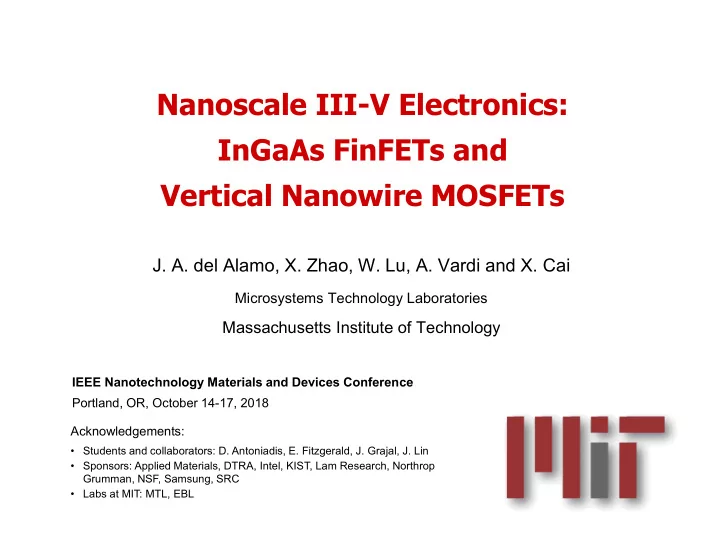
Nanoscale III-V Electronics: InGaAs FinFETs and Vertical Nanowire MOSFETs

  • J. A. del Alamo, X. Zhao, W. Lu, A. Vardi and X. Cai

Microsystems Technology Laboratories

Massachusetts Institute of Technology

IEEE Nanotechnology Materials and Devices Conference Portland, OR, October 14-17, 2018 Acknowledgements:

  • Students and collaborators: D. Antoniadis, E. Fitzgerald, J. Grajal, J. Lin
  • Sponsors: Applied Materials, DTRA, Intel, KIST, Lam Research, Northrop

Grumman, NSF, Samsung, SRC

  • Labs at MIT: MTL, EBL
slide-2
SLIDE 2

2

Evolution of transistor structure for improved scalability

Planar bulk MOSFET Thin-body SOI MOSFET Nanowire MOSFET

Enhanced gate control  improved scalability

FinFET

slide-3
SLIDE 3

Moore’s Law: The Problem

3

Scaling: Voltage ↓  Current density ↓  Performance ↓ Current density of n-MOSFETs at nominal voltage:

slide-4
SLIDE 4

III-V CMOS: The Promise

4

del Alamo, Nature 2011

Source injection velocity: Si vs. InGaAs vinj(InGaAs) > 2vinj(Si) at less than half VDD  high current at low voltage

slide-5
SLIDE 5

5

Evolution of transistor structure for improved scalability

Planar bulk MOSFET Thin-body SOI MOSFET Nanowire MOSFET

Enhanced gate control  improved scalability

FinFET Thin-body MOSFET

slide-6
SLIDE 6

n-MOSFETs in Intel’s nodes at nominal voltage

Transconductance of Planar Si vs. InGaAs MOSFETs

6

“Comparisons always fraught with danger…”

slide-7
SLIDE 7

n-MOSFETs in Intel’s nodes at nominal voltage

Transconductance of Planar Si vs. InGaAs MOSFETs

7

  • InGaAs stagnant for a long time
slide-8
SLIDE 8

n-MOSFETs in Intel’s nodes at nominal voltage

Transconductance of Planar Si vs. InGaAs MOSFETs

8

  • Rapid recent progress  Atomic Layer Deposition
  • InGaAs exceeds Si
slide-9
SLIDE 9

n-MOSFETs in Intel’s nodes at nominal voltage

Transconductance of Planar Si vs. InGaAs MOSFETs

9

MIT (VDS=0.5 V)

Lin, IEDM 2014, EDL 2016

  • Rapid recent progress  Atomic Layer Deposition
  • InGaAs exceeds Si
slide-10
SLIDE 10

10

Evolution of transistor structure for improved scalability

Planar bulk MOSFET Thin-body SOI MOSFET Nanowire MOSFET

Enhanced gate control  improved scalability

FinFET FinFET

slide-11
SLIDE 11

Transconductance of planar Si vs. InGaAs MOSFETs

11

slide-12
SLIDE 12

Transconductance of Si vs. InGaAs FinFETs

12

slide-13
SLIDE 13

Transconductance of Si vs. InGaAs FinFETs

13

gm normalized by fin width

Wf FinFET: large increase in current density per unit footprint over planar MOSFET

slide-14
SLIDE 14

Transconductance of Si vs. InGaAs FinFETs

14

Best InGaAs FinFETs nearly match 14 nm Si MOSFETs

MIT (VDS=0.5 V)

gm normalized by fin width

Wf

slide-15
SLIDE 15

Transconductance of Si vs. InGaAs FinFETs

15

10 nm node Si MOSFETs: a great new challenge!

10 nm node Intel (VDS=0.7 V)

gm normalized by fin width

Wf

MIT (VDS=0.5 V)

slide-16
SLIDE 16

InGaAs FinFETs @ MIT

16

Vardi, DRC 2014, EDL 2015, IEDM 2015

Key enabling technologies: BCl3/SiCl4/Ar RIE + digital etch

  • Sub-10 nm fin width
  • Aspect ratio > 20
  • Vertical sidewalls
slide-17
SLIDE 17

InGaAs FinFETs @ MIT

17

Vardi, IEDM 2017

  • Si-compatible process
  • Contact-first, gate-last process
  • Fin etch mask left in place  double-gate MOSFET

InAlAs InGaAs

n+-InGaAs

W/Mo Lg SiO2 HSQ High-K InP δ - Si InP Mo Mo HSQ High-K InGaAs

slide-18
SLIDE 18

18

Most aggressively scaled FinFET

Wf=5 nm, Lg=50 nm, Hc=50 nm (AR=10), EOT=0.8 nm:

Vardi, IEDM 2017

  • 0.2

0.0 0.2 0.4 0.6 0.8 1E-9 1E-8 1E-7 1E-6 1E-5 1E-4 1E-3

Ssat=75 mV/dec Slin=65 mV/dec

50 mV VDS=500 mV Id [A/m] VGS [V] Lg=50 nm Wf=5 nm 0.0 0.1 0.2 0.3 0.4 0.5 50 100 150 Id [A/m] VGS [V]

VGS=-0.2 to 0.5 V VGS=0.1 V

gm,max=565 µS/µm (VDS=0.5 V)

Normalized by conducting gate periphery = 2Hc

slide-19
SLIDE 19

5 10 15 20 25 40 60 80 100 120 Ssat Slin S [mV/dec] Wf [nm]

19

  • Excellent subthreshold swing scaling behavior
  • From long Lg devices: Dit ~ 8x1011 cm-2.eV-1

Vardi, IEDM 2017

Slin (VDS = 50 mV) Ssat (VDS = 0.5 V) Lg=40-60 nm

  • 0.2

0.0 0.2 0.4 0.6 0.8 1E-9 1E-8 1E-7 1E-6 1E-5 1E-4 1E-3

Ssat=75 mV/dec Slin=65 mV/dec

50 mV VDS=500 mV Id [A/m] VGS [V] Lg=50 nm Wf=5 nm

Wf scaling of OFF-state characteristics

slide-20
SLIDE 20

5 10 15 20 25 200 400 600 800 1000 Ron[-m] Wf [nm]

5 10 15 20 25 0.0 0.5 1.0 1.5 2.0 gm[mS/m] Wf [nm]

Wf scaling of ON-state characteristics

20

  • gm independent of Wf down

to Wf=7 nm

  • In planar MOSFET (x=0.53)

expect gm~ 2.2 mS/µm

  • Missing performance hints

at sidewall damage

Vardi, IEDM 2017 in planar MOSFETs expect 2.2 mS/µm

Lg=40-60 nm VDS = 0.5 V Normalized by conducting gate periphery = 2Hc

slide-21
SLIDE 21

DC underestimates transistor potential!

21

gm frequency dispersion Pulsed vs. DC

  • Severe frequency dispersion in gm
  • Pulsed I-V ≠ DC I-V
  • Due to gate oxide trapping

Cai, CSW 2018

slide-22
SLIDE 22

22

Planar bulk MOSFET Thin-body SOI MOSFET Nanowire MOSFET FinFET VNW MOSFET

InGaAs Vertical Nanowire MOSFETs

Vertical NW MOSFET:  ultimate scalable transistor  uncouples footprint scaling from Lg, Lspacer, and Lc scaling

slide-23
SLIDE 23

InGaAs Vertical Nanowires on Si by direct growth

23

Selective-Area Epitaxy (SAE) InAs NWs on Si by SAE Riel, MRS Bull 2014, IEDM 2012

VNW MOSFETs: path for III-V integration on Si for future CMOS

NMOS PMOS

slide-24
SLIDE 24

InGaAs VNWs by top-down approach

Key enabling technologies: BCl3/SiCl4/Ar RIE + digital etch DE = O2 plasma oxidation + acid-based oxide removal

24

Zhao, EDL 2014 RIE + 5 cycles DE Radial etch rate = 1 nm/cycle

slide-25
SLIDE 25

25

10% HCl in DI water, Yield = 0%

Broken NWs

8 nm InGaAs VNWs after 7 DE cycles: Lu, EDL 2017 RIE down to D~20 nm + multiple cycles of DE

Towards D<10 nm InGaAs VNWs

slide-26
SLIDE 26

26

10% HCl in DI water, Yield = 0%

Broken NWs

8 nm InGaAs VNWs after 7 DE cycles: Lu, EDL 2017 Water-based acid is problem:

Surface tension (mN/m):

  • Water: 72
  • Methanol: 22
  • IPA: 23

Solution: alcohol-based digital etch RIE down to D~20 nm + multiple cycles of DE

Towards D<10 nm InGaAs VNWs

slide-27
SLIDE 27

27

10% HCl in IPA, Yield = 97% 10% HCl in DI water, Yield = 0%

Alcohol-based DE key for D < 10 nm

Broken NWs

8 nm InGaAs VNWs after 7 DE cycles: Lu, EDL 2017 RIE down to D~20 nm + multiple cycles of DE

Towards D<10 nm InGaAs VNWs

slide-28
SLIDE 28

D=5.5 nm InGaAs VNW arrays

28

90% yield

10% H2SO4 in methanol

  • H2SO4:methanol yields 90% at D=5.5 nm!
  • Viscosity matters: methanol (0.54 cP) vs. IPA (2.0 cP)

Lu, EDL 2017

slide-29
SLIDE 29

29

Aspect Ratio > 40

D=5 nm InGaAs VNW

Lu, EDL 2017

slide-30
SLIDE 30

30

InGaAs VNW-MOSFETs by top-down approach @ MIT

Zhao, IEDM 2017

Top-down approach: flexible and manufacturable

slide-31
SLIDE 31

III-V VNW MOSFET process flow

31

also Ni

slide-32
SLIDE 32

32

D=7 nm InGaAs VNW MOSFET (Ni contact)

Zhao, IEDM 2017, TED 2018

  • 0.2

0.0 0.2 0.4 0.6 10

  • 9

10

  • 8

10

  • 7

10

  • 6

10

  • 5

10

  • 4

10

  • 3

D = 7 nm

Slin/Ssat = 85/90 mV/dec DIBL = 222 mV/dec Vds=0.5 V Vgs(V) Id (A/m) Vds=0.05 V

0.0 0.1 0.2 0.3 0.4 0.5 100 200 300 400 500 600 700 800 Id (A/m)

Vgs= 0 V to 0.8 V in 0.1 V step D = 7 nm

Vds (V) 0.0 0.1 0.2 0.3 0.4 0.5 20 40 60 80 100 Vgs= 0 V to 0.8 V in 0.1 V step D = 7 nm Top contact = Source Vds (V) Id (A/m)

Source down Source up

  • Single nanowire MOSFET (Lch= 80

nm)

  • First sub-10 nm diameter VNW FET
  • f any kind on any material system
slide-33
SLIDE 33

33

Output characteristics

  • vs. D (source up)

As D↓:

  • Ni contact becomes

Schottky

  • Mo contact opens

up Source up: Ni top contact Mo top contact

Zhao, TED 2018

slide-34
SLIDE 34

Sidewall MOS interface quality

34

Subthreshold swing vs. electrostatic aspect ratio of channel:

Zhao, TED 2018

Poor MOS interface at sidewall Dit ~ 6x1012 cm-2.eV-1 (200oC RTA)

(ideal)

Dit ~ 4x1012 cm-2.eV-1 (300oC RTA)

slide-35
SLIDE 35

60 160 260 400 800 1200 1600 2000 This work - Mo Vds=0.5 V

Ssat (mV/dec)

gm,pk (S/m)

Persson EDL 2010 Tomioka IEDM 2011 Tomioka Nature 2012 Persson DRC 2012 Berg IEDM 2015 Ramesh VLSI 2016, 0.4 V Kilpi VLSI 2017 Kilpi IEDM 2017 Ramesh IEDM 2017 Zhao IEDM 2013 This work - Mo This work - Ni

This work - Ni

Benchmark with Si/Ge VNW MOSFETs

35

Excellent combination of on-and off-state characteristics Peak gm (VDS=0.5 V) vs. Ssat of InGaAs VNW MOSFETs

Zhao, IEDM 2017

slide-36
SLIDE 36

5 10 15 20 25 30 35 40 400 800 1200 1600 2000 Target: D = 7 nm This work - Mo gm,pk (S/m)

Si/Ge, 1-1.2 V InGaAs This work - Mo This work - Ni

Diameter (nm) This work - Ni

Benchmark with Si/Ge VNW MOSFETs

36

InGaAs competitive with Si [hard to add strain] Peak gm of InGaAs (VDS=0.5 V), Si and Ge VNW MOSFETs

Zhao, IEDM 2017

slide-37
SLIDE 37

37

InGaAs/InAs VNW Tunnel FETs @ MIT

slide-38
SLIDE 38

38

InGaAs VNW-TFET

0.0 0.1 0.2 0.3 0.4 0.5 0.0 0.5 1.0 1.5 2.0

Vgs=0 V to 0.6 V in 0.1 V step Vds (V)

Id (A/m)

  • 0.4
  • 0.2

0.0 0.2 0.4 10

  • 6

10

  • 5

10

  • 4

10

  • 3

10

  • 2

10

  • 1

10

Vgs= 0 V to 0.6 V in 0.1 V step Vds (V)

Id (A/m)

  • Saturated output characteristics
  • Clear negative differential resistance
  • Peak to valley ratio of 3.4 @ Vgs = 0.6 V

Zhao, EDL 2017 Single NW: D= 40 nm, Lch= 60 nm, 3 nm Al2O3 (EOT = 1.5 nm)

slide-39
SLIDE 39

39

VNW-TFET subthreshold characteristics

0.0 0.1 0.2 0.3 0.4 0.5 10

  • 11

10

  • 10

10

  • 9

10

  • 8

10

  • 7

10

  • 6

10

  • 5

0.0 0.1 0.2 0.3 0.4 0.5 5 10 15 20 Vgs(V) gm (S/m) Vd= 0.3 V

Vd=0.3 V Vgs(V) Id (A/m) Vd=0.05 V

  • Sub-thermal for 2 orders of magnitude of current
  • Slin = 55 mV/dec
  • Ssat = 53 mV/dec

10

  • 11

10

  • 10

10

  • 9

10

  • 8

10

  • 7

10

  • 6

50 60 70 80 90 100 110 120 130 140 150

10

  • 10

10

  • 9

50 55 60 Id (A/m) S (mV/dec) Vd = 0.3 V

S (mV/dec) Id (A/m)

Vd = 0.05 V Vd = 0.3 V

T=300 K

Zhao, EDL 2017

slide-40
SLIDE 40

Conclusions

1. Great recent progress on planar, fin and nanowire InGaAs MOSFETs 2. Device performance still lacking for 3D architecture designs  severe oxide trapping masks true transistor potential 3. Vertical Nanowire MOSFET: ultimate scalable transistor; integrates well on Si

40

NMOS PMOS

slide-41
SLIDE 41