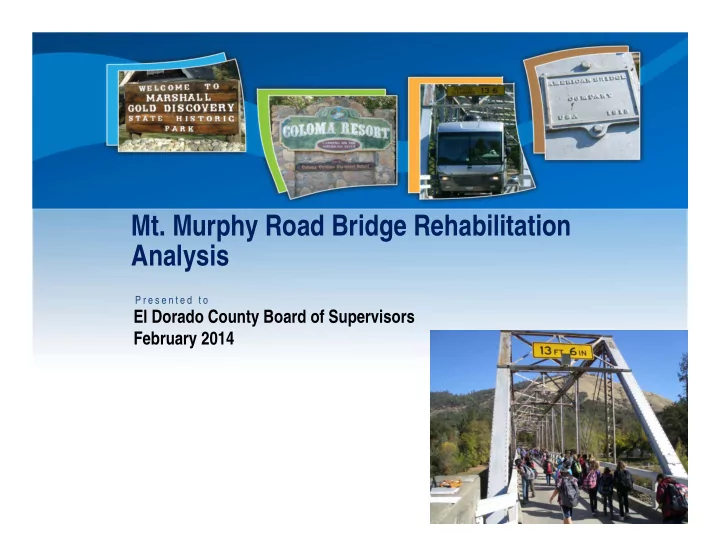
Mt. Murphy Road Bridge Rehabilitation Analysis P r e s e n t e d t - - PowerPoint PPT Presentation

mt murphy road bridge rehabilitation analysis
SMART_READER_LITE
LIVE PREVIEW

Mt. Murphy Road Bridge Rehabilitation Analysis P r e s e n t e d t - - PowerPoint PPT Presentation

Mt. Murphy Road Bridge Rehabilitation Analysis P r e s e n t e d t o El Dorado County Board of Supervisors February 2014 Agenda Introduction & Background Rehabilitation Findings Access Historic Considerations Agency

slide-1
SLIDE 1
  • Mt. Murphy Road Bridge Rehabilitation

Analysis

P r e s e n t e d t o

El Dorado County Board of Supervisors February 2014

slide-2
SLIDE 2

2

  • Introduction & Background
  • Rehabilitation Findings
  • Access
  • Historic Considerations
  • Agency Positions
  • Costs
  • Recommendation

Agenda

slide-3
SLIDE 3

3

  • Present findings of Phase 1A of the Alternatives

Analysis for Mt. Murphy Road Bridge

Introduction

slide-4
SLIDE 4

4

  • Bridge replaced in 1915, approach spans replaced in in1931
  • Caltrans sufficiency rating – 0.00/100
  • Eligible for replacement – 100% Federal funding
  • Safety is primary concern to qualify for federal funding
  • Community meeting held – February 2013
  • Board authorized Phase 1A to further evaluate existing bridge
  • n April 23, 2013
  • Further public involvement as part of Phase 1B

Project Background

slide-5
SLIDE 5

5

  • Functional Obsolence

– Substandard geometry (width, height, barriers)

Rehabilitation Findings

slide-6
SLIDE 6

6

  • Structural Deficiency

– Bridge does not meet structural condition ratings, fixes needed

Rehabilitation Findings

Retrofit Columns Strength beams and slabs Retrofit Footings

slide-7
SLIDE 7

Rehabilitation Findings

Retrofit Piers Replace all Diagonals Replace Upper and Lower Chords Replace Barriers

slide-8
SLIDE 8

Rehabilitation Findings

Replace Floorbeams Replace Stringers Replace deck

slide-9
SLIDE 9

9

Access

  • Closure required for

rehabilitation

  • 20+ mile detour

results in need for temporary bridge

– Impacts to adjacent land, $$

slide-10
SLIDE 10

10

  • Built in 1915 – not considered part of Marshall Gold historic

era

  • Rehabilitation compromises

historic eligibility

Historic Considerations

slide-11
SLIDE 11

11

  • Met with Gold Discovery State Park in September

2013:

– They do not want to own the bridge – Pedestrian safety is #1 concern – Improvements to bridge capacity creates more opportunity for park to use both sides of river – Willing to negotiate on right-of-way issues – Maintain historic context of the park

State Park Consultation

slide-12
SLIDE 12

12

  • Met with Caltrans Local Assistance November 2013:

– Rehabilitation will need to improve pedestrian safety – Bridge must accommodate emergency vehicle access (includes during construction) – SHPO and FWHA will decide if design exceptions are acceptable – Detour costs will be considered – FHWA and Caltrans will need to approve any rehabilitation

  • r replacement option

Caltrans Consultation

slide-13
SLIDE 13

13

  • Rehabilitation

– Bridge scenarios range from $6.5 - $14.2 million ($700/sf - $1,550/sf) – County may be required to pay for all or a portion of the fix – Higher future maintenance costs for inspection and painting, shorter life span than a new bridge

  • Replacement - assumes 2-lane, shoulders, pathway

– $1.7 million to keep old bridge as pedestrian only bridge plus $15.3 million ($555/sf) for a replacement bridge County does not need to contribute to funding of new bridge, but would have to pay for keeping the old bridge for use as a pedestrian bridge

Costs (Excluding ROW, ED/Design/CM)

slide-14
SLIDE 14

14

  • Move to dismiss rehabilitation options due to:

– 1. Risk of no funding if not all functionally obsolete issues are addressed – 2. Cost of rehabilitation is 1.5X to 3X cost of replacement

  • n a per square foot basis

– 3. Historic value of structure is lost with rehabilitation

  • Move to Initiate Phase 1B of the Alternatives Analysis

Study

  • Explore options for using old bridge for non-vehicular

travel during next phase

Recommendation