www.kanaltek.com info@kanaltek.com Origin of Rehabilitation During - - PowerPoint PPT Presentation
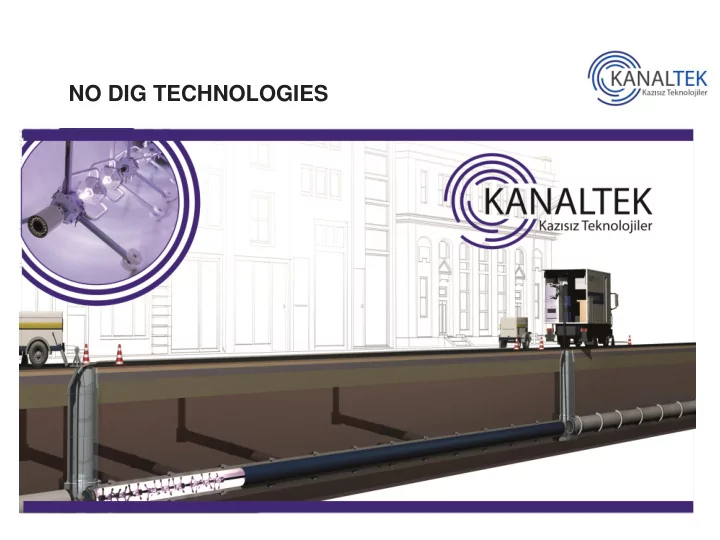
NO DIG TECHNOLOGIES www.kanaltek.com info@kanaltek.com Origin of Rehabilitation During the 1980s Japanese gas companies decided, in view of the frequent earthquakes in their country, to use the CIPP (*)concept to secure their pipeline
Origin of Rehabilitation
- During the 1980’s Japanese gas companies decided,
in view of the frequent earthquakes in their country, to use the CIPP (*)concept to secure their pipeline networks.
- Over 35 years of experience and more than 46000
kilometers installed confirm the long term durability of lining with this product.
WHY REHABILITATION?
- To secure the whole lenght of the pipe;
- Sealing of leaking joints, corrosion pits, cracks,
intervals between pipes, etc..
- Flow performances are improved;
- Internal corrosion definitely stopped;
- Incrustations are elimininated;
- Lifetime of pipes is increased;
- Vibrations and some soil movements are acceptable.
- NO to dig and replace. No excavation.
- Reduction of execution time is significant – so the
costs.
- No or less traffic disruption.
- Low noise process.
- Avoid infiltration in existing Pipes.
Decrease the volume of the Water treatment plants Avoid risk of road collapsing
- Avoid exfiltration in the ground.
Stop the pollution of the soil by chemicals & waste Avoid risk of road collapsing
- Quick Regeneration of the soil.
Environment Protection & Safety
Fields of Application
- Gravity Pipes (Sewer and Drain)
- Pressure Pipes (drinking water,etc…)
- Gas Pipes
- Industrial Pipes (Petrochemica, etc…)
Application Diametres DN50 – DN3000
Cicular Profile Arch Profile Oval Profile
- High Pressure Cleaning
- CCTV Monitoring
- Cutter Robot
- CIPP Rehabilitation- Water Curing
- CIPP Rehabilitationn – Ultraviolet (UV)
- CIPP House Connections Rehabilitation
- Close Fit (Fold and Form ) Technology
- PrimusLine–PressurePipe Rehabilitation
- Profile Rehabilitation
- Consultancy / Project Management
NO DIG - PIPE REHABILITATION TECHNOLOGIES
Experience with Liner Technologies in Pipe Rehabilitation
- Turkey’s leading company in No Dig Technologies
- Trenchless solutions for infrastructure
- Rehabilitation since 2004
- Experienced team and technical support
- Latest technologies and machinery
- More than 200000 metres of pipe rehabilitation
ULTRAVIOLET ( UV )TECHNOLOGY
DN150-DN1400
Controlled curing with innovative UV equipment
CIPP - UV Rehabilitasyon
Pure resin Layer with GFRP Fiberglass Reinforcement Liner cured Ultraviyolet (UV) light
CIPP – WATER CURING
Pipe rehabilitation system in which: A flexible Liner coated is inverted in to the host pipe on the whole lenght by water tower and cured by hot water. (Polymerization)
HOUSE CONNECTION LINING
- Lining with a flexiable liner
- Able to turn 90 degree bends
CIPP – Impregnation
The amount of resin is calculated exactly based
- n specific weight, porous volume of the woven
jacket characteristics and Liner dimensions. Vacuum is applied to absorb moisture and avoid entrapped air, which could influence the final physical properties.
CLOSE FIT - (Fold&Form ) Technology
HDPE Close Fit liner is pulled into the existing pipe over the total length. Heating of Close Fit Liner takes place with Water Steam
Uygulama aralığı DN100 – DN400
High Pressure Jet Cleaning…
- Various solid wastes, deposits and obstacles in pipes are
cleaned with high pressure water jet systems
- High pressure jet cleaning has been proven to be the most
efficient method.
PRESSURE PIPE REHABILITATION
PRIMUS LINE
DN50-DN500
Primus Line is a trenchless technology for the rehabilitation of medium and high-pressure pipelines for media including water, gas and oil. The technology is based on a semi-structural, flexible, ultra-high strength hose consisting of three layers: Inner layer: media specific; based on polyethylene (PE) or thermoplastic polyurethane (TPU) Middle layer: Seamless, woven Kevlar fabric (single or double layer design) Outer layer: protective, abrasion-resistant PE sheath to protect inner layers of the liner Once the pipeline is properly prepared, the liner is folded and inserted into the host pipe. After connection fittings are attached at each end, the liner is then reverted using compressed air. The liner is reconnected to the existing pipeline utilizing specialty flanged or welded fitting. This liner can withstand pressures ranging from 145 psi up to 900 psi.
Benefits: Installation lengths up to 500 metre Able to negotiate bends up to 30 degrees Ultra-high strength liner design No corrosion of Primus Line Fast return-to-service Increases flow capacity Designed for transmission-pressure pipelines Trenchless technology - cost effective & environmentally friendly Sustainability due to use of existing infrastructure 50-year design life
Primus Line has short rehabilitation times and rapid recommissioning and, therefore, represents not only an inexpensive alternative to open rehabilitation, but also a high quality method of the renewal of pressure pipelines.
Preparation of pipe for Rehabilitation by Cutter Robot after cleaning
- Surface cleanliness of the pipe wall
- Residues: e.g. sharp edges
- Corrosion
- Obstacles, Residues, sharp edges are cut by Cutter Robot
- Before lining, the location of the house connections are
measured by Cutter Robot
- Re-opening of house connections after lining
CCTV INSPECTION
- Pipeline Monitoring
- Is important to define
rehabilitation technology
- Reporting
CIPP – LINING
önce sonra
CIPP – LINING
PROFILE SOLUTIONS FOR SEWER PIPES
- Large diameter pipelines : 800 to 5000 mm
- Circular and non-circular shapes (including culverts, tunnels)
- Installation possible in live flow conditions
- Structural design requirements requiring different grout thickness
around liner
- Small installation footprint : truly trenchless, existing manholes
can be utilized
- Curved pipelines : sections of curved weser pipe can be
rehabilitated
- Vertical applications
- Restoration of positive slope