MOS Transistor MOS Transistor Professor Chris H. Kim Gate - - PowerPoint PPT Presentation

mos transistor
SMART_READER_LITE
LIVE PREVIEW

MOS Transistor MOS Transistor Professor Chris H. Kim Gate - - PowerPoint PPT Presentation

MOS Transistor MOS Transistor Professor Chris H. Kim Gate University of Minnesota Dept. of ECE chriskim@umn.edu Source Drain www.umn.edu/~chriskim/ Body Kuroda, IEDM panel 2 Basic Operation (1) MOS Transistor Current Equation


slide-1
SLIDE 1

1

MOS Transistor

Professor Chris H. Kim

University of Minnesota

  • Dept. of ECE

chriskim@umn.edu www.umn.edu/~chriskim/

2

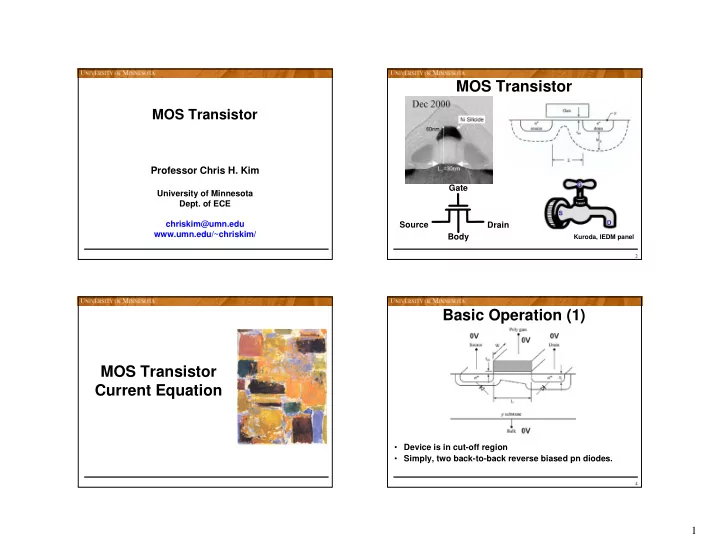
MOS Transistor

Drain Source Gate

Kuroda, IEDM panel

Body

MOS Transistor Current Equation

4

Basic Operation (1)

  • Device is in cut-off region
  • Simply, two back-to-back reverse biased pn diodes.
slide-2
SLIDE 2

2

5

Basic Operation (2)

  • With a positive gate bias, electrons are pulled toward the

positive gate electrode

  • Given a large enough bias, the electrons start to “invert”

the surface (pn type), a conductive channel forms

  • Threshold voltage Vt

6

Basic Operation (3)

  • Current flows from drain to source with a positive drain

voltage

  • What is current in terms of Vgs, Vds, Vbs?

7

MOS Current

Ids = 0 Vgs< Vt : cut-off Ids = μeCoxW/L ((Vgs-Vt) Vds-0.5Vds2) 0 < Vds < Vgs- Vt : triode (linear) mode Ids = μeCoxW/(2L) (Vgs-Vt)2 0 < Vgs- Vt < Vds : saturation mode

8

Channel Length Modulation

ds

  • V

L L ζ − =

  • Pinch-off depletion layer width increases as the drain

voltage increases

  • Extreme case of this is punch-through

) 1 (

ds dsat ds

  • dsat

ds

V I V L L I I λ ζ + × = − × =

slide-3
SLIDE 3

3

9

Simulation versus Model (NMOS)

  • The square-law model doesn’t match well with simulations
  • Only fits for low Vgs, low Vds (low E-field) conditions

10

Simulation versus Model (PMOS)

  • Not as bad as the NMOS device
  • Still large discrepancies at high E-field conditions

11

Simulation versus Model (Ids vs. Vgs)

  • Saturation current does not increase quadratically
  • The simulated curves looks like a straight line
  • Main reason for discrepancy: velocity saturation

12

Velocity Saturation

  • E-fields have gone up as dimensions scale
  • Unfortunately, carrier velocity in silicon is limited
  • Electron velocity saturates at a lower E-field than holes
  • Mobility (μe=v/E) degrades at higher E-fields
  • Simple piecewise linear model can be used
slide-4
SLIDE 4

4

13

Velocity Saturation

c sat c n n c e

E E for v E E for E E E v > = < ⎟ ⎟ ⎠ ⎞ ⎜ ⎜ ⎝ ⎛ ⎟ ⎠ ⎞ ⎜ ⎝ ⎛ + =

1

1 μ

e sat c

v E μ 2 =

[Toh, Ko, Meyer, JSSC, 8/1988]

  • Modeled through a variable mobility
  • n=1 for PMOS, n=2 for NMOS
  • To get an analytical expression, let’s assume n=1

14

Velocity Saturation

  • Plug it into the original current equation

L E V V L E V V V V V V V V Wv C V V L E V V V V V L W C I

c t gs c t gs dsat dsat ds dsat t gs sat

  • x

dsat ds c ds ds ds t gs

  • x

e ds

+ − − = ⎪ ⎪ ⎩ ⎪ ⎪ ⎨ ⎧ > − − < + × ⎟ ⎟ ⎠ ⎞ ⎜ ⎜ ⎝ ⎛ − − = ∴ ) ( ) ( ) ( ) ( ) ( 1 1 2 ) (

2

μ

Equate the two expressions to get

15

Simulation versus Model

  • Model incorporating velocity saturation matches fairly

well with simulation

16

Unified MOS Model

100 200 300 400 500 600 700 0.2 0.4 0.6 0.8 1 1.2 VDS [V] IDS [V] 0.4V 0.6V 0.8V 1.0V 1.2V

simulation unified model linear saturation

  • vel. saturation

Vdsat

slide-5
SLIDE 5

5

17

Unified MOS Model Equations

γ - body effect parameter

  • Model presented is compact and suitable for hand

analysis.

  • Still have to keep in mind the main approximation: that

VDSat is constant.

  • But the model still works fairly well.

18

Alpha Power Law

α

μ ) ( 2

t gs

  • x

e ds

V V C L W I − =

  • Simple empirical model for short channel MOS
  • Parameter α is between 1 and 2
  • α=1-1.2 for short channel

devices

  • Parameters α and Vt are fitted

to measured data for minimum square error fitted Vt can be different from physical Vt

[Sakurai and Newton, JSSC 1990]